
Smart doorbells have transformed home security from a luxury into a standard feature for many households. Two of the most recognized names in the space—Ring and Nest—offer compelling devices with strong video quality, motion detection, and mobile integration. But behind the sleek hardware lies a critical difference that affects long-term ownership: their subscription models. For consumers who value both functionality and fairness, the question isn't just about which camera performs better—it’s about which service demands less from your wallet and patience over time.
Ring Doorbells and the Nest Hello both require subscriptions to unlock core features like cloud storage and advanced alerts. However, the way each company structures its plans—and how much you're expected to pay for basic functionality—can make one feel far more intrusive than the other. This article breaks down the subscription models of Ring and Nest Hello, compares real-world value, and helps you decide which is truly less annoying to live with month after month.
Understanding the Subscription Trap
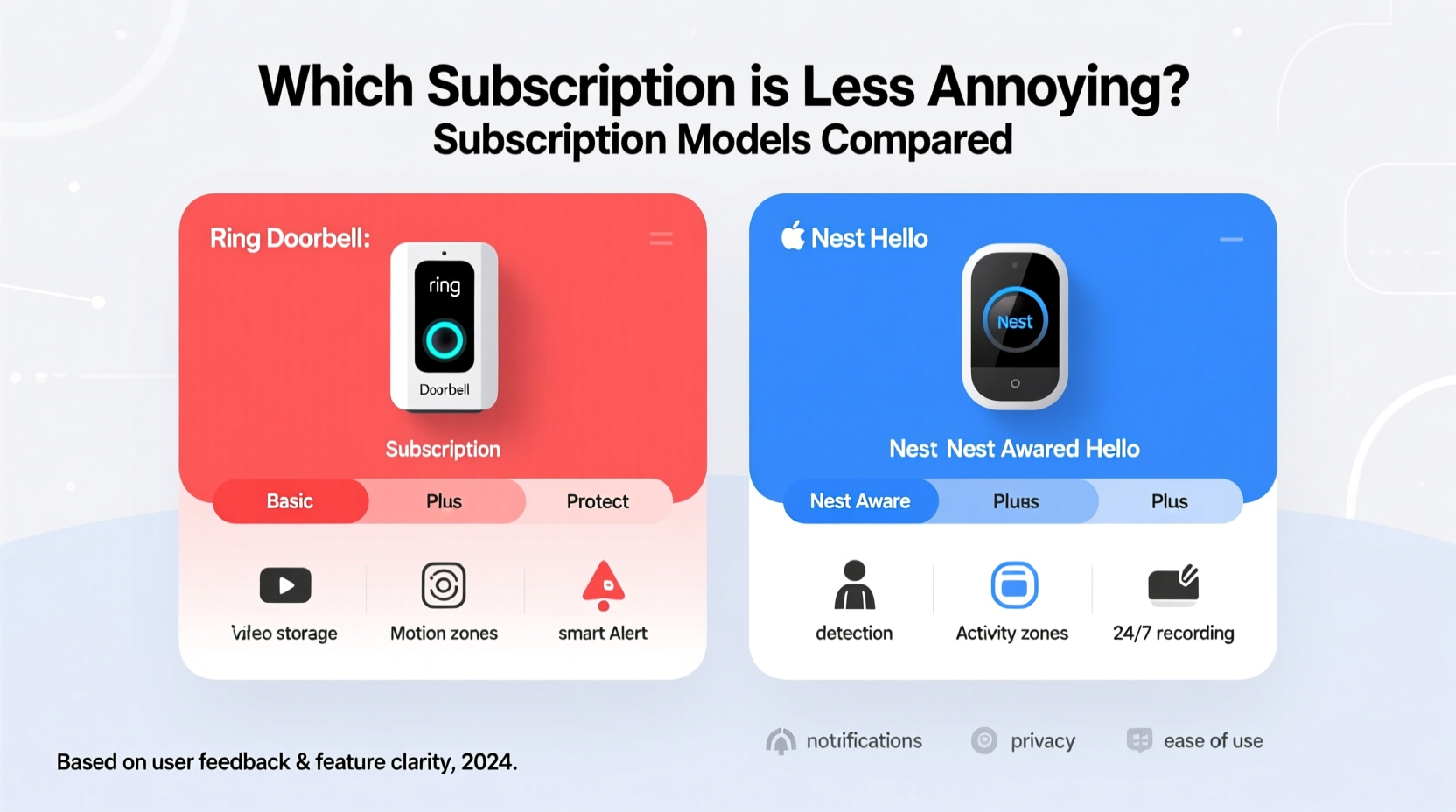
When you buy a smart doorbell, it’s easy to assume that once the device is installed, most features will work out of the box. Unfortunately, that’s no longer the case. Both Ring and Nest operate on a freemium model where essential functions—like reviewing past footage or receiving intelligent alerts—are locked behind paid tiers.
This shift reflects a broader trend in consumer tech: hardware sold at near-cost (or even at a loss) to lock users into recurring revenue streams. While this can keep initial prices low, it also means that skipping the subscription often renders the device only partially useful.
The annoyance doesn’t just come from having to pay. It stems from:
- Limited free features that tease full functionality
- Aggressive in-app prompts to upgrade
- Gradual removal of previously free capabilities
- Price hikes on existing plans without proportional feature upgrades
With that context, let’s examine how Ring and Nest Hello compare in terms of what they offer—and what they demand.
Ring’s Subscription Model: Pay More, Get Tiered Access
Ring offers three primary subscription plans under its Protect program:
| Plan | Cost (Monthly) | Key Features | Limitations |
|---|---|---|---|
| Protect Basic | $3.99–$4.99/device | Video recording, sharing, extended warranty | No package detection, limited smart alerts |
| Protect Plus | $19.99/month (covers entire home) | All Basic features + unlimited cameras/doorbells, 24/7 monitoring, professional installation | Expensive for small homes; requires multiple devices to justify cost |
| No Subscription | $0 | Live view only; no saved videos or alerts history | Virtually unusable for security purposes |
The biggest pain point with Ring is pricing per device. If you own two Ring doorbells or cameras, Protect Basic jumps to nearly $10/month. Three devices? That’s $15. Compare that to Nest’s flat-rate approach, and it becomes clear why some users feel nickel-and-dimed.
Another frustration: Ring frequently changes its policies. In recent years, it removed free video sharing and shortened trial periods for new users. These shifts erode trust and create a sense that the goalposts are always moving.
Nest Hello’s Subscription Approach: Simpler, but Still Costly
The Nest Hello, while discontinued as a standalone product, remains supported and widely used. Its subscription model operates through Google’s Nest Aware service, which follows a unified tier system across all Nest devices.
Here’s how Nest Aware stacks up:
| Plan | Cost (Monthly) | Key Features | Value Notes |
|---|---|---|---|
| Nest Aware (Standard) | $8/month or $80/year | 3 hours of event video history, familiar detection (people, animals), emergency savings | Flat rate regardless of number of devices |
| Nest Aware Plus | $15/month or $150/year | 10 days of video history, 24/7 continuous recording, package detection, video export | Better value for multi-camera users |
| No Subscription | $0 | Live view, manual recording, basic motion alerts | No saved clips; not suitable for evidence or review |
One major advantage of Nest’s model is simplicity. You pay one flat fee, and every Nest device in your home gets full access to the selected tier. Whether you have one camera or five, the price doesn’t scale upward. This predictability makes budgeting easier and reduces the feeling of being exploited for owning multiple units.
Additionally, Nest’s AI-powered features—like facial recognition (“Familiar Faces”) and package detection—are included in the higher tier, giving users more tangible value for the extra cost. The 24/7 recording option on Aware Plus is especially useful for those who want constant oversight, something Ring does not offer at any tier.
“Subscription fatigue is real. When companies charge per device, it feels punitive. Flat-rate models like Nest’s reduce friction and build long-term loyalty.” — David Lin, IoT Product Analyst at HomeTech Insights
Real User Experience: A Mini Case Study
Consider Sarah, a homeowner in Portland who installed a Ring Video Doorbell 3 in 2021 and added an indoor camera a year later. Initially, she opted for the free plan, thinking alerts and live view would suffice. After missing a porch pirate incident because there was no recorded footage, she upgraded to Protect Basic at $4.99. With two devices, her bill rose to $9.98.
Frustrated by the rising cost and lack of advanced features, she switched to a Nest system in 2023. She now pays $8/month for Nest Aware, covering both her Nest Hello and a Nest Cam Indoor. She gets 10-day event history with the Plus plan, facial recognition for family members, and seamless integration with her Google Home routines.
“I actually use the app more now,” Sarah said. “With Ring, I dreaded opening it because of all the upgrade pop-ups. Nest feels less pushy. I know exactly what I’m paying for.”
Her experience highlights a crucial distinction: annoyance isn’t just about dollar amounts—it’s about perception of fairness and transparency.
Which Model Is Less Annoying? A Feature-by-Feature Breakdown
To determine which subscription feels less intrusive, we evaluated several factors beyond price:
- Pricing scalability: Does the cost grow fairly with usage?
- Free tier usefulness: Can you get basic value without paying?
- Upgrade pressure: How aggressively are you prompted to subscribe?
- Feature depth: Are premium tools worth the investment?
- Transparency: Are changes communicated clearly?
Based on these criteria:
- Ring wins on broad device compatibility and neighborhood watch integration (via Neighbors app).
- Nest wins on consistent pricing, smarter AI features, and cleaner user experience.
In terms of sheer annoyance reduction, Nest comes out ahead. Its flat-rate structure avoids the psychological sting of per-device fees, and Google’s ecosystem integration reduces friction in daily use. Ring’s persistent upselling and incremental pricing make it feel more transactional and less user-centric.
How to Minimize Subscription Annoyance: A Practical Checklist
Regardless of which brand you choose, these steps can help reduce the burden of ongoing fees:
- ✅ Audit your actual usage: Do you check footage daily, or only during incidents?
- ✅ Start with the free tier for 2–4 weeks to assess necessity
- ✅ Use local storage alternatives when possible (some third-party hubs support microSD cards)
- ✅ Bundle services: If you already pay for Google One or Amazon Prime, see if discounts apply
- ✅ Set calendar reminders for annual renewals to avoid auto-renewal surprises
- ✅ Monitor official forums for upcoming policy changes
FAQ: Common Questions About Ring and Nest Subscriptions
Can I use Ring or Nest Hello without a subscription?
Yes, but functionality is extremely limited. You can view live video and receive real-time alerts, but you cannot save, review, or share past events. For meaningful security use, a subscription is effectively mandatory.
Is Nest Aware worth it if I only have one doorbell?
If you value features like facial recognition, extended video history, or automatic emergency backup, then yes. At $8/month, it’s competitively priced compared to single-device Ring plans. However, if you only want occasional recordings, local solutions or non-subscription brands might be more cost-effective.
Did Google discontinue Nest Hello? Should I still subscribe?
Google stopped selling the Nest Hello as a standalone product in 2022, but it continues to support existing users with firmware updates and subscription services. As long as you own the device, your subscription remains functional and worthwhile if you rely on its features.
Final Verdict: Nest Wins on Subscription Sanity
While both Ring and Nest Hello lock key features behind paywalls, the way they do so defines the user experience. Ring’s per-device pricing and aggressive monetization tactics create a sense of constant negotiation—each new camera feels like another bill. Nest, by contrast, offers a straightforward, flat-fee model that scales gracefully and respects user autonomy.
The Nest Hello’s subscription isn’t cheap, but it’s predictable. You know what you’re getting, and you’re not punished for protecting more than one entry point. Combined with superior AI features and smoother integration, it delivers better long-term value for most households.
Annoyance in tech subscriptions isn’t just about money—it’s about respect. When a company charges fairly, communicates clearly, and delivers consistent value, users are more likely to stay loyal. Nest’s approach reflects that principle. Ring, despite its popularity, still treats subscriptions like a lever to squeeze maximum revenue, rather than a service to enhance trust.
“The best business model is one where the customer forgets they’re paying. That’s the gold standard of satisfaction.” — Lena Patel, Customer Experience Strategist
Take Control of Your Smart Home Costs
You don’t have to accept high-pressure subscriptions as the cost of modern convenience. By understanding how Ring and Nest monetize their devices, you can make informed choices that align with your budget and values. If you’re tired of per-device fees and constant upgrade prompts, switching to a flat-rate system like Nest Aware could be the relief you’ve been looking for.




 浙公网安备
33010002000092号
浙公网安备
33010002000092号 浙B2-20120091-4
Comments
No comments yet. Why don't you start the discussion?