
In the era of remote work, online streaming, and virtual meetings, how you appear on camera matters more than ever. Lighting plays a pivotal role in shaping your on-screen presence—poor illumination can make even the most articulate speaker look unprofessional. Two of the most popular lighting tools today are ring lights and softboxes. Both promise improved visibility and flattering visuals, but they serve different needs and produce distinct results. Choosing between them isn’t about which is universally superior, but rather which aligns best with your environment, goals, and technical setup.
Understanding the Basics: What Are Ring Lights and Softboxes?
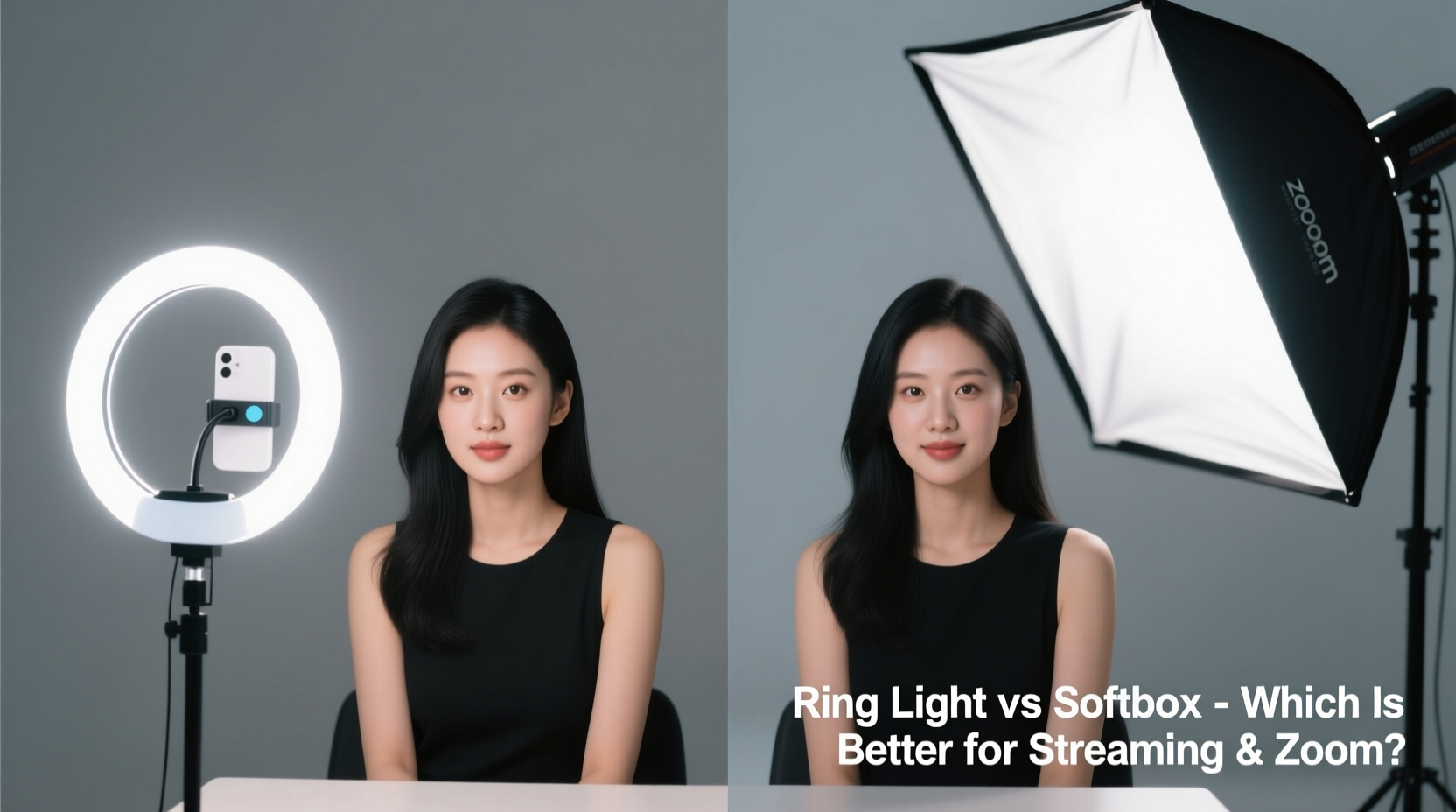
A ring light is a circular LED fixture that typically surrounds a phone or webcam. Its design delivers even, diffused front-facing light with a signature circular catchlight in the eyes—popular among beauty influencers and vloggers. Most models are compact, plug-and-play, and often come with adjustable color temperatures and brightness levels. They’re designed for convenience and consistent facial illumination.
A softbox, on the other hand, is a rectangular, square, or octagonal light modifier used with studio strobes or continuous lamps. It works by diffusing light through one or more layers of fabric, creating a broad, soft, and directional source. Unlike ring lights, softboxes require external stands, power sources, and often separate control units. They offer greater control over shadow direction, intensity, and overall scene dynamics.
“Lighting isn’t just about brightness—it’s about shaping perception. A softbox gives you precision; a ring light gives you consistency.” — Jordan Lin, Broadcast Lighting Technician
Performance Comparison: Quality, Control, and Real-World Use
The core difference lies in light quality and control. While both aim to reduce harsh shadows, their methods and outcomes vary significantly.
Ring lights produce a flat, even wash of light directly from the front. This minimizes under-eye shadows and eliminates backlighting issues, making them ideal for quick setups. However, because the light comes straight on-axis with the camera, it tends to flatten facial features and eliminate depth. The result can look two-dimensional, especially in professional video production where dimensionality enhances credibility.
Softboxes excel in creating three-dimensionality. By positioning the light at an angle (typically 30–45 degrees from the subject), they sculpt the face using gentle gradients and subtle shadows. This adds depth, definition, and a polished aesthetic common in broadcast interviews and high-end content. The larger surface area of a softbox also produces softer transitions between light and dark, reducing specular highlights and minimizing skin imperfections naturally.
Color Accuracy and Adjustability
Both lighting types now offer variable color temperature (measured in Kelvin), allowing users to match ambient lighting or create specific moods. Entry-level ring lights often range from 3200K (warm) to 5600K (daylight), while higher-end softbox systems provide more precise tuning and consistent output across multiple units.
However, softboxes paired with professional-grade LEDs or tungsten-balanced fixtures tend to have superior Color Rendering Index (CRI) ratings—often above 95. High CRI means colors appear truer to life, critical for product reviewers, educators, and anyone whose content relies on accurate visual representation. Many budget ring lights fall short here, with CRIs around 80–85, leading to washed-out or unnatural skin tones.
Size, Portability, and Setup Time
Ring lights win hands-down in portability and ease of use. Most models attach directly to laptops, tripods, or desks, require only USB or wall power, and turn on instantly. Their compact footprint makes them perfect for small apartments, home offices, or travel setups.
Softboxes demand more space and time. You’ll need light stands, diffuser panels, bulbs or LED heads, and sometimes external power packs. Assembly can take 10–15 minutes, and repositioning during use is less convenient. That said, this complexity translates into flexibility—you can adjust height, angle, distance, and diffusion level to fine-tune your look.
“I switched from a ring light to a softbox after my clients started commenting that I looked ‘flat’ on calls. Within one meeting, my feedback changed to ‘so much more present and engaging.’” — Lena Park, Corporate Trainer & Online Educator
Detailed Comparison Table: Ring Light vs Softbox
| Feature | Ring Light | Softbox |
|---|---|---|
| Light Quality | Even, frontal, low-shadow | Soft, directional, dimensional |
| Setup Time | Under 1 minute | 5–15 minutes |
| Portability | High – lightweight, compact | Moderate to low – bulky components |
| Control Over Shadows | Minimal – shadows directly behind | High – adjustable angles and falloff |
| Color Accuracy (Typical CRI) | 75–88 | 90–98+ |
| Best For | Quick Zoom calls, social media, minimal editing | Streaming, professional video, content creation |
| Price Range (Entry-Level) | $30–$80 | $100–$250 (kit) |
| Learning Curve | Low – plug and play | Moderate – requires lighting knowledge |
When to Choose a Ring Light
If your priority is simplicity and speed, a ring light is likely the better option. Consider it if:
- You join back-to-back Zoom or Teams meetings with little prep time.
- Your workspace is limited—a small desk or shared room.
- You primarily use smartphones or webcams without advanced cameras.
- You value consistent lighting without manual adjustments.
- Budget is a constraint, and you want immediate improvement over overhead room lights.
Ring lights are particularly effective when placed at eye level, slightly above the monitor. This mimics natural daylight coming from above and reduces unflattering upward shadows. Their circular reflection in the eyes also creates a sense of connection, which can enhance engagement during live streams or instructional videos.
Limitations of Ring Lights
Despite their popularity, ring lights have notable drawbacks. The centered light source erases facial contours, making expressions appear flatter. This can subtly reduce perceived authority or seriousness in business settings. Additionally, cheaper models may flicker under certain camera frame rates or emit uneven color casts, especially as they age.
When a Softbox Is Worth the Investment
Softboxes shine when image quality and professionalism are non-negotiable. They’re ideal for:
- Live streamers using DSLR or mirrorless cameras.
- Content creators producing tutorials, reviews, or branded videos.
- Coaches, consultants, or speakers who want to project authority and clarity.
- Anyone using multi-light setups (e.g., key, fill, backlight).
By placing a softbox at a 30–45 degree angle from your face, you create what’s known as “three-point lighting” when combined with a fill light and background light. This technique adds depth, separates you from the background, and ensures balanced exposure. The soft, wraparound nature of the light gently illuminates the side of your face turned away from the source, preserving detail without harshness.
Step-by-Step: Setting Up a Basic Softbox for Streaming
- Choose your softbox size: A 24x36” or 24” octabox offers a good balance between portability and light spread.
- Mount the softbox onto a light stand and position it 4–6 feet from your face.
- Angle the light at 30–45 degrees to your dominant side (left or right).
- Adjust height so the center of the softbox is slightly above eye level.
- Set color temperature to 5000K–5600K for neutral daylight balance.
- Add a reflector or second light on the opposite side to reduce shadows (fill light).
- Test with your camera and adjust brightness until skin tones look natural and no blown-out highlights appear.
This configuration transforms a basic home office into a mini studio. Viewers subconsciously perceive better lighting as higher credibility, even if they can’t articulate why.
Real-World Scenario: From Flat to Professional in One Upgrade
Mark T., a financial advisor who transitioned to virtual client meetings during the pandemic, initially used his laptop’s built-in camera with ceiling lighting. Clients commented that he looked “tired” or “hard to read.” He invested $60 in a 10-inch ring light—improvement was noticeable, but feedback remained mixed: “You look better, but kind of… flat?”
After researching lighting techniques, Mark upgraded to a 24x36” softbox kit with a 5600K LED panel. He positioned it at a 40-degree angle to his left, added a white foam board as a fill reflector on the right, and adjusted his chair to optimize the light fall-off. In his next client call, the feedback shifted dramatically: “You look so much more confident and clear. Was it a new camera?” Mark hadn’t changed his camera—only his light.
The softbox added subtle modeling to his jawline and cheekbones, reduced the sallow appearance caused by overhead lights, and created a sense of depth that made him appear more engaged and trustworthy.
Checklist: Choosing Your Streaming Lighting Solution
- ✅ Assess your primary use case: daily Zoom calls vs. scheduled streams or recorded content.
- ✅ Measure your available space—can you accommodate stands and modifiers?
- ✅ Check your camera type—webcams benefit more from ring lights; pro cameras pair better with softboxes.
- ✅ Determine your budget—not just for lights, but stands, diffusers, and power options.
- ✅ Test lighting against your wall color—dark walls absorb light; light walls help bounce it softly.
- ✅ Prioritize CRI >90 if color accuracy matters (e.g., fashion, art, education).
- ✅ Consider future scalability—will you add more lights later?
Frequently Asked Questions
Can I use both a ring light and a softbox together?
Yes, but carefully. Some creators use a softbox as the main (key) light and a ring light as a fill or accent. However, mixing color temperatures or intensities can create imbalance. Always meter your lights or preview through your camera to avoid conflicting shadows or hotspots.
Do I need a softbox if I’m just doing Zoom calls?
Not necessarily. If your goal is legibility and basic professionalism, a high-CRI ring light or even a well-placed desk lamp with a warm-white bulb can suffice. But if you host frequent client calls, presentations, or want to stand out visually, a softbox provides a tangible upgrade in perceived expertise.
Are ring lights bad for your eyes?
No evidence suggests ring lights cause eye damage at typical usage levels. However, staring directly into any bright LED source can cause eye strain or discomfort. Position the light slightly above or beside your screen, not directly in line with your gaze.
Final Verdict: Which Is Better?
There’s no single “better” option—only what’s better for your context. For fast, functional lighting in constrained environments, a ring light is practical and effective. It’s the go-to for influencers, remote workers, and casual streamers who need reliability without complexity.
For those serious about image quality, brand perception, and visual storytelling, a softbox delivers superior results. It requires more investment and learning, but pays off in richer, more dynamic visuals that command attention and convey professionalism.
The truth is, many top creators start with a ring light and evolve toward softboxes as their needs grow. The best approach may be hybrid: use a ring light for daily calls, and deploy a softbox setup for recorded content or high-stakes meetings.




 浙公网安备
33010002000092号
浙公网安备
33010002000092号 浙B2-20120091-4
Comments
No comments yet. Why don't you start the discussion?