
For content creators—whether filming YouTube videos, streaming on Twitch, or shooting product photos—the quality of lighting can make or break the final output. Two of the most popular tools in the creator’s lighting arsenal are ring lights and softboxes. Both promise professional-looking illumination, but they serve different purposes and produce distinct results. Choosing between them isn’t about which is universally “better,” but rather which aligns with your content style, setup, and desired aesthetic.
This guide dives deep into the technical and practical differences between ring lights and softboxes, helping you make an informed decision based on real-world performance, not marketing hype.
Understanding the Basics: How Each Light Works
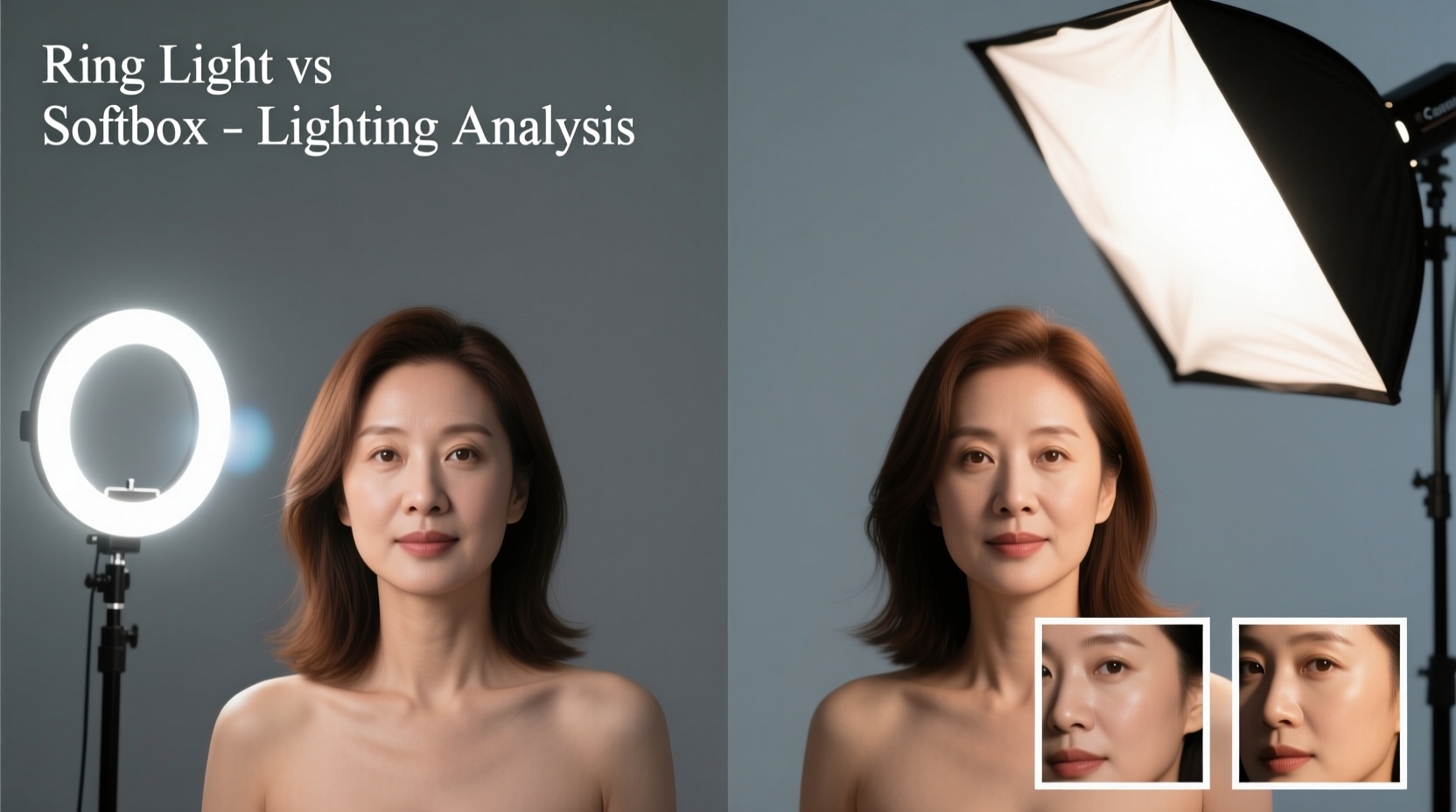
Before comparing performance, it's essential to understand how each light functions and what kind of illumination it produces.
Ring lights are circular-shaped LED panels that emit light from all around the circumference. They’re typically mounted around a camera lens or placed directly in front of the subject. The defining feature of a ring light is its ability to cast even, shadow-free light across the face, creating a signature catchlight in the eyes—a bright, circular reflection that adds life to portraits.
Softboxes, on the other hand, are rectangular, square, or octagonal enclosures attached to studio strobes or continuous lights. Their purpose is to diffuse and soften harsh light by bouncing it off reflective interior surfaces and spreading it through a translucent fabric panel. Softboxes are directional—they're positioned at angles relative to the subject (e.g., key, fill, or backlight)—and offer greater control over light shaping and shadow direction.
Light Quality: Softness, Shadows, and Dimension
The core difference lies in how each modifies light. While both aim to reduce harshness, they do so in fundamentally different ways.
Ring lights provide a flat, even wash of light. Because the source wraps around the lens, shadows are minimized, especially under the eyes, nose, and chin. This makes them ideal for beauty content, makeup tutorials, and live streams where clarity and blemish reduction are priorities. However, the lack of directional shadows can flatten facial features, making subjects appear two-dimensional.
Softboxes, by contrast, create soft yet defined lighting with gentle gradients and subtle shadows. When used correctly—with proper positioning and modifiers—they sculpt the face, adding depth and realism. A 3-light softbox setup (key, fill, back) mimics natural sunlight dynamics and is standard in professional photography and filmmaking.
“Flat lighting hides flaws but sacrifices character. Dimensional lighting reveals texture—and truth.” — Daniel Reeves, Cinematic Lighting Director
If your goal is authenticity and visual storytelling, softboxes deliver superior tonal range. But if your priority is quick, flattering illumination with minimal setup, ring lights win on convenience.
Practical Comparison: Key Factors for Creators
To help you decide, here’s a detailed comparison across critical factors for content creators.
| Factor | Ring Light | Softbox |
|---|---|---|
| Setup Complexity | Plug-and-play; often USB-powered with adjustable stands | Requires light stand, power source, diffuser attachment, and positioning skill |
| Portability | Compact, lightweight, travel-friendly | Bulkier; requires more space and careful packing |
| Light Direction & Control | Front-facing only; limited angle adjustment | Full control over position, height, angle, and diffusion |
| Shadow Management | Minimal shadows; can appear flat | Controlled, soft shadows for depth |
| Color Accuracy & CRI | Varies widely; budget models often have low CRI (~75) | High-end models offer CRI >95 for true color rendering |
| Best For | Makeup tutorials, vlogging, live streaming, selfies | Product photography, interviews, cinematic videos, portraits |
| Cost (Entry-Level) | $30–$100 | $100–$200+ (light + softbox + stand) |
When Simplicity Wins: Use Cases for Ring Lights
Consider a beauty influencer named Maya who records daily skincare routines from her bedroom. She needs consistent, flattering light without spending time adjusting gear. A 18-inch ring light mounted on her phone stand delivers exactly that. With one switch, she gets uniform brightness, perfect eye catchlights, and no learning curve. Her audience sees every product detail clearly, and her skin appears smooth and radiant.
In fast-paced environments like TikTok content creation or Instagram Lives, ring lights eliminate guesswork. Many models include adjustable color temperature (warm to cool white), allowing adaptation to ambient conditions.
When Professionalism Matters: Why Softboxes Dominate Studios
Now consider James, a freelance videographer producing client testimonials. He uses a three-point softbox setup: a 24x36” softbox as the key light at 45 degrees, a smaller fill on the opposite side, and a hair light behind the subject. This configuration separates the subject from the background, defines jawlines, and creates a polished, broadcast-ready look.
Softboxes also allow precise feathering—angling the light so only the edge illuminates the subject—for a natural fade-in effect. This level of control is unattainable with ring lights.
Step-by-Step Guide: Choosing and Setting Up Your Light
Follow this process to determine which lighting solution fits your workflow.
- Define Your Content Type: Are you doing close-up makeup demos (favor ring light) or narrative-driven videos (favor softbox)?
- Assess Your Space: Small desk? Ring light. Dedicated corner with backdrop? Softbox system.
- Determine Budget: Entry-level ring lights cost less than a single softbox. Factor in stands, power sources, and potential upgrades.
- Test Lighting Needs: Shoot a short clip with natural window light. Notice where shadows fall. If you need fill in the eyes, a ring light helps. If you want depth, go softbox.
- Start Simple, Scale Later: Begin with a ring light for ease. As skills grow, invest in a softbox for creative expansion.
- Optimize Positioning: Place ring lights slightly above eye level. Angle softboxes at 30–45 degrees from the subject for balanced modeling.
- Adjust Color Temperature: Match your light to ambient room temperature (typically 5000K for daylight balance).
Common Mistakes to Avoid
- Over-relying on ring lights for all scenarios: They’re great for faces but poor for full-body shots or background separation.
- Using low-CRI softboxes: Cheap knockoffs may claim high output but render colors inaccurately—critical for product creators.
- Placing ring lights too close: Causes blown-out highlights and hotspots. Maintain 2–3 feet distance.
- Neglecting diffusion with softboxes: Without the front fabric layer, the light remains harsh despite the box structure.
- Ignoring multiple light sources: Even with a softbox, adding a reflector or fill light improves exposure balance.
Expert Insight: What Industry Pros Recommend
Professional photographers and cinematographers rarely rely solely on ring lights—except for specific effects. The consensus leans toward softboxes for serious production value.
“Ring lights have their place—especially in mobile journalism—but they’re a shortcut, not a solution. Real lighting is about direction, quality, and intention.” — Lena Park, Commercial Photographer
That said, modern hybrid setups are emerging. Some creators use a ring light as a fill or eye-light while employing a softbox as the primary source. This combines the best of both: dimensionality from the softbox and the iconic ring catchlight for engagement.
Checklist: Ring Light vs Softbox Decision Guide
Answer these questions to determine your best fit:
- ✅ Do I record mostly close-ups or talking-head videos? → Ring light favorable
- ✅ Is my setup space-limited (e.g., dorm room, small apartment)? → Ring light favorable
- ✅ Do I need to shoot quickly with minimal adjustments? → Ring light favorable
- ✅ Am I creating cinematic, narrative, or commercial content? → Softbox favorable
- ✅ Do I want control over shadows, depth, and mood? → Softbox favorable
- ✅ Am I willing to invest time in learning lighting techniques? → Softbox favorable
- ✅ Do I work with products, clothing, or food? → Softbox favorable
- ✅ Is accurate color reproduction essential? → Softbox with high CRI recommended
Frequently Asked Questions
Can I use both a ring light and a softbox together?
Absolutely. Many creators use a softbox as the main light source and a ring light as a fill or accent to maintain the signature eye glow. Just ensure the ring light is dimmed to avoid overpowering the key light and creating flatness.
Are ring lights bad for professional content?
Not inherently. High-quality ring lights with excellent color rendering (CRI >90) and adjustable brightness can produce clean, professional results—especially for beauty, tech reviews, or social media content. The stigma comes from overuse of low-end models that create harsh, artificial looks.
Do softboxes work for solo content creators?
Yes, but they require more effort. A single softbox used as a key light, combined with a white reflector as a fill, forms a functional one-person setup. Once configured, it can be left in place for repeatable results. Automation via remote-controlled lights can further simplify operation.
Final Verdict: It Depends on Your Goals
There is no single “best” choice between ring light and softbox. The answer depends entirely on your content goals, technical comfort, and creative ambitions.
If you prioritize speed, simplicity, and consistent facial illumination—especially for digital platforms where engagement hinges on eye contact and clarity—a ring light is a smart, cost-effective tool. It lowers the barrier to entry and ensures you never shoot in poor light again.
But if you aim to elevate your visual storytelling, produce polished portfolios, or deliver commercial-grade content, a softbox—or a multi-light softbox setup—offers unmatched control and quality. It rewards learning with professional results that stand out in crowded online spaces.
The most successful creators don’t stick to one tool. They start with accessible options like ring lights and gradually integrate softboxes as their skills and needs evolve. Lighting is not static—it’s a craft that grows with you.




 浙公网安备
33010002000092号
浙公网安备
33010002000092号 浙B2-20120091-4
Comments
No comments yet. Why don't you start the discussion?