
Choosing between robot building blocks and 3D puzzles isn’t just about entertainment—it’s about shaping how we learn, think, and create. Both are popular STEM-focused activities for children and adults alike, but they offer distinct experiences in terms of engagement, cognitive development, and long-term skill building. One emphasizes mechanical logic and programming; the other focuses on spatial reasoning and patience. Understanding their differences helps parents, educators, and hobbyists make informed decisions about which activity better suits a learner’s goals—or whether combining both might be the ideal approach.
The Core Differences in Design and Purpose
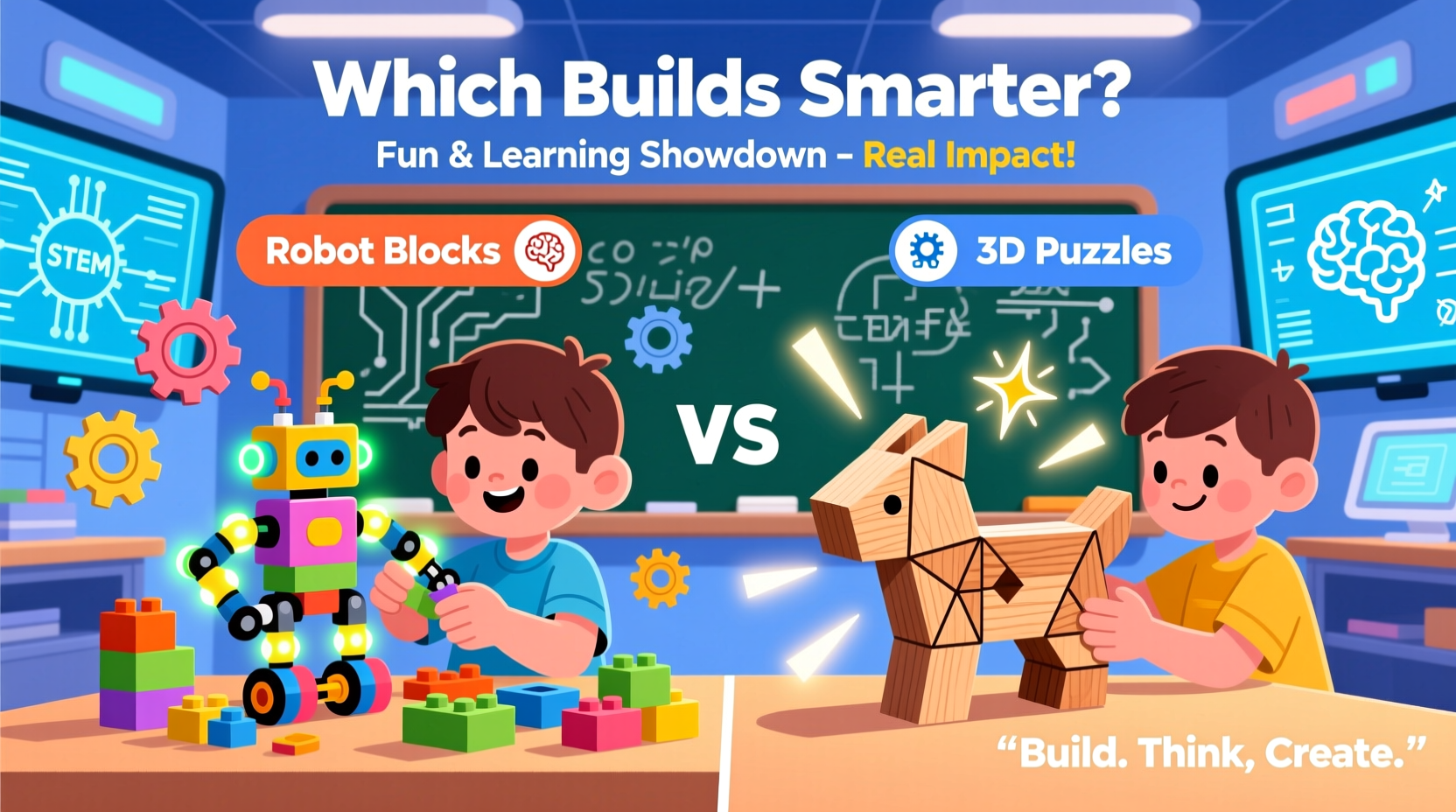
At first glance, robot building blocks and 3D puzzles may seem similar—both involve assembling pieces into a final structure. But their underlying design philosophies diverge significantly.
Robot building blocks, such as LEGO Mindstorms, Makeblock, or Sphero kits, are modular systems that allow users to construct programmable robots. These kits integrate motors, sensors, microcontrollers, and coding interfaces, enabling learners to build machines that move, respond to stimuli, and execute tasks. The end goal is dynamic interaction: a robot that walks, avoids obstacles, or follows lines.
In contrast, 3D puzzles—like those from Ravensburger, CubicFun, or Wrebbit—are static models made from interlocking plastic, foam, or wooden pieces. They replicate famous landmarks (Eiffel Tower, Globe), animals, or vehicles. Once assembled, they serve as display objects. The challenge lies in precision, sequencing, and visual-spatial coordination—not movement or function.
Educational Value: What Skills Do Each Develop?
Both formats foster learning, but through different pathways. Robot building blocks emphasize active problem-solving within a technological framework. Learners engage with real-world engineering principles: gear ratios, sensor feedback loops, cause-and-effect programming logic. They write code to control behavior, troubleshoot errors, and iterate designs—mirroring actual robotics workflows.
This hands-on exposure builds computational thinking, a critical skill in modern education. According to Dr. Marina Krcmar, professor of computer science at Wake Forest University:
“Children who interact with programmable toys develop an intuitive understanding of algorithms and debugging before they ever see a textbook definition.” — Dr. Marina Krcmar, Human-Computer Interaction Researcher
On the other hand, 3D puzzles strengthen fine motor skills, attention to detail, and spatial intelligence. Assembling a spherical globe without glue requires understanding curvature, symmetry, and structural balance. These puzzles also teach persistence and task completion, especially when tackling 500+ piece sets over several days.
A study published in the journal *Thinking Skills and Creativity* found that regular puzzle solvers demonstrated stronger mental rotation abilities—a key predictor of success in architecture, engineering, and design fields.
Comparison Table: Key Features Side-by-Side
| Feature | Robot Building Blocks | 3D Puzzles |
|---|---|---|
| Primary Focus | Engineering, coding, automation | Spatial reasoning, precision assembly |
| Average Age Range | 8–16+ (with adult help under 10) | 5–adult (varies by complexity) |
| Active Engagement | High (requires testing, coding, iteration) | Moderate (focused, sequential work) |
| Durability & Reusability | High (rebuildable into new models) | Low to moderate (often displayed permanently) |
| Cost Range | $50–$300+ | $15–$80 |
| Skill Transfer to Real-World Careers | Strong in robotics, software, AI | Useful in design, modeling, craftsmanship |
Real Example: Two Siblings, Two Paths
Consider the case of the Rivera family in Portland, Oregon. Twelve-year-old Liam gravitated toward his LEGO SPIKE Prime set after school, spending hours coding a robotic arm to sort colored blocks. He debugged sensor misreads, adjusted motor power, and even presented his project at a local maker fair. His younger sister, Sofia, age 9, preferred assembling a 3D model of the Colosseum. She worked on it over weekends, following diagrams meticulously, learning Roman architectural styles along the way.
Both children showed deep engagement—but in different forms. Liam thrived on trial-and-error experimentation; Sofia found calm in structured progression. Their parents noticed Liam improved in logical reasoning and resilience with failure, while Sofia developed patience and visual memory. Neither was “better” educated—just differently.
Which Is More Fun? It Depends on Personality and Goals
\"Fun\" is subjective and tied closely to personality type and intrinsic motivation. Children who enjoy open-ended creation, tinkering, and seeing immediate results from their actions often prefer robot building blocks. The ability to command a robot to dance or follow voice commands delivers instant gratification and encourages further exploration.
Conversely, individuals who appreciate aesthetics, order, and tangible outcomes may find greater satisfaction in completing a 3D puzzle. There's a meditative quality to fitting each piece perfectly, watching a recognizable shape emerge gradually. For some, this process reduces stress and enhances mindfulness.
Adults aren't excluded from either category. Many use robot kits for prototyping ideas or teaching coding workshops. Others collect 3D puzzles as decorative art pieces, enjoying them as screen-free hobbies that stimulate focus without digital overload.
Step-by-Step Guide to Choosing the Right Option
- Assess the learner’s interests: Are they drawn to technology, machines, and “smart” devices? Or do they enjoy crafts, models, and detailed visuals?
- Evaluate existing skills: Does the child already show interest in coding or math? Or are they more artistic and observant?
- Consider space and budget: Robot kits require storage for small parts and access to devices for programming. 3D puzzles need flat surfaces and protection from disturbances during assembly.
- Test with entry-level products: Start with a basic coding robot (e.g., Botley 2.0) or a 100-piece 3D puzzle. Observe engagement level and completion rate.
- Encourage reflection: After completion, ask what they liked most. Was it the process, the product, or the problem-solving?
Checklist: Questions Before Buying
- Does the kit include clear instructions and support resources?
- Is it reusable or single-purpose?
- Does it require batteries, apps, or additional tools?
- Are replacement parts available?
- Can it grow with the user (e.g., advanced coding modules)?
- Is it safe for the intended age group (no choking hazards, non-toxic materials)?
Frequently Asked Questions
Can 3D puzzles teach STEM concepts?
Yes. While not explicitly technological, 3D puzzles reinforce geometry, symmetry, structural integrity, and scale modeling—all foundational to engineering and architecture. Some advanced kits even simulate moving parts using gears and levers.
Are robot building blocks too complex for young kids?
Not necessarily. Many brands now offer screen-free coding options with color-coded command tiles or block-based drag-and-drop interfaces (like Scratch). With guided supervision, children as young as six can start exploring robotics fundamentals.
Which has longer-lasting educational value?
Robot building blocks generally offer deeper long-term growth due to scalability. Users can progress from simple commands to complex autonomous behaviors, integrating AI elements or sensors. However, 3D puzzles remain valuable for developing concentration and three-dimensional visualization—skills that complement technical learning.
Conclusion: Why Choose One When You Can Leverage Both?
The debate between robot building blocks and 3D puzzles isn’t about declaring a winner—it’s about recognizing complementary strengths. One cultivates innovation and systems thinking; the other nurtures precision and perseverance. The most effective learning environments don’t force a choice but integrate both into a balanced developmental toolkit.
For holistic growth, consider pairing a monthly robotics challenge with a themed 3D puzzle—such as building a Mars rover while assembling a 3D model of the International Space Station. This synergy bridges imagination with knowledge, action with reflection.




 浙公网安备
33010002000092号
浙公网安备
33010002000092号 浙B2-20120091-4
Comments
No comments yet. Why don't you start the discussion?