
For homeowners with compact lawns, the choice between a robot lawn mower and a manual push mower isn’t just about cutting grass—it’s about time, effort, noise, and long-term value. As automation becomes more accessible, many are questioning whether the convenience of a robotic mower justifies its cost and operational sound levels, especially when a simple push mower offers near-silent operation and minimal maintenance. The answer depends on lifestyle, yard specifics, and personal tolerance for both labor and mechanical hum.
Small yards—typically under 5,000 square feet—present a unique case. They’re often manageable by hand but frequent enough that weekly mowing can become a chore. This gray zone makes the decision particularly nuanced. Let’s dissect the real-world trade-offs between robot and manual mowers to determine whether automation truly delivers peace of mind—or just another source of background noise.
How Robot Mowers Work: Efficiency at a Cost
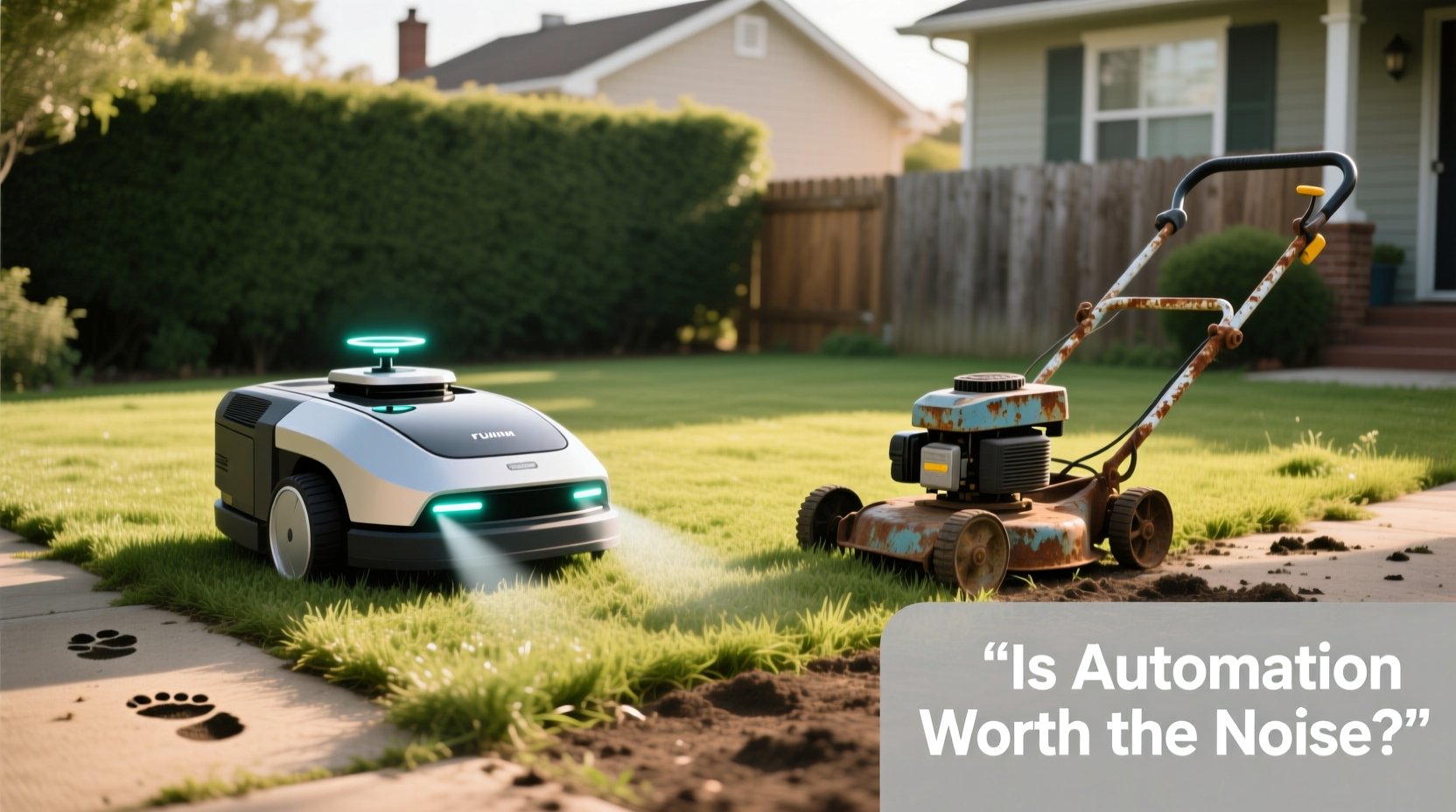
Robot lawn mowers operate autonomously, navigating predefined boundaries using either a perimeter wire or GPS-based mapping. Once programmed, they mow on a set schedule, returning to their charging station when power runs low. For small yards, this means consistent, incremental cutting—often multiple times per week—which promotes healthier grass growth through the “mulch-and-go” method. Clippings are finely chopped and left on the lawn, enriching the soil naturally.
Modern models from brands like Husqvarna, Worx, and Robomow offer adjustable cutting heights, rain sensors, anti-theft features, and smartphone app control. Some even integrate with smart home systems. But despite their sophistication, these machines aren’t silent. Most operate between 58 and 65 decibels—comparable to a normal conversation or a refrigerator hum. While not disruptive in open suburban areas, that level of noise may be noticeable in tightly packed neighborhoods or during early morning or evening operation.
The Enduring Appeal of Manual Push Mowers
Manual reel mowers, powered solely by human effort, have seen a resurgence among eco-conscious homeowners. With no electricity, fuel, or emissions, they represent the quietest and most sustainable mowing option available. Operating at around 50–55 decibels, they’re barely louder than rustling leaves. Their simplicity also translates to reliability: no batteries to degrade, no software updates, and virtually no maintenance beyond occasional blade sharpening.
For small, flat lawns under 3,000 square feet, a push mower can complete the job in 15–25 minutes. The physical effort doubles as light exercise, appealing to those seeking to incorporate movement into daily routines. However, performance declines on uneven terrain, thick grass, or damp conditions. Reel mowers struggle with taller or wet vegetation and require more pushing force than motorized alternatives.
One overlooked benefit is precision. Without the risk of ricocheting debris, users can edge closely along flower beds and walkways without fear of damaging plants or spraying stones. This makes them ideal for meticulously maintained gardens where control trumps speed.
Comparative Analysis: Key Factors at a Glance
| Factor | Robot Lawn Mower | Manual Push Mower |
|---|---|---|
| Initial Cost | $600–$2,000+ | $100–$300 |
| Noise Level | 58–65 dB (moderate) | 50–55 dB (very low) |
| Labor Required | Nearly zero (after setup) | Moderate to high (physical effort) |
| Maintenance | Blade replacement, cleaning, software checks | Blade sharpening, rust prevention |
| Environmental Impact | Low (electric, but battery production footprint) | Negligible (zero emissions, no energy use) |
| Best For | Busy homeowners, irregular mowing schedules | Active individuals, eco-focused users |
The data reveals a clear divide: automation trades upfront cost and modest noise for time savings, while manual mowers demand effort but deliver silence and sustainability. Neither option is universally superior—the best choice hinges on individual priorities.
Real-Life Scenario: A Suburban Twin-Lot Decision
Consider Sarah, a remote worker living in a suburban neighborhood with a 2,800-square-foot yard. Her schedule varies, and she often works late into the evening. She initially used a manual push mower but found herself postponing cuts due to fatigue, leading to overgrown patches every few weeks.
After researching options, she invested in a mid-range robot mower. She installed the perimeter wire over a weekend and programmed it to mow three times a week during lunch hours. Though she noticed a faint mechanical whir from her backyard office, it didn’t interfere with calls. Within a month, her lawn became noticeably greener and denser due to consistent trimming.
“I was skeptical about the noise,” she said, “but it’s quieter than my coffee grinder. The real win is never having to think about mowing. It’s done before I even notice it needs doing.”
Her neighbor, Mark, opted differently. He enjoys morning routines and uses a reel mower every Saturday. “It takes me 20 minutes, and I get fresh air and movement. Plus, I can hear birds while I work—not motors.” His lawn is slightly less uniform, but he values the ritual over perfection.
“Automation isn’t about laziness—it’s about reallocating time to higher-value activities. For some, that’s work. For others, it’s presence in the moment.” — Dr. Lena Torres, Urban Sustainability Researcher, Portland State University
When Automation Makes Sense: A Step-by-Step Evaluation
Deciding whether a robot mower is worth the investment—and the noise—requires a structured assessment. Follow this timeline to evaluate your needs:
- Assess Yard Size and Complexity (Week 1): Measure your lawn. If it’s under 5,000 sq ft and has few obstacles, a robot mower is technically feasible. Note slopes, tight corners, and mulch beds that could challenge navigation.
- Track Your Current Mowing Habits (Weeks 2–4): Record how often you mow, how long it takes, and whether you delay due to schedule or motivation. Frequent procrastination signals a potential need for automation.
- Evaluate Noise Sensitivity (Ongoing): Observe ambient sound levels in your yard. Test decibel perception by running a vacuum indoors and listening from outside. If that level feels intrusive, a 60dB mower may bother you or neighbors.
- Budget for Total Cost (Week 4): Include purchase price, installation (if not DIY), and expected blade replacements every 1–2 years. Compare against the cost of a quality push mower and your time valuation.
- Pilot a Solution (Optional, Week 5+): Rent or borrow a robot mower for a trial period. Alternatively, test a reel mower for one season. Real-world experience trumps speculation.
Common Misconceptions About Both Options
A widespread myth is that robot mowers damage lawns. In reality, their lightweight design and frequent mowing reduce soil compaction and scalping risks. Conversely, some believe reel mowers are always eco-friendly—but if used infrequently and followed by chemical herbicides due to overgrowth, their net environmental benefit diminishes.
Another misconception is that robot mowers are “set and forget.” Initial setup requires careful boundary wire placement, slope calibration, and obstacle mapping. Poor installation leads to missed strips or trapped units. Similarly, push mowers aren’t effortless; improper technique can strain the back or produce uneven cuts.
Actionable Checklist: Choosing Your Mower Type
- ☐ Measure total lawn area and note any slopes exceeding 20% grade
- ☐ Determine your weekly availability for mowing tasks
- ☐ Assess neighborhood noise norms—would moderate sound disrupt conversations or relaxation?
- ☐ Calculate your hourly time value (e.g., $25/hour) and compare to robot mower’s annualized cost
- ☐ Test-push a reel mower on your lawn to gauge physical effort required
- ☐ Research local regulations—some HOAs restrict autonomous equipment or mowing hours
- ☐ Prioritize key values: time savings, quiet operation, environmental impact, or physical activity
Frequently Asked Questions
Can robot mowers handle uneven terrain in small yards?
Yes, most modern models manage gentle slopes up to 20–25 degrees. However, severe dips, hidden holes, or loose gravel can cause navigation issues. Leveling problem areas or choosing a model with all-wheel drive improves performance.
Do manual mowers really save money over time?
In pure operating costs, yes. A $150 reel mower lasts 10–15 years with basic care and zero energy costs. A robot mower may cost $1,200 upfront plus $100/year in electricity and blade replacements. However, if your time is valued at $30/hour and mowing takes 30 minutes weekly, that’s $780/year in opportunity cost—making automation potentially economical.
Are robot mowers safe around pets and children?
Generally, yes. Most feature lift-and-tilt sensors that stop blades instantly if lifted or tipped. However, they don’t detect small animals or toys on the ground. Supervision during operation is recommended, especially for curious pets. Clear the yard before activation.
Final Verdict: Is Automation Worth the Noise?
For small-yard owners who value time, consistency, and hands-off maintenance, a robot lawn mower is often worth the modest noise increase. The 58–65 dB range is rarely disruptive during daytime use and pales in comparison to gas-powered mowers (often 85+ dB). The real benefit lies in transformed lawn health and reclaimed personal time.
However, if your priority is tranquility, sustainability, or integrating light exercise into your routine, a manual push mower remains an elegant, efficient solution. It produces no emissions, requires no charging, and blends seamlessly into quiet mornings.
The decision ultimately reflects lifestyle philosophy. Automation excels when mowing competes with meaningful activities. Simplicity wins when the act itself holds value. In small yards, both approaches are viable—one prioritizes convenience, the other mindfulness.




 浙公网安备
33010002000092号
浙公网安备
33010002000092号 浙B2-20120091-4
Comments
No comments yet. Why don't you start the discussion?