
For homeowners with sloped yards, choosing the right lawn mower is more than a matter of convenience—it’s about effectiveness and safety. The rise of robot lawn mowers has brought promises of hands-free cutting, but many remain skeptical: can these compact machines truly handle hills, or do they simply struggle and stall like underpowered toys? In contrast, traditional push mowers—especially self-propelled models—are known for their reliability on uneven terrain. This article cuts through marketing claims to deliver real insights into how robot mowers perform on inclines compared to conventional push mowers.
Understanding Lawn Mower Performance on Slopes
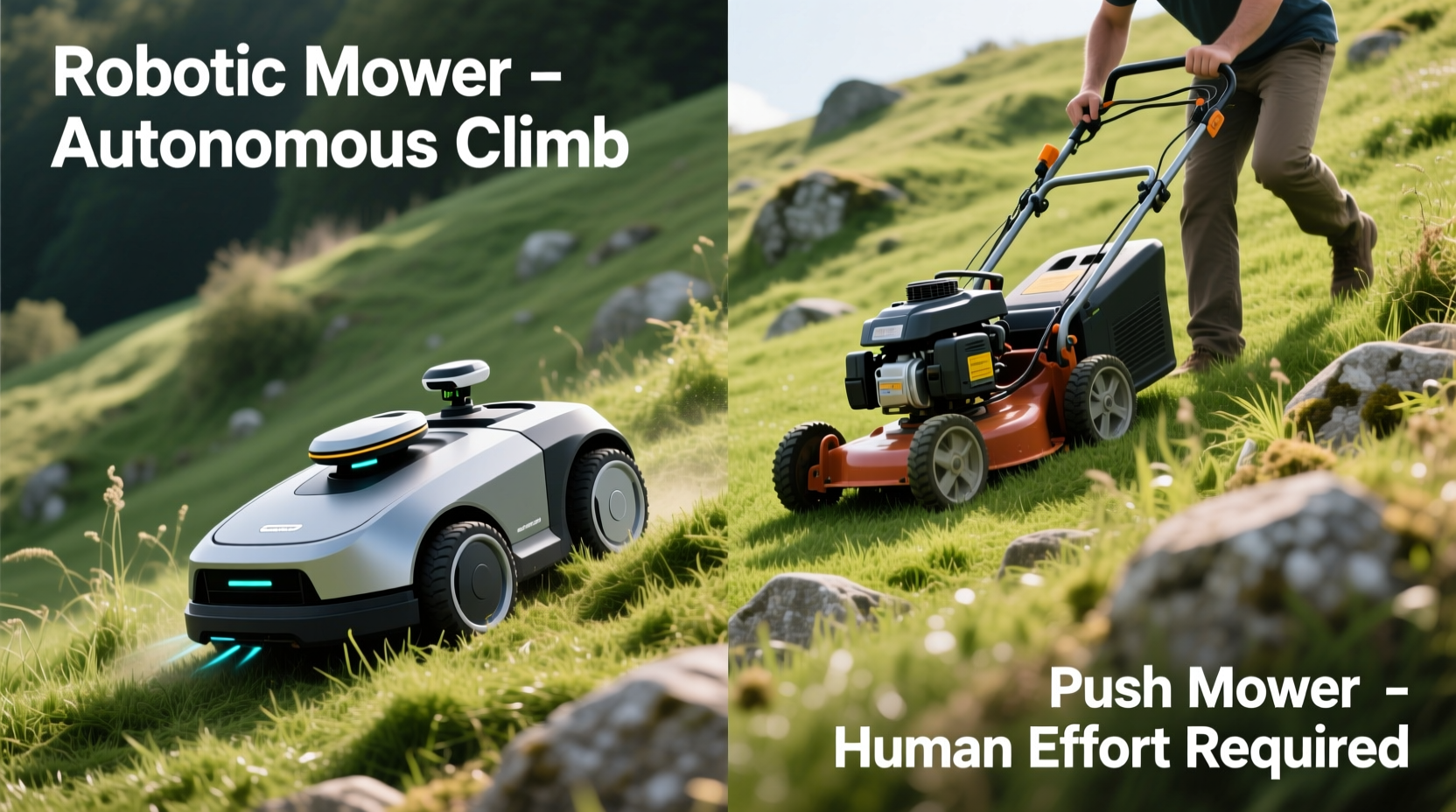
The ability of any mower to handle hills depends on traction, weight distribution, motor power, wheel design, and control systems. Push mowers rely on user input and mechanical propulsion, while robot mowers depend on sensors, algorithms, and electric motors to navigate autonomously. On flat lawns, both types perform well. But when gradients increase, differences in capability become apparent.
Most manufacturers specify maximum incline ratings for their mowers, typically expressed as degrees or percentages. A 15% slope equals roughly 8.5 degrees. While some robot mowers claim to handle up to 30%, real-world performance often falls short due to variables like grass length, moisture, soil type, and obstacles.
How Robot Mowers Handle Hills: Technology and Limitations
Modern robot mowers use dual-wheel drive systems, aggressive treads, and gyroscopic sensors to maintain stability on slopes. High-end models from brands like Husqvarna, Worx, and Ambrogio are engineered specifically for hilly landscapes. These units adjust speed dynamically, reduce cutting width on steep sections, and recalibrate direction if slippage occurs.
However, physics still applies. Lightweight robots (typically under 20 lbs) can lose traction, especially on wet grass or loose soil. When wheels spin without grip, the mower may stop, retreat, or circle aimlessly—behavior that frustrs users expecting seamless automation.
Some advanced models integrate GPS or boundary wire tension monitoring to detect changes in elevation and terrain resistance. For instance, the Husqvarna Automower® 450X can manage inclines up to 35% (about 19 degrees), thanks to its large drive wheels and intelligent torque control. Still, even this model recommends repositioning the charging station on very steep lots to avoid repeated climbing attempts.
“Robot mowers have come a long way, but they’re not magic. Their success on hills depends as much on yard preparation as on specs.” — Daniel Reeves, Landscape Automation Engineer
Push Mowers on Inclines: Power, Control, and User Effort
Self-propelled push mowers offer consistent performance on slopes because they combine engine power with direct operator control. Gas-powered models like Honda’s HRX series generate high torque at low RPMs, allowing them to power through thick grass on inclines up to 20 degrees without issue. Electric and battery-powered push mowers have improved significantly, though their hill performance varies by motor strength and wheel size.
Unlike robot mowers, humans can adapt instantly to changing conditions—leaning forward for balance, adjusting speed, or avoiding slick patches. This responsiveness gives push mowers an edge in unpredictable or rugged terrain. However, pushing any mower uphill increases physical strain, making it less ideal for elderly users or those with mobility concerns.
One downside: operating a push mower on steep slopes raises safety risks. According to the Consumer Product Safety Commission, over 60,000 lawn mower injuries occur annually in the U.S., many involving loss of control on inclines. Robot mowers eliminate this risk by removing the operator from the equation entirely.
Comparative Analysis: Robot vs Push Mower on Hills
| Feature | Robot Lawn Mower | Push Mower (Self-Propelled) |
|---|---|---|
| Max Incline Capacity | 15–35% (varies widely) | 20–25° (approx. 36%) |
| Traction System | Dual-drive wheels, rubber treads | Front or rear-wheel drive, larger tires |
| User Effort Required | None after setup | Moderate to high on slopes |
| Safety on Slopes | High (no operator present) | Moderate (risk of slipping or tipping) |
| Adaptability to Terrain Changes | Limited (requires reprogramming or barriers) | High (operator adjusts in real time) |
| Performance in Wet Conditions | Poor (slips easily) | Fair to good (depends on model) |
| Maintenance Complexity | Low to moderate | Moderate (engine, belts, oil) |
This comparison shows that while robot mowers excel in safety and automation, they lag behind push mowers in raw adaptability and wet-condition performance. However, for moderately sloped, well-maintained lawns, modern robots are increasingly viable.
Real-World Example: A Hillside Yard in Oregon
Consider Mark T., a homeowner in Portland, Oregon, whose backyard drops at a 27% grade (about 15 degrees). He replaced his aging Honda push mower with a Worx Landroid S WR142, rated for 30% slopes. Initially, the robot struggled near a mossy retaining wall where morning dew made the grass slick. After installing small gravel strips for better traction and raising the cutting height slightly, the mower adapted successfully.
“It took two weeks of tweaking,” Mark said, “but now it handles the hill better than I did manually. I no longer dread mowing day.” His experience highlights a key truth: robot mowers on hills often require environmental adjustments, not just technical capability.
Choosing the Right Mower for Your Terrain
Selecting between a robot and a push mower shouldn’t be based solely on hill percentage. Consider these factors:
- Consistency of slope: Gradual, uniform inclines favor robots; sudden drops or uneven ground challenge navigation.
- Yard size: Larger hilly yards benefit more from automation due to reduced physical effort.
- Grass type: Thick, tall, or wet grass increases resistance, making climbs harder for lightweight robots.
- Budget: Entry-level robot mowers ($500–$800) often lack the torque for sustained hill climbing. Premium models ($1,500+) deliver better results.
- Time availability: If weekly mowing fits your schedule, a push mower may suffice. For busy households, automation pays off despite initial setup complexity.
Step-by-Step: Preparing Your Yard for a Robot Mower on Hills
- Map your yard’s inclines: Walk the property with a slope-measuring app to identify problem zones.
- Clear debris: Remove loose stones, branches, or hidden dips that could cause tripping or sliding.
- Install boundary wire properly: Follow manufacturer guidelines for securing the wire in hilly areas—use staples every 12 inches and avoid sharp bends.
- Create traction aids: Add crushed gravel paths or landscape fabric in slippery spots to improve grip.
- Position the charging station wisely: Place it on level ground, preferably at the base of a slope to minimize uphill travel.
- Adjust settings gradually: Start with higher cutting heights and slower mowing schedules to allow the robot to adapt.
- Monitor early cycles: Observe the first few runs to catch navigation errors or stalling points.
Common Myths About Robot Mowers and Hills
Several misconceptions persist about robotic mowers’ hill capabilities:
- Myth: All robot mowers can handle any hill under 30%.
Reality: Performance varies drastically by brand and model. Some budget units stall at 15%. - Myth: They’ll roll backward and cause damage.
Reality: Most have anti-roll sensors and automatic shutdown on excessive tilt. - Myth: They cut less effectively on slopes.
Reality: Blade speed remains constant; only ground speed may reduce to maintain traction.
Checklist: Is a Robot Mower Right for Your Hilly Yard?
- ✅ Measure your steepest slope—is it within the mower’s rated capacity?
- ✅ Is your grass type suitable for frequent, light cutting (robot mowers work best with regular mowing)?
- ✅ Can you install a boundary wire safely across uneven terrain?
- ✅ Are you willing to make minor landscaping tweaks (e.g., adding gravel paths)?
- ✅ Do you value time savings over upfront cost?
- ❌ Avoid if: Your yard has drop-offs, loose soil, or exceeds 35% grade without stabilization.
Frequently Asked Questions
Can robot mowers handle wet grass on hills?
No mower performs optimally on wet grass, but robot mowers are particularly prone to slipping on moist, inclined surfaces. Most manufacturers recommend avoiding operation during or immediately after rain. Some high-end models delay mowing automatically based on weather data.
Do robot mowers get stuck on hills?
They can, especially if the incline exceeds their traction limits, the grass is too tall, or the wheels are clogged. However, modern units feature obstacle detection and retraction algorithms that help them back down and retry rather than remain stranded. Regular cleaning and proper setup reduce the risk significantly.
Are there robot mowers designed specifically for hills?
Yes. Models like the Husqvarna Automower 450X, Ambrogio L60 Deluxe, and Worx Landroid Robotic Lawn Mower (WR150) are built for challenging terrain. These include reinforced drivetrains, wider wheels, and enhanced motor torque. Look for terms like “all-terrain” or “hill-friendly” in product descriptions.
Final Verdict: Do Robot Mowers Actually Work on Hills?
The answer isn’t binary. Robot lawn mowers *can* handle hills—but not universally or effortlessly. Success depends on matching the machine to your specific yard conditions. For gentle to moderate slopes (under 25%), well-prepared lawns, and owners willing to invest in premium models, robot mowers deliver impressive results with minimal intervention.
Push mowers, meanwhile, remain more adaptable and powerful in extreme or unpredictable conditions. They’re also generally cheaper upfront and easier to repair. But they demand time, effort, and carry inherent safety risks on inclines.
If your yard has consistent, manageable slopes and you prioritize convenience, a high-quality robot mower is a smart investment. For steeper, rougher, or wetter terrain, a self-propelled push mower may still be the more reliable choice.




 浙公网安备
33010002000092号
浙公网安备
33010002000092号 浙B2-20120091-4
Comments
No comments yet. Why don't you start the discussion?