
For homeowners with compact outdoor spaces, choosing the right lawn care tool is more than a matter of convenience—it’s about time, effort, and long-term value. As technology reshapes everyday tasks, the debate between robot lawnmowers and traditional manual push mowers has grown sharper. While one promises effortless automation, the other offers simplicity, control, and reliability. The decision isn’t just about preference; it hinges on lifestyle, budget, yard characteristics, and personal values like environmental impact and physical activity.
This article breaks down both options in detail, examining performance, cost, usability, and hidden trade-offs to help you determine which mower truly suits your small yard—and your life.
Understanding Your Yard Needs
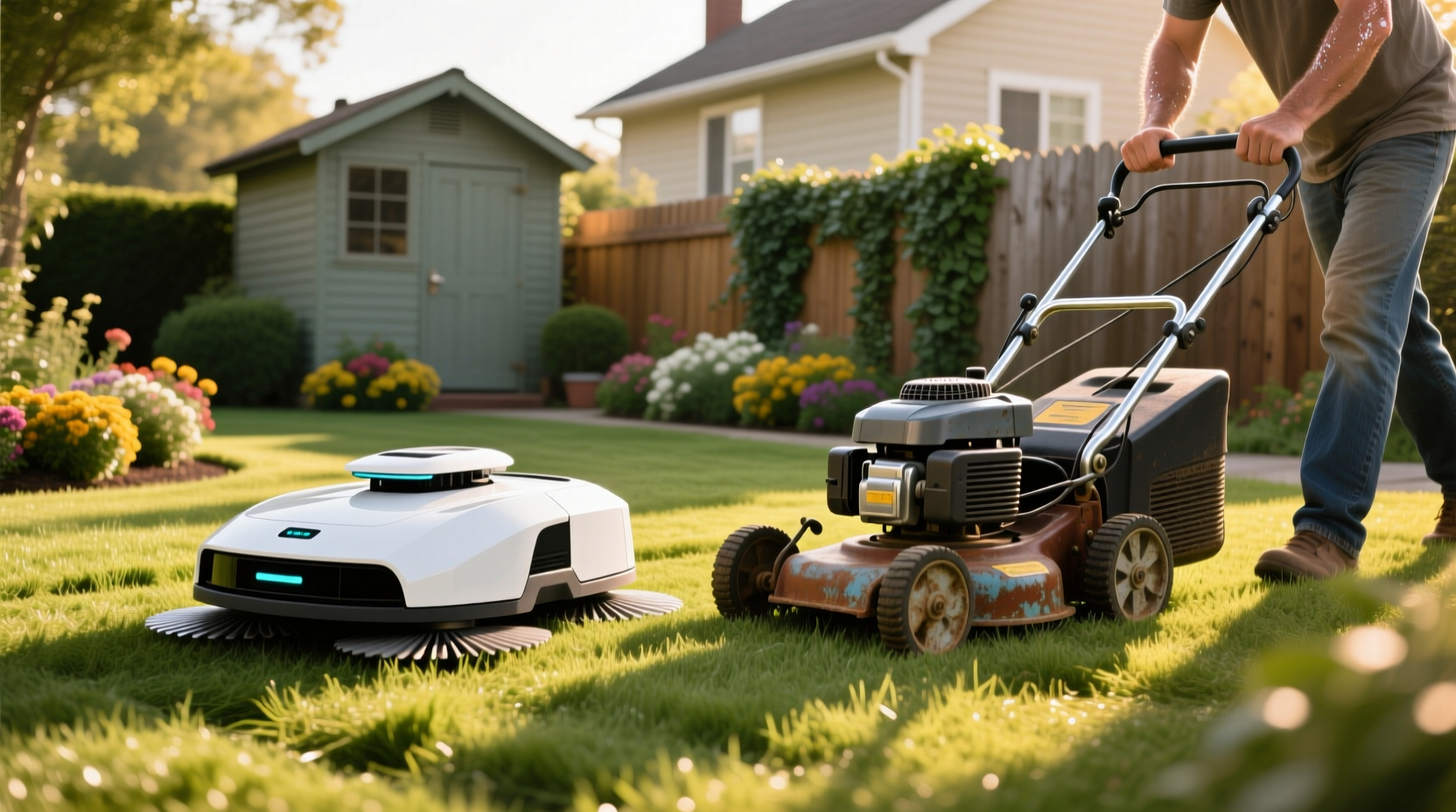
Before comparing machines, it's essential to assess your yard. Small yards—typically under 0.25 acres or roughly 10,000 square feet—often have simpler layouts but can still present challenges: narrow passages, slopes, flower beds, or obstacles like trees and play equipment. These factors directly influence how well either a robot or a manual mower performs.
A robot mower excels in predictable, enclosed environments with minimal obstructions. It requires boundary wires and careful programming but operates independently once set up. A manual push mower, meanwhile, thrives on flexibility. You steer it precisely, avoid obstacles intuitively, and don’t need to worry about navigation errors or theft.
The frequency of mowing also matters. Cool-season grasses may need cutting every 5–7 days during peak growth, while warm-season types might require less frequent attention. If you're willing to spend 20–30 minutes weekly pushing a mower, manual may suffice. But if consistency is hard to maintain, automation could preserve lawn health through regular, scheduled cuts.
How Robot Lawnmowers Work
Robot lawnmowers are autonomous devices that cut grass using rotating blades powered by rechargeable lithium-ion batteries. They navigate via an invisible boundary wire installed around the perimeter of the lawn. Some advanced models use GPS or onboard sensors to map terrain and avoid obstacles.
Once programmed, they operate on a schedule—often daily—cutting small amounts of grass each time. This \"mulch-and-go\" approach returns clippings to the soil as natural fertilizer, promoting healthier turf. When the battery runs low, the robot returns to its charging station automatically.
Top brands like Husqvarna Automower, Robomow, and Worx Landroid offer models tailored to small yards, with coverage ranging from 0.25 to 0.5 acres. Entry-level units start around $600, while premium versions exceed $2,000 with smart features like app control, geofencing, and weather adaptation.
Installation typically takes a few hours: laying the boundary wire, anchoring it with stakes, and setting up the charging base near an outdoor power outlet. After setup, operation is nearly hands-free—ideal for busy professionals, seniors, or anyone seeking to eliminate weekend chores.
“Robotic mowers represent a shift from reactive to proactive lawn care. Their frequent mowing mimics professional groundskeeping practices.” — Dr. Alan Peterson, Turfgrass Management Specialist, University of Minnesota
Advantages and Limitations of Manual Push Mowers
Manual push mowers—especially reel models—are among the oldest lawn tools still in widespread use. They rely entirely on human power: as you walk forward, wheels turn gears that spin the cutting reel. No fuel, no electricity, no emissions.
These mowers deliver a clean, scissor-like cut that’s gentler on grass than the tearing action of rotary blades. They’re quiet, lightweight, and require minimal maintenance—just occasional blade sharpening and cleaning. Prices range from $100 to $300, making them significantly cheaper upfront than most robot mowers.
However, their effectiveness depends on user effort and lawn conditions. Reel mowers struggle with tall, wet, or thick grass. Uneven terrain can make pushing difficult, especially for older users or those with limited mobility. And while they provide light exercise, not everyone wants to trade Saturday mornings for lawn work.
Gas-powered push mowers offer more cutting power and handle tougher conditions, but introduce noise, fumes, and higher maintenance. For this comparison, we focus on non-motorized reel mowers versus robotic electric models, as these represent the clearest contrast in philosophy and function.
Comparative Analysis: Robot vs Manual
| Feature | Robot Lawnmower | Manual Push Mower |
|---|---|---|
| Upfront Cost | $600–$2,500 | $100–$300 |
| Operating Cost | Minimal (electricity) | None |
| Maintenance | Blade replacement, software updates, sensor cleaning | Blade sharpening, rust prevention |
| Labor Required | Nearly none after setup | Full user effort per mow |
| Noise Level | Quiet (~60 dB) | Silent |
| Environmental Impact | Low (electric, mulching) | Zero (no emissions) |
| Best For | Busy schedules, consistent care, tech-savvy users | Budget-conscious, eco-focused, active individuals |
The table highlights a fundamental trade-off: investment in time versus money. Robot mowers demand high initial spending but return hours of saved labor annually. Manual mowers save cash but require recurring physical input. Over five years, a robot mower used weekly might save 100–150 hours of work—a significant benefit for time-poor households.
Yet cost isn’t everything. Manual mowers never suffer from connectivity issues, stolen units, or software bugs. They’re immune to hacking, weather-related malfunctions, and compatibility problems. In neighborhoods with high outdoor equipment theft, a visible robot mower may be a liability despite security PINs and alarms.
Real-World Example: Two Homes, Two Choices
Consider two neighbors on the same suburban street, each with a 0.15-acre yard.
Sarah, 38, works remotely with flexible hours. She enjoys being outdoors and sees mowing as light exercise and mental reset. She bought a high-quality Fiskars reel mower for $180. Every Saturday morning, she spends 25 minutes cutting her lawn. She appreciates the silence, the lack of fumes, and knowing she’s not contributing to noise pollution. Her grass stays healthy with weekly cuts, and she feels satisfied completing the task herself.
James, 42, is a hospital administrator with unpredictable shifts. He often works weekends and returns home too tired for yard work. His lawn had become patchy and overgrown until he invested $1,200 in a Husqvarna Automower 115H. After installing the boundary wire over a weekend, he programmed it to mow Monday through Friday at noon. Within weeks, his lawn improved dramatically due to consistent trimming. He now enjoys a pristine yard without lifting a finger.
Both approaches succeed—but for different reasons. Sarah values control and physical engagement. James prioritizes reliability and time savings. Neither solution is objectively better; context determines the best fit.
Step-by-Step Decision Guide
Choosing between a robot and manual mower doesn’t have to be overwhelming. Follow this sequence to identify the right option for your situation:
- Evaluate your available time. Do you consistently have 20–30 minutes per week for mowing? If not, automation may be worth the cost.
- Assess your physical ability. Are you comfortable pushing a mower over uneven ground? Chronic pain, age, or mobility issues favor robotic options.
- Calculate total ownership cost. Include purchase price, installation (for robots), maintenance, and expected lifespan (robots: 5–7 years; manual: 10+ years).
- Check yard suitability. Robots need clear access, secure storage, and a power source nearby. Yards with multiple levels, loose debris, or frequent foot traffic may disrupt navigation.
- Determine your lawn goals. Want show-quality grass? Robots promote even growth. Prefer organic, zero-impact maintenance? Manual wins on sustainability.
- Test alternatives if possible. Borrow a reel mower for a month. Rent a robot mower to trial its performance before committing.
Common Misconceptions Debunked
Myth: Robot mowers cut poorly.
Reality: Modern models use sharp, fast-spinning blades and mulch finely. Frequent mowing leads to healthier lawns than infrequent deep cuts.
Myth: Manual mowers are always cheaper.
Reality: While upfront cost is lower, consider the hourly value of your time. At $20/hour, saving 2 hours/month equals $480/year—quickly offsetting a robot’s price.
Myth: Robots can’t handle slopes.
Reality: Most handle inclines up to 20 degrees (35% grade). Some, like the Ambrogio L60, manage up to 55%. Always check specs for your yard’s steepest area.
Frequently Asked Questions
Can a robot mower handle dog poop or toys left on the lawn?
No. Unlike humans, robots cannot detect soft obstacles. Dog waste, balls, shoes, or garden tools can cause clogs, stains, or damage. Always clear the lawn before activation. Many users adopt a “clean-first” rule with family members.
Do manual mowers work on thick Bermuda or Zoysia grass?
Only if the grass is short and dry. These dense, tough grasses often require powered mowers. Reel mowers perform best on cool-season grasses like fescue or bluegrass maintained at 2.5–3 inches.
Are robot mowers safe around children and pets?
Yes, with precautions. Blades stop within seconds of lift detection. Most models have safety switches and obstacle sensors. However, supervision is advised during operation, especially with curious pets or toddlers.
Final Recommendation Checklist
- ✅ I have at least $600 to invest for long-term time savings
- ✅ My yard is under 0.25 acres with few tight spaces
- ✅ I struggle to maintain a consistent mowing schedule
- ✅ I prefer silent, emission-free operation
- ✅ I’m comfortable installing a boundary wire and managing basic tech
If four or more apply, a robot mower is likely the better choice. Otherwise, a manual push mower remains a practical, economical, and environmentally sound alternative.
Conclusion: Make the Choice That Fits Your Life
The choice between a robot lawnmower and a manual push mower isn’t about technological superiority—it’s about alignment with your lifestyle. For those who cherish routine, simplicity, and self-reliance, the manual mower offers unmatched satisfaction and sustainability. For others whose time is scarce and consistency hard-won, the robot mower delivers peace of mind and a perpetually neat yard.
There’s no universal winner. But there is a right answer for you—one that balances cost, convenience, capability, and personal values. Assess your priorities honestly, test options when possible, and choose the tool that removes burden rather than adds complexity.




 浙公网安备
33010002000092号
浙公网安备
33010002000092号 浙B2-20120091-4
Comments
No comments yet. Why don't you start the discussion?