
When it comes to choosing a robot vacuum, one of the most critical decisions is how it navigates your home. Two dominant technologies—LiDAR (Light Detection and Ranging) and camera-based visual navigation—power today’s smart models. While both offer impressive mapping and cleaning capabilities, their performance around furniture varies significantly. For homeowners with cluttered layouts, low-profile sofas, or tight spaces between chairs and tables, getting “stuck” is more than an annoyance—it can mean incomplete cleanings, wasted time, and even damage to furniture or the robot itself.
This article dives deep into how LiDAR and camera-based systems detect obstacles, map environments, and respond to furniture. We’ll compare real-world reliability, examine edge cases, and provide actionable insights so you can choose the system that minimizes entrapment and maximizes efficiency.
How LiDAR Navigation Works in Robot Vacuums
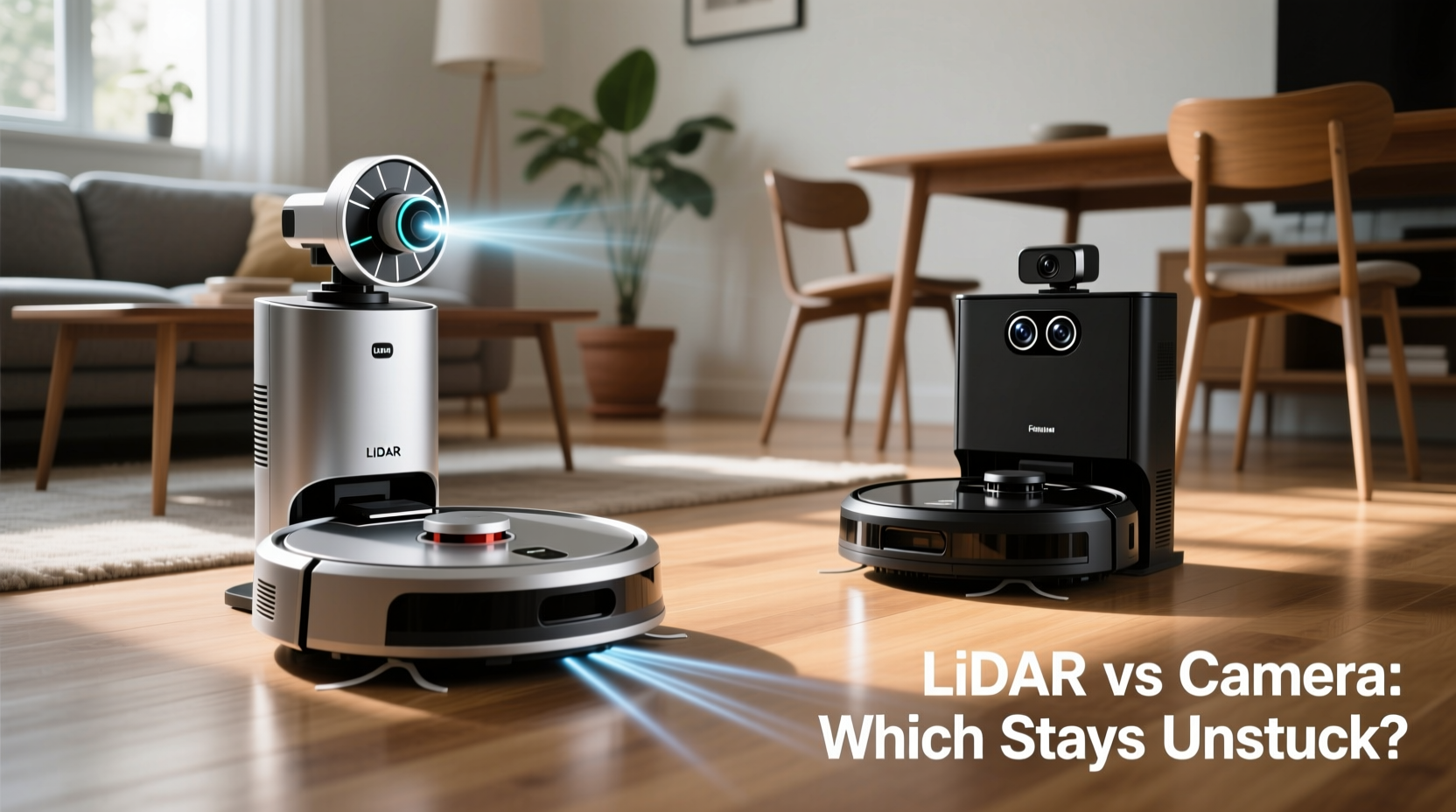
LiDAR-equipped robot vacuums use a rotating laser sensor mounted on top to emit pulses of infrared light. These pulses bounce off walls, furniture legs, baseboards, and other objects, returning to the sensor at varying times based on distance. By calculating these time intervals across 360 degrees, the robot builds a precise, real-time map of its surroundings.
The strength of LiDAR lies in its consistency. It operates independently of ambient lighting, meaning it performs equally well in pitch-black rooms and sunlit living areas. Because it relies on physical measurements rather than image interpretation, LiDAR creates geometrically accurate floor plans down to the centimeter. This allows the robot to maintain consistent clearance from furniture edges, reducing the chance of grazing or wedging into tight corners.
Most high-end models like the Roborock S8 series, Ecovacs Deebot X2, and older Neato D-series use LiDAR as their primary navigation method. These robots typically follow systematic, grid-like cleaning patterns because they know exactly where they are at all times.
How Camera-Based Navigation Functions
Camera-based navigation, also known as vSLAM (visual Simultaneous Localization and Mapping), uses one or more optical cameras to capture images of the ceiling, walls, and room features. The robot compares sequential frames to estimate movement and build a map over time. Unlike LiDAR, this method depends heavily on visual contrast and sufficient lighting.
Brands like iRobot (Roomba j7+, Combo-j9+) and some newer Shark models rely primarily on camera systems. These robots often incorporate AI-powered object recognition—such as identifying shoes, cords, or pet waste—to dynamically adjust paths. However, the effectiveness of this approach hinges on environmental conditions. In dimly lit rooms or homes with uniform décor (white walls, neutral floors), the camera may struggle to find enough reference points, leading to disorientation.
One common issue arises when navigating under low-clearance furniture. A camera-only robot might misjudge depth perception near dark couches or reflective surfaces, increasing the risk of getting wedged. Additionally, sudden changes in lighting—like sunlight shifting during the day—can cause temporary confusion, making the robot pause, spin, or back up unpredictably.
“While camera systems have improved dramatically, they still face challenges in visually sparse or highly reflective environments. LiDAR remains the gold standard for spatial accuracy.” — Dr. Alan Zhou, Robotics Engineer at MIT CSAIL
Which Technology Gets Stuck Less on Furniture?
The short answer: LiDAR-based robot vacuums generally get stuck less than camera-based ones when navigating around furniture.
Here’s why:
- Predictable Sensing Range: LiDAR detects objects within a fixed radius (usually 6–8 meters) regardless of color or texture. This means it consistently avoids brushing against table legs or sliding too close to chair rungs.
- Better Edge Avoidance: Since LiDAR maps space using measurable distances, robots can be programmed with precise buffer zones—say, maintaining a 5 cm gap from any obstacle—reducing accidental contact.
- Less Affected by Visual Ambiguity: Dark wood furniture, black metal legs, or glass coffee tables often confuse cameras due to low reflectivity or transparency. LiDAR handles these better because it measures physical presence, not appearance.
- Fewer Reorientation Failures: When a camera robot loses tracking, it may stop, rotate randomly, or attempt sharp turns near furniture—increasing the likelihood of entrapment. LiDAR systems rarely lose localization once mapped.
That said, modern camera robots are closing the gap. The Roomba j7+, for example, uses AI to recognize over 80 common household objects and actively steers clear of them—even avoiding socks and cords. But this requires extensive training data and works best only in familiar environments. In unfamiliar or complex layouts, the margin for error grows.
Real-World Example: Living Room Layout Challenge
Consider a mid-sized living room with a U-shaped sofa, glass side tables, and a central ottoman. The floor is medium-gray hardwood, and natural light fluctuates throughout the day.
A user runs two robots: a LiDAR-equipped Roborock S7 and a camera-driven Roomba j7+.
- The Roborock completes the job in 48 minutes, hugging walls evenly and maintaining consistent spacing from each piece of furniture. It never touches any leg or corner.
- The Roomba j7+ begins confidently but pauses twice near the glass table, seemingly uncertain about its boundaries. Once, it grazes the edge of the ottoman while turning, causing a slight wobble. Later, it spins in place beneath the sofa after losing ceiling references. Total runtime: 62 minutes, with one manual rescue required.
This scenario illustrates how environmental factors amplify the inherent limitations of camera navigation, especially in spaces with reflective or low-contrast elements.
Comparison Table: LiDAR vs Camera Navigation Performance Around Furniture
| Feature | LiDAR Navigation | Camera Navigation |
|---|---|---|
| Accuracy near furniture | High – consistent distance measurement | Moderate – depends on lighting and contrast |
| Performance in low light | Unaffected – uses infrared lasers | Poor – needs visible light for tracking |
| Handling dark/black furniture | Excellent – detects physical proximity | Fair – may misjudge depth or miss edges |
| Risk of getting stuck | Low – predictable pathing and buffers | Moderate to high – occasional disorientation |
| Object recognition capability | Limited without additional sensors | Strong – AI-enhanced identification |
| Best for furniture-heavy homes? | Yes – superior spatial awareness | Sometimes – if lighting and layout are favorable |
Actionable Tips to Reduce Sticking Incidents
No robot is completely immune to getting stuck. Even advanced systems benefit from environmental optimization. Follow this checklist to minimize risks:
Obstacle Minimization Checklist
- Clear loose cables: Secure power cords and ethernet lines with clips or tape.
- Lift area rugs: Tuck fringes under or use double-sided tape to prevent tangling.
- Adjust furniture height: Ensure at least 10 cm (4 inches) of clearance under sofas and beds.
- Use virtual barriers: Set no-go zones in the app near problematic spots like recliner mechanisms.
- Maintain sensor cleanliness: Wipe LiDAR dome or camera lens weekly with a microfiber cloth.
- Test in daylight first: Let camera robots learn your layout under consistent lighting before running at night.
Hybrid Systems: The Best of Both Worlds?
Some premium models now combine LiDAR and camera inputs for enhanced navigation. For instance, the Ecovacs Deebot X2 Omni uses dual LiDAR sensors along with a forward-facing camera and AI processing. This fusion allows it to leverage LiDAR’s precision mapping while using the camera for object classification—like distinguishing a slipper from a pillow.
These hybrid systems tend to outperform single-sensor robots in complex environments. They avoid furniture reliably thanks to LiDAR, yet still adapt intelligently to dynamic clutter. However, they come at a higher price point and increased computational load, which can affect battery life.
If your budget allows, a hybrid model offers the lowest risk of entrapment while delivering smart decision-making. But for pure furniture avoidance and consistent navigation, standalone LiDAR remains more dependable than camera-only alternatives.
Frequently Asked Questions
Can I improve a camera robot’s performance around furniture?
Yes. Ensure consistent overhead lighting, avoid glossy or mirrored surfaces near cleaning paths, and keep ceiling features (like fans or beams) unobstructed. Training the robot during daytime hours helps it establish reliable visual anchors.
Do LiDAR robots recognize specific objects like shoes or trash?
Not inherently. Basic LiDAR systems detect shapes and distances but cannot classify objects unless paired with AI and additional sensors. Newer models integrate machine learning to enhance recognition, but this is still secondary to their core mapping function.
Is there a robot that never gets stuck?
No robot is 100% foolproof. Even the best systems can encounter unforeseen obstacles—like a fallen book or a child’s toy. However, LiDAR-based models statistically require fewer interventions and navigate furniture more smoothly over time.
Final Recommendations Based on Home Type
- Modern minimalist home with glass/metal furniture: Choose LiDAR. Reflective surfaces challenge cameras; LiDAR sees through visual deception.
- Bright, open-plan layout with defined features: Camera robots perform well here, especially if you value AI obstacle avoidance.
- Cluttered family home with pets and kids: Opt for hybrid or LiDAR-first models. Predictability matters more than object recognition when dealing with unpredictable environments.
- Dark hardwood floors and black furniture: Avoid camera-only robots. Low contrast makes navigation unreliable. Stick with LiDAR.
Conclusion: Prioritize Spatial Accuracy Over Gimmicks
When evaluating robot vacuums, marketing often highlights AI smarts and camera tricks. But for everyday reliability—especially around furniture—consistent spatial awareness trumps flashy features. LiDAR delivers precisely that: a stable, accurate understanding of your home’s geometry, minimizing collisions and entrapments.
While camera-based navigation continues to evolve, it remains more susceptible to environmental variables that lead to hesitation, scraping, or full-on stalling beneath a coffee table. For most users seeking a hands-off experience, particularly in furnished or complex layouts, LiDAR is the safer, smarter choice.




 浙公网安备
33010002000092号
浙公网安备
33010002000092号 浙B2-20120091-4
Comments
No comments yet. Why don't you start the discussion?