
When it comes to holiday decorating or enhancing outdoor landscapes with soft ambient lighting, few techniques are as effective as wrapping bushes in lights. Whether you're preparing for Christmas, a summer garden party, or year-round curb appeal, choosing between rope lights and net lights can significantly impact both the time investment and final visual outcome. While both options illuminate greenery beautifully, they differ greatly in structure, application method, coverage efficiency, and overall neatness. Understanding these differences helps homeowners and decorators make informed decisions that balance speed, aesthetics, and durability.
Understanding Rope Lights and Net Lights
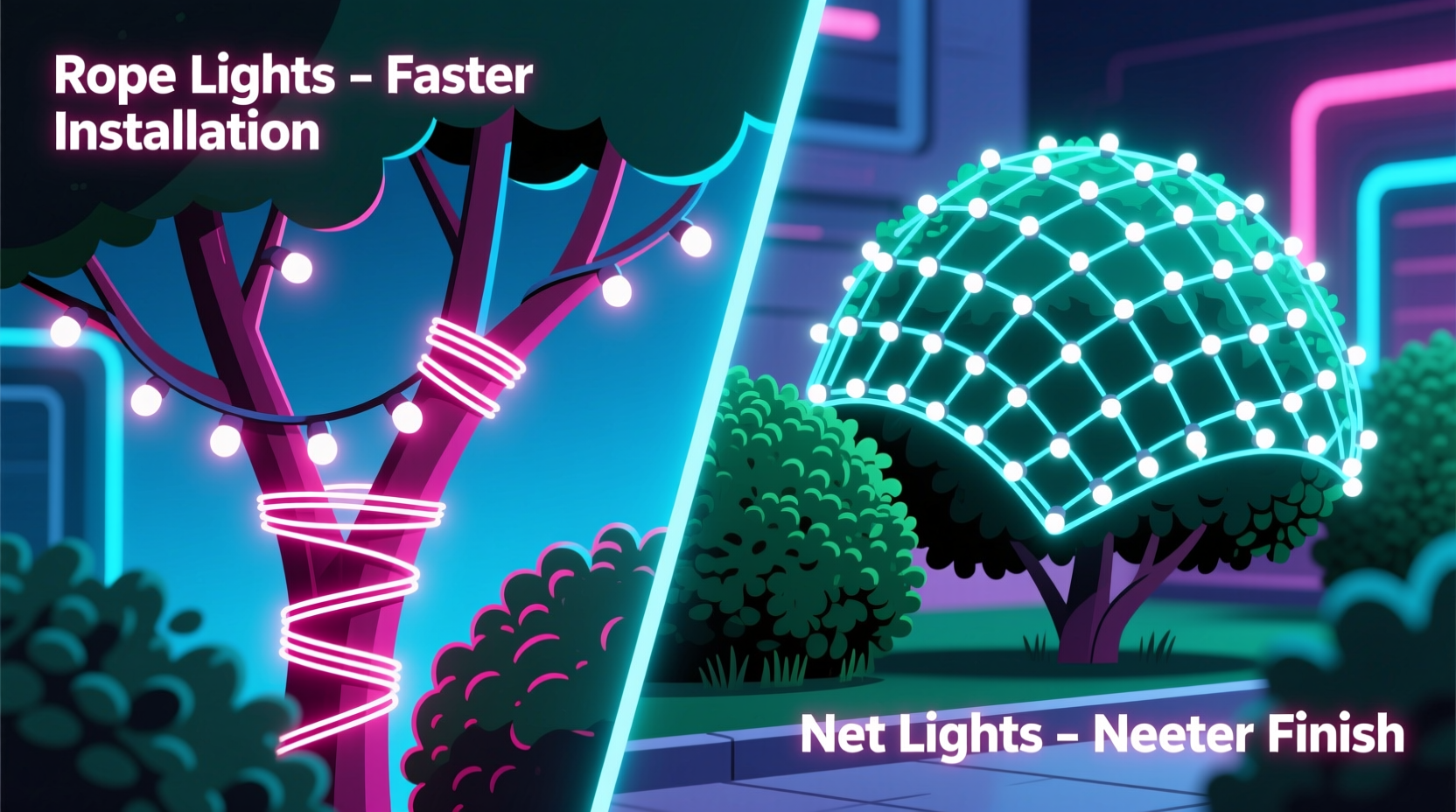
Rope lights and net lights serve similar purposes but are constructed differently, leading to distinct performance characteristics when used on shrubs and bushes.
Rope lights consist of small LED bulbs encased in a continuous, flexible plastic tube, forming a linear strand. They come in straight runs—typically 25 to 100 feet—and must be manually wrapped around foliage. Their rigid casing provides protection from weather and physical damage, making them durable for long-term use.
Net lights, on the other hand, are arranged in a grid-like pattern resembling fishing nets. Individual strands of lights form square or diamond-shaped cells, allowing the entire sheet to drape over bushes like a blanket. Most net lights range from 4x6 feet to 6x9 feet, designed specifically for quick coverage of wide areas such as hedges, trees, and foundation plantings.
The structural difference is fundamental: rope lights require active wrapping, while net lights rely on passive draping. This distinction directly influences how fast each type installs and how uniformly they light up dense vegetation.
Installation Speed: Which Gets the Job Done Faster?
Time is often a critical factor during seasonal decorating, especially when managing multiple bushes across a property. The installation process for each lighting type varies dramatically.
With **rope lights**, installing on a medium-sized bush typically involves securing the starting end with clips or twist ties, then spiraling upward in a corkscrew motion around the branches. Thicker or irregularly shaped bushes may require backtracking, adjusting tension, and hiding gaps where foliage blocks visibility. A single 25-foot rope light might take 10–15 minutes per bush, depending on density and user experience.
In contrast, **net lights** drastically reduce labor. Once unrolled, they are simply tossed or draped over the bush and adjusted slightly to conform to its shape. For standard-sized shrubs (3–5 feet tall), full coverage takes under three minutes. Larger installations using multiple panels connected via plug-and-play connectors can cover rows of bushes in rapid succession.
A side-by-side test conducted by a residential decorator in Portland, Oregon, demonstrated this disparity clearly. Covering eight boxwood shrubs along a front walkway took 92 minutes with rope lights, compared to just 23 minutes using pre-sized net lights. That’s a 75% reduction in installation time—making net lights the clear winner for speed.
Appearance and Neatness: Which Looks More Professional?
Speed means little if the result looks sloppy. Visual quality matters, particularly for homes in neighborhoods with high aesthetic standards or those participating in seasonal lighting contests.
Rope lights offer precision. When installed carefully, they create a deliberate, uniform glow that follows the contours of the bush. Because each wrap is placed intentionally, overlaps can be minimized, and dark spots avoided. However, achieving this polished look demands skill and patience. Inexperienced users often end up with uneven spacing, visible start/end points, or tangled sections near the base.
Net lights, due to their mesh design, distribute illumination more evenly across the surface. The consistent spacing of bulbs within the grid ensures there are no large dark zones, producing what many describe as a \"twinkling blanket\" effect. Since the net conforms naturally to the bush's shape, shadows are reduced, and the overall appearance tends to look fuller and more cohesive—even from a distance.
That said, net lights aren’t flawless. On very narrow or upright shrubs, excess material may hang loosely at the sides, creating an unkempt silhouette. Additionally, because the wires are exposed between bulbs, frayed edges or misaligned connections can detract from the clean finish—especially after years of storage and reuse.
“Net lights give you instant volume and even dispersion. For most homeowners, they deliver a ‘decorator-done’ look without requiring decorator-level effort.” — Marcus Lin, Landscape Lighting Designer, Seattle Outdoor Illuminations
Comparison Table: Key Features at a Glance
| Feature | Rope Lights | Net Lights |
|---|---|---|
| Installation Time (per average bush) | 10–15 minutes | 2–4 minutes |
| Coverage Style | Wraps manually around branches | Drapes over like a blanket |
| Light Distribution | Linear, customizable path | Even grid pattern |
| Best For | Tall, narrow, or sculpted bushes | Wide, rounded, or clustered shrubs |
| Storage & Reusability | Durable tubing resists kinking | Fragile wire junctions prone to breakage |
| Customization | High – can cut and cap some models | Low – fixed size and shape |
| Price Range (per unit) | $12–$30 (25–50 ft) | $15–$35 (4x6 ft panel) |
Step-by-Step Installation Guide
Whether you choose rope or net lights, following a systematic approach ensures better results and reduces frustration.
For Rope Lights:
- Measure the height and circumference of the bush to estimate needed length (rule of thumb: 1.5x vertical height).
- Secure the male plug end to a stable lower branch using a plastic zip tie or insulated hook.
- Begin wrapping from bottom to top in a spiral pattern, maintaining 4–6 inch spacing between loops.
- Use additional ties every 12–18 inches to prevent sagging.
- Conceal excess cord at the base or route it discreetly toward the power source.
- Test the lights before finalizing placement; adjust any loose or bunched sections.
For Net Lights:
- Lay the net flat and check for damaged bulbs or torn mesh.
- Drape the net over the bush starting from the top, letting it fall naturally.
- Gently stretch corners to cover thin areas and tuck edges into dense foliage.
- Secure perimeter with lawn staples or coated wire hooks every 12 inches.
- If connecting multiple panels, align connector ends upward to avoid water pooling.
- Plug in and inspect for dead zones or lopsided hanging.
Real Example: A Suburban Holiday Upgrade
Sarah Thompson, a homeowner in suburban Denver, wanted to enhance her front yard for the holidays without spending weekends on setup. Her property included six medium-sized arborvitae and four spreading junipers. Previously, she’d used rope lights, taking nearly three hours total to wrap all plants. Last season, she switched to pre-cut net lights sized 6x9 feet.
She began by measuring each bush and selecting two net sizes: 4x6 for the smaller junipers and 6x9 for the taller evergreens. With help from her teenager, she had all bushes covered in 35 minutes. “I was shocked,” Sarah said. “It looked like a professional job, and my neighbors asked who I hired.” The even spread of lights gave her yard a cohesive, magazine-worthy appearance. She now stores the nets in labeled bins and reuses them annually with minimal wear.
This case illustrates how switching from rope to net lights can transform not only appearance but also practicality—especially for busy households seeking impactful results with minimal effort.
When to Choose Rope Lights Over Net Lights
Despite the advantages of net lights, rope lights remain the superior choice in specific scenarios:
- Narrow or columnar shrubs: Plants like Sky Pencil holly or Italian cypress have little width, making net lights impractical due to excess fabric.
- Custom shaping needs: If you want lights to follow a specific design—such as outlining a topiary form—rope lights allow artistic control.
- Long-term permanent installations: Rope lights are better suited for semi-permanent outdoor setups due to sturdier construction and UV-resistant casings.
- Areas needing directional lighting: You can aim rope light wraps toward pathways or architectural features for functional illumination.
In these cases, the extra installation time pays off in precision and longevity.
Common Mistakes to Avoid
Both lighting types are simple to use, but common errors can compromise safety and appearance.
- Overlapping net lights too much: Excessive layering causes cluttered hotspots and increases energy use unnecessarily.
- Using indoor-rated lights outdoors: Always verify that product labels state “for outdoor use” to prevent short circuits or fire hazards.
- Ignoring transformer load limits: Connecting too many strands can overload circuits. Check manufacturer specifications for maximum run lengths.
- Pulling net lights too tight: Stretching the mesh distorts bulb alignment and stresses wire joints, leading to early failure.
- Leaving zip ties exposed: Trim excess tails flush to avoid snagging clothing or looking unsightly.
FAQ
Can I connect rope lights and net lights together?
Only if they share compatible connectors and voltage requirements. Most manufacturers do not support mixing types on the same circuit due to differing electrical loads. Use separate timers or outlets to operate them independently.
Which lasts longer—rope or net lights?
Rope lights generally last longer due to their protective outer jacket and fewer connection points. Well-maintained rope lights can exceed 50,000 hours of use, while net lights average 30,000–40,000 hours, depending on handling and weather exposure.
Are net lights safe for evergreen bushes?
Yes, provided they are properly secured and not pulled tightly. Lightweight netting won’t damage healthy branches. However, remove them after the season to prevent bark abrasion or snow-load stress.
Final Checklist Before You Buy
- ✅ Measure bush dimensions (height, width, depth)
- ✅ Decide whether speed (net) or customization (rope) is more important
- ✅ Confirm outdoor/wet-location rating on packaging
- ✅ Check bulb spacing (3–6 inches ideal for dense coverage)
- ✅ Ensure adequate outlet access or plan for extension cords
- ✅ Purchase spare fuses and connectors for long-term maintenance
Conclusion
Choosing between rope lights and net lights for covering bushes ultimately depends on your priorities. If installation speed and effortless elegance are paramount, net lights deliver unmatched convenience and a consistently attractive finish. They’re ideal for homeowners who value efficiency and want a professionally lit landscape without investing hours in wrapping and adjusting.
Rope lights, while slower to install, offer greater flexibility for unique shapes and long-term setups. Their durability and precise placement make them a favorite among detail-oriented decorators and landscapers.




 浙公网安备
33010002000092号
浙公网安备
33010002000092号 浙B2-20120091-4
Comments
No comments yet. Why don't you start the discussion?