
When it comes to accenting the architectural lines of your home, few lighting options are as effective or visually appealing as outlining windows and doors. Whether for seasonal decor, year-round curb appeal, or enhancing security through illumination, choosing between rope lights and string lights can dramatically affect both the look and longevity of your setup. While they may seem similar at first glance—both offer strings of small bulbs—there are critical differences in design, durability, light output, and ease of use that determine which option truly wins for window and door outlining.
This guide dives deep into the functional and aesthetic distinctions between rope lights and string lights, helping you make an informed decision based on real-world performance, not just price or availability.
Understanding the Core Differences
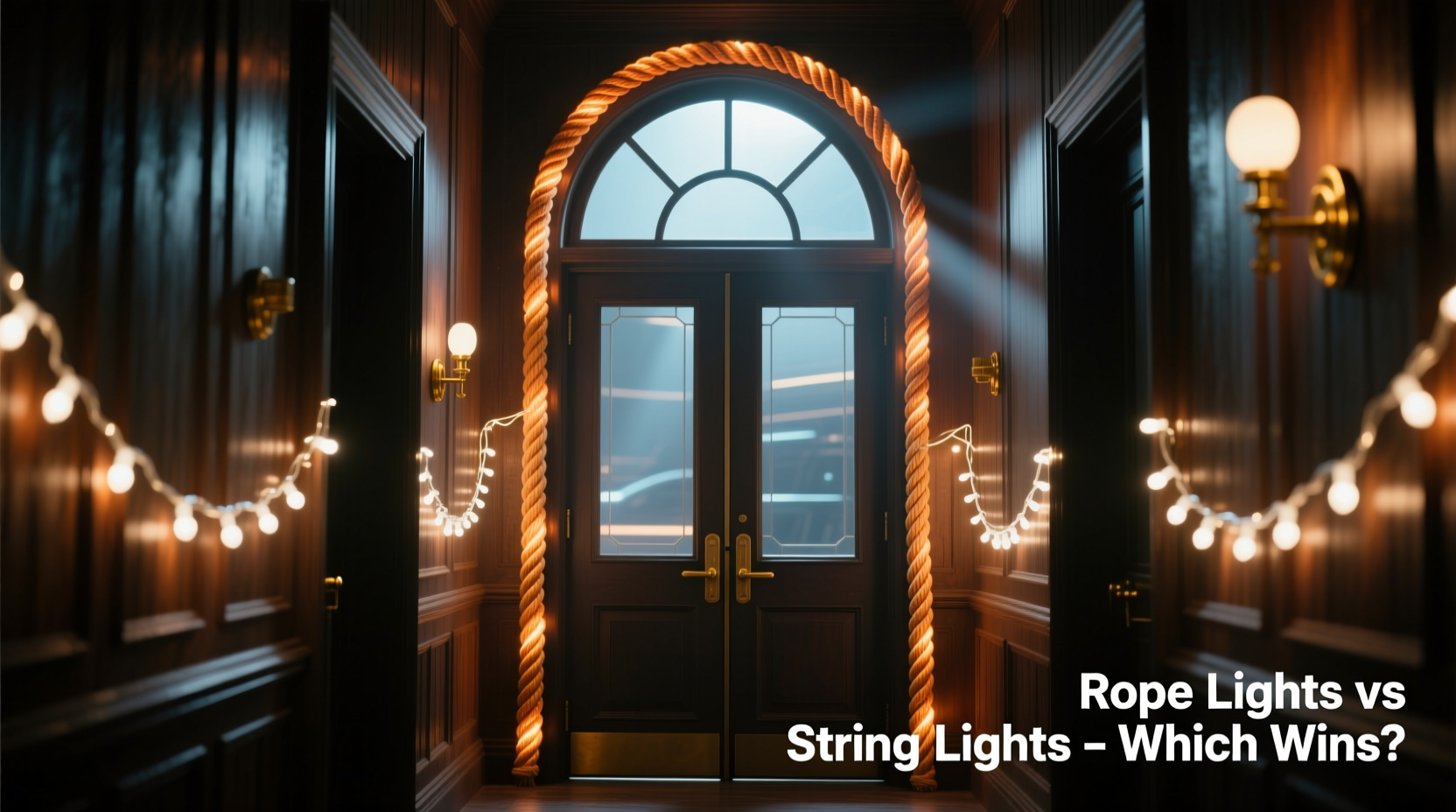
The confusion between rope lights and string lights often stems from their shared purpose: delivering ambient or decorative lighting along defined edges. However, their construction, materials, and intended applications differ significantly.
- Rope lights consist of a continuous flexible tube—usually made of PVC or silicone—housing a series of evenly spaced LED bulbs inside. The result is a smooth, diffused glow that runs the entire length of the cord.
- String lights, also known as fairy or twinkle lights, feature individual bulbs attached at intervals (typically 4 to 12 inches apart) along a thin wire. These bulbs protrude outward and emit focused points of light.
Because of these structural differences, each type performs uniquely when outlining vertical and horizontal surfaces like window frames and door trims. Rope lights create a clean, modern outline resembling neon signage, while string lights produce a whimsical, scattered sparkle more suited to draping than precise contouring.
Performance Comparison: Key Factors Evaluated
To determine the superior option for outlining, we assess five critical factors: light quality, durability, weather resistance, installation effort, and versatility.
| Factor | Rope Lights | String Lights |
|---|---|---|
| Light Uniformity | Excellent – consistent glow along entire length; ideal for sharp edges | Fair – visible gaps between bulbs; creates broken line effect |
| Durability | High – UV-resistant casing protects internal LEDs; less prone to damage | Moderate – exposed wires and sockets vulnerable to bending and moisture |
| Weather Resistance | Superior – fully sealed design; many models rated IP65 or higher | Variable – outdoor-rated versions exist but seals degrade faster |
| Installation Ease | Good – rigid yet flexible; holds shape but requires secure fasteners | Fair – floppy wires sag over time; difficult to align precisely |
| Versatility | Limited – best for linear paths; hard to customize mid-run | High – can be cut at intervals (on some models); easy to drape creatively |
The data shows a clear pattern: rope lights outperform string lights in nearly every category relevant to outlining fixed structures. Their sealed, tubular design provides consistent coverage and long-term resilience—especially important when exposed to sun, rain, and temperature swings.
“Rope lights are engineered for precision architectural lighting. If you're outlining windows or doors, especially with a permanent or semi-permanent goal, they’re the professional-grade solution.” — Marcus Tran, Residential Lighting Designer
Real-World Application: A Seasonal Home Makeover Case Study
Consider the experience of Sarah L., a homeowner in Portland, Oregon, who wanted to enhance her Craftsman-style bungalow’s exterior for winter holidays. She initially installed traditional C7 string lights around all eight window frames and two front doors using clips and zip ties.
Within three weeks, wind caused sagging in multiple sections. Bulbs near the roofline flickered due to moisture ingress, and the uneven spacing made the outlines look jagged rather than crisp. After dismantling the setup post-holiday, she invested in commercial-grade LED rope lights with adhesive backing and end caps.
During the next season, she reinstalled the rope lights. This time, the results were dramatically different. The soft, even glow traced each window perfectly, maintaining alignment without additional support in most areas. Even after four months outdoors—including heavy rains—the lights remained fully functional. She now uses them year-round, switching between warm white in winter and cool white in summer.
Sarah’s case illustrates a broader trend: homeowners who prioritize neatness and durability increasingly favor rope lights for outlining, reserving string lights for temporary displays like garlands or tree wraps.
Step-by-Step Guide to Installing Rope Lights on Windows and Doors
If you decide rope lights are the right choice, follow this proven process for clean, lasting results:
- Measure Each Frame: Use a flexible tape measure to record the perimeter of every window and door. Add 10% extra length for corners and connections.
- Choose the Right Diameter: Standard rope lights come in 8mm, 10mm, and 12mm thicknesses. For delicate window mullions, 8mm offers subtlety; for larger doors, 10–12mm provides greater visibility.
- Select Adhesive or Clip Mounting: High-quality rope lights often include peel-and-stick backing. For painted wood or vinyl, ensure the surface is clean and dry. Alternatively, use plastic mounting clips spaced every 6–8 inches.
- Route the Cord Carefully: Start at the power source. Work clockwise around the frame, gently bending the rope at 90-degree angles. Avoid kinking—bend gradually over 1–2 inches.
- Seal the Ends: Most kits include rubber end caps. Apply waterproof silicone sealant before inserting to prevent moisture entry.
- Test Before Finalizing: Plug in the lights before securing the last section. Check for dark spots or flickering.
- Conceal Wiring: Run extension cords along downspouts or under eaves. Use paintable conduit if needed to blend with siding.
When String Lights Might Still Be the Better Choice
Despite rope lights’ advantages for outlining, string lights retain value in specific scenarios:
- Temporary holiday décor: If you only display lights for a few weeks per year, string lights offer lower upfront cost and easier storage.
- Decorative accents beyond framing: Want to wrap columns, outline roof peaks, or hang from eaves? String lights provide more creative flexibility.
- Budget constraints: Entry-level string light sets start under $10, while quality rope lights average $25–$50 per 16-foot segment.
- Color-changing effects: Many string light models offer remote-controlled RGB modes, whereas rope lights typically come in single fixed colors or limited dual-tone options.
However, even in these cases, hybrid approaches work well. One strategy is to use rope lights for permanent architectural outlines and supplement with string lights for seasonal flair—such as draping icicle lights below eaves or wrapping porch railings.
Checklist: Choosing the Right Option for Your Needs
Use this checklist to finalize your decision:
- ☐ Do you want a clean, continuous line around windows/doors? → Choose rope lights.
- ☐ Will the lights stay up year-round? → Choose rope lights.
- ☐ Is weather exposure a concern (rain, snow, UV)? → Choose rope lights.
- ☐ Are you on a tight budget and only decorating seasonally? → String lights may suffice.
- ☐ Do you want dynamic color changes or twinkling effects? → Consider string lights or smart rope variants.
- ☐ Do you plan to reuse the lights for multiple purposes (trees, patios, etc.)? → String lights offer more versatility.
- ☐ Is professional appearance a priority? → Rope lights deliver superior finish.
Frequently Asked Questions
Can I cut rope lights to fit my window size?
Yes, but only at designated cut points—usually marked every 12 or 24 inches with copper pads. Cutting elsewhere will break the circuit. After cutting, always seal the end with a provided cap and silicone to maintain weather resistance.
Are rope lights brighter than string lights?
Not necessarily in total lumens, but they appear brighter for outlining because the light is continuous. A 16-foot rope light with 120 LEDs will look more substantial than a string light with 50 bulbs over the same distance due to gap-free emission.
How long do outdoor rope lights last?
High-quality LED rope lights last 30,000 to 50,000 hours—approximately 8 to 15 years with seasonal or nightly use. String lights typically last 15,000 to 25,000 hours, though individual bulb failure is more common due to environmental stress.
Conclusion: Rope Lights Win for Outlining—Here’s Why It Matters
For outlining windows and doors, rope lights are the superior choice in nearly every practical category: durability, visual consistency, weather resistance, and long-term value. They transform ordinary façades into sharply defined, inviting spaces with minimal maintenance. While string lights have their place in festive and flexible décor, they simply can’t match the precision and resilience required for architectural outlining.
The difference isn't just technical—it's perceptual. A home outlined with rope lights conveys care, permanence, and attention to detail. It stands out in the neighborhood, not for being flashy, but for looking thoughtfully finished.
If you’ve been hesitating between these two options, let function guide form. Invest in quality rope lights, install them correctly, and enjoy a cleaner, longer-lasting exterior glow that enhances your home’s character all year round.




 浙公网安备
33010002000092号
浙公网安备
33010002000092号 浙B2-20120091-4
Comments
No comments yet. Why don't you start the discussion?