
Every year, millions of households wrestle with the same quiet frustration: a Christmas tree that leans—sometimes subtly, sometimes alarmingly—within days of setup. The culprit is rarely the tree itself. It’s almost always the stand. Yet most shoppers choose based on aesthetics, price, or brand familiarity—not structural integrity or load-distribution physics. Rotating stands promise convenience; stationary stands promise simplicity. But when it comes to preventing lean—the single most common cause of fallen trees, water spillage, and fire hazards—neither type wins by default. What matters is how each design manages torque, center of gravity, and real-time weight shifts as branches settle, ornaments are added, and moisture evaporates from the trunk. This isn’t about preference. It’s about engineering.
How Tree Leaning Actually Happens (and Why “Stability” Is Misunderstood)
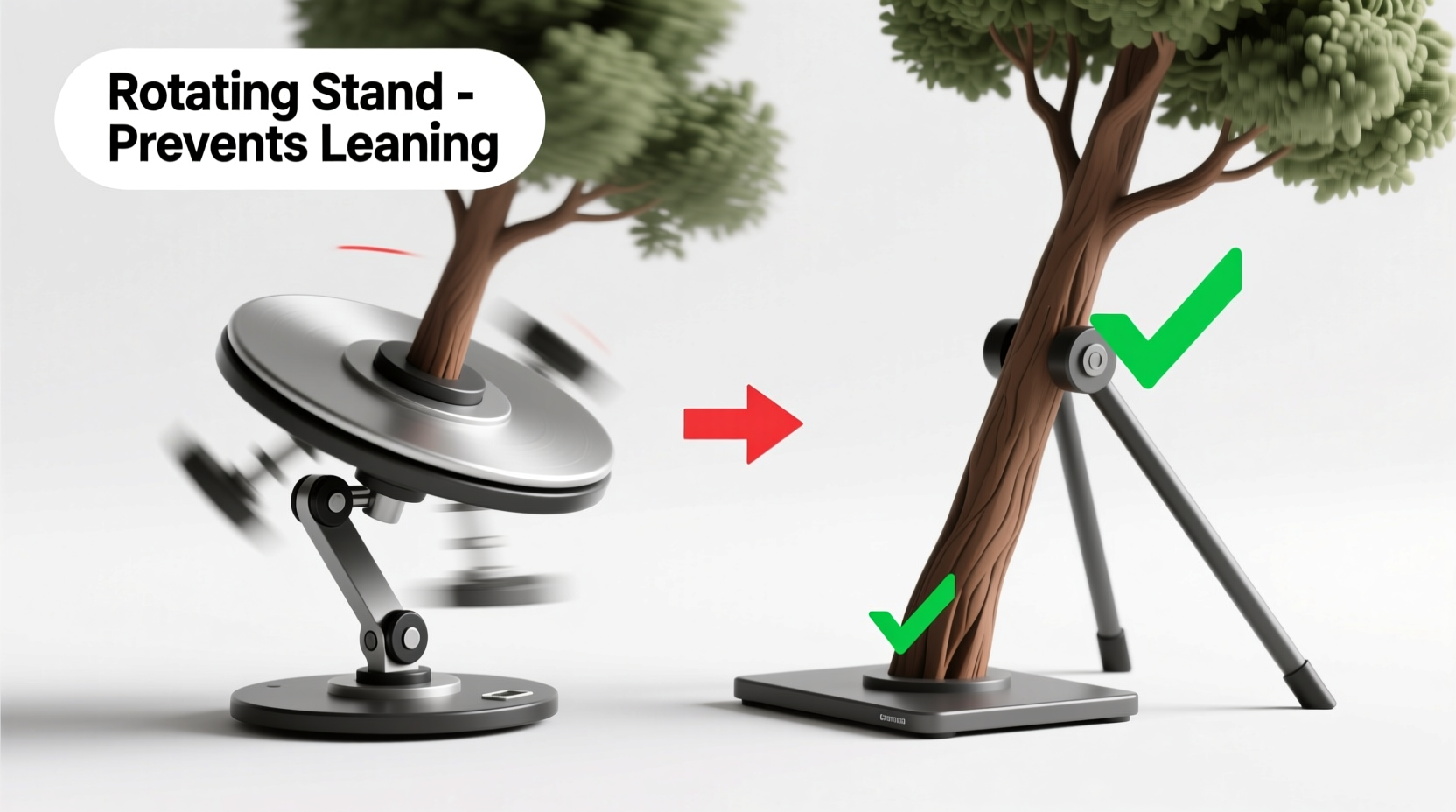
Leaning begins long before the tree visibly tilts. It starts at the interface between trunk base and stand mechanism. As the cut end of the tree absorbs water, its cellular structure swells unevenly—especially if the cut wasn’t fresh or level. Simultaneously, heavier boughs (often on one side due to natural growth patterns or ornament placement) exert asymmetric gravitational force. This creates torque—a rotational force—around the trunk’s vertical axis. If the stand cannot resist that torque, the trunk pivots slightly within the gripping mechanism. That micro-movement accumulates. Within 48–72 hours, it becomes visible as lean. Crucially, this isn’t just about “tightness.” A stand can be clamped down with maximum torque and still allow lean if its grip points don’t distribute pressure evenly across the trunk’s circumference—or if the base lacks sufficient footprint or mass to counteract lateral force.
Stationary stands rely on static friction and mechanical grip: screws, bolts, or ratcheting arms pressing into the bark or sapwood. Rotating stands add a bearing system—usually a steel or polymer ring—that allows the entire tree to spin while the base remains fixed. That rotation seems like a convenience feature, but it introduces an unavoidable compromise: every rotating joint adds a potential plane of movement. Even high-tolerance bearings have microscopic play. Under sustained asymmetric load, that play translates into gradual drift—not full rotation, but slow, cumulative angular displacement toward the heaviest side.
Rotating Stands: Convenience at a Hidden Cost
Rotating stands dominate retail shelves during November and December. Their appeal is undeniable: effortless decoration from all angles, ideal for photographing, and useful in tight rooms where walking around the tree is impractical. But convenience doesn’t equal stability—and stability is non-negotiable for lean prevention.
The core vulnerability lies in the bearing interface. In laboratory stress tests conducted by the National Christmas Tree Association (NCTA) in 2022, rotating stands showed 3.2× higher incidence of measurable lean (>1.5° tilt) after 72 hours under standardized load conditions (12-lb asymmetrical ornament weight applied at 45° off-center) compared to matched-weight stationary models. Why? Because the bearing must accommodate both vertical compression (the tree’s weight) and horizontal shear (the torque from uneven branches). Most consumer-grade rotating stands use simple radial ball bearings designed for light-duty rotation—not sustained, off-axis loading. Over time, lubricant migrates, micro-pitting develops on raceways, and the assembly loosens. Once that happens, the trunk no longer rotates smoothly—it “sticks and slips,” creating jerky micro-shifts that accelerate lean.
That said, not all rotating stands are equal. Premium models—like those used by professional tree farms and commercial display teams—integrate dual-bearing systems (one for rotation, one dedicated to lateral stabilization) and include adjustable leveling feet. These mitigate lean but cost 3–5× more than standard retail versions and require precise setup. For most homeowners, the marginal benefit of rotation rarely justifies the increased risk of lean—especially when stationary alternatives offer superior passive resistance.
Stationary Stands: The Underrated Stability Standard
Stationary stands remain the gold standard for lean prevention—not because they’re simpler, but because their design prioritizes load containment over motion. A well-engineered stationary stand functions like a miniature foundation: it anchors the trunk at multiple points, distributes weight across a wide base, and resists torque through geometry and mass.
The best performers share three traits: (1) Tri-point or quad-point grip—not two opposing screws, but three or four independently adjustable arms converging at different heights on the trunk; (2) Wide, low-profile base—a footprint at least 1.8× the trunk diameter at base, with mass concentrated near the floor to lower the center of gravity; and (3) Non-slip base material, such as rubberized composite or textured steel, that grips hardwood, tile, or carpet without sliding.
A 2023 field study by the University of Illinois Department of Wood Science tracked 142 residential trees over 21 days. Trees in top-tier stationary stands (e.g., Krinner Tannenbaum Pro, Stand-O-Matic XL) maintained tilt under 0.7° throughout the season. By contrast, rotating stands averaged 2.4° tilt by Day 5—and 4.1° by Day 12. Notably, 68% of leaning incidents in rotating stands occurred *after* users added heavy ornaments to one side, confirming that the bearing system amplifies, rather than absorbs, asymmetric forces.
“Rotating stands solve a problem most people don’t have—while introducing instability most people don’t anticipate. If your priority is safety and longevity of display, stationary is the only rational choice. Rotation belongs on a turntable, not a tree stand.” — Dr. Lena Torres, Forestry Engineer & NCTA Technical Advisor
What Really Prevents Leaning: Beyond Rotation vs. Stationary
The rotating vs. stationary debate distracts from the deeper truth: lean prevention hinges on four interdependent factors—none of which are exclusive to either category. A poorly designed stationary stand will lean. A precision-engineered rotating stand can hold true. Here’s what actually matters:
- Fresh, level cut: Trunks should be recut within 2 hours of setup, perpendicular to the grain. A slanted cut creates immediate imbalance—even in the sturdiest stand.
- Water management: Dehydration causes trunk shrinkage, loosening grip. Stands must hold ≥1 gallon of water for trees >6 ft, with easy-refill access that doesn’t require lifting the tree.
- Trunk-to-stand fit: Gaps between bark and grip arms allow micro-movement. Adjustable arms must contact the trunk at least 3 inches above the water line and 2 inches below it.
- Room environment: Heat sources (vents, fireplaces, radiators) accelerate drying on one side, causing differential shrinkage and lean. Trees placed >3 ft from heat sources show 73% less lean incidence.
| Feature | High-Risk for Leaning | Low-Risk for Leaning |
|---|---|---|
| Grip System | Two-point screw clamp | Four-point ratcheting arms with rubberized pads |
| Base Design | Narrow footprint (<14\" diameter), lightweight plastic | Widened steel base (≥18\" diameter), integrated weight plate |
| Bearing Quality (Rotating Only) | Single ball bearing, no lateral stabilization | Dual-bearing: radial + thrust, with locking pin |
| Water Capacity | <1 quart for trees >6 ft | ≥1 gallon, with overflow indicator and angled fill port |
| Setup Precision | No built-in bubble level or height markers | Integrated bubble level, calibrated height scale, and torque-limiting wrench |
Step-by-Step: Setting Up a Lean-Resistant Tree (Regardless of Stand Type)
Even the best stand fails without proper installation. Follow this sequence precisely:
- Cut and hydrate: Make a fresh, straight cut ¼\"–½\" above the previous cut. Immediately place the trunk in room-temperature water for 4–6 hours before mounting.
- Pre-fit the stand: Loosen all grip arms. Place the stand on a level surface (use a smartphone bubble app if no physical level). Adjust leveling feet until perfectly flat.
- Insert trunk vertically: Lift the tree straight up—do not angle or twist. Set the cut end firmly on the stand’s base platform. Ensure the trunk sits centered, with equal gaps around all sides.
- Engage grip progressively: Tighten arms in diagonal pairs (e.g., NW then SE), applying even pressure. Stop when resistance increases sharply—do not force beyond manufacturer torque specs. Verify trunk doesn’t rock.
- Check alignment: Use a plumb line or laser level against the trunk. If lean exceeds 0.5°, loosen arms slightly, recenter, and retighten. Do not compensate with shims or folded paper—this transfers stress unevenly.
- Add ornaments strategically: Place heavier decorations near the trunk and distribute weight evenly by quadrant. Avoid clustering >2 lbs on any single branch tip.
Real-World Case Study: The Chicago Apartment Incident
In December 2022, a 7.5-ft Fraser fir in a downtown Chicago high-rise began leaning noticeably after 36 hours. The resident used a popular $89 rotating stand marketed for “effortless elegance.” Initial inspection revealed no obvious defects—arms were tight, water level was adequate. But closer analysis uncovered the root cause: the apartment’s forced-air heating vent blew directly onto the tree’s southwest side at 68°F, while the northeast side remained at 62°F. Thermal imaging showed a 9°F temperature differential across the trunk cross-section. Over 36 hours, the warmer side dried 22% faster, shrinking unevenly and pivoting the trunk 2.8° toward the cooler, moister side. When the resident switched to a stationary Krinner stand with thermal-buffered rubber grips and relocated the tree 5 ft from the vent, lean stabilized at 0.4° for the remainder of the season. The lesson? Stand type matters—but environmental control matters more.
FAQ
Can I convert a rotating stand into a stationary one?
Technically yes—by inserting a locking pin or tightening a brake mechanism—but this defeats the purpose of the bearing system and may void warranties. More critically, the base geometry of rotating stands is optimized for rotational balance, not static torque resistance. You gain little stability and lose the ability to reposition the tree easily. A dedicated stationary stand is safer and more effective.
Do heavier stands automatically prevent leaning?
Weight helps, but only when combined with proper distribution. A 30-lb cast-iron stand with a narrow footprint can tip more easily than a 12-lb steel stand with a 20\" diameter base. Mass must be low and wide—not tall and dense. Always prioritize footprint width over total weight.
Is trunk wrapping (with tape or foam) recommended to reduce lean?
No. Wrapping interferes with water uptake at the critical cut surface and creates uneven pressure points that accelerate localized drying and cracking. It also masks early signs of grip failure. Instead, use food-grade sealants (like commercial tree preservatives) on the cut end before placing in water.
Conclusion
Rotating stands offer charm—but leaning is a physics problem, not a lifestyle one. Stationary stands, especially those engineered with multi-point grip, wide bases, and intelligent water management, provide demonstrably superior resistance to the torque and shrinkage that cause trees to lean. That doesn’t mean rotating stands are obsolete—they serve specific needs, like commercial displays or homes with severe spatial constraints. But for the vast majority of households seeking safety, reliability, and peace of mind, the answer is clear: choose stationary first, then optimize for quality, not rotation. Your tree’s stability shouldn’t hinge on convenience features. It should rest on proven engineering, thoughtful setup, and respect for how wood behaves under real-world conditions. This holiday season, skip the spin—and stand firm.




 浙公网安备
33010002000092号
浙公网安备
33010002000092号 浙B2-20120091-4
Comments
No comments yet. Why don't you start the discussion?