
Royal Enfield has redefined the mid-capacity motorcycle segment in India with its new generation of engines and purpose-built platforms. The Himalayan 450 and Scram 411 are two standout models born from this evolution—each powered by a modern, liquid-cooled engine but tailored for different kinds of riders. On paper, the Himalayan 450 edges out the Scram 411 in peak power and top speed. But does that difference translate into meaningful advantages on Indian roads? For most riders, the answer might surprise you.
This isn’t just about numbers; it’s about context. Real-world riding conditions—traffic, terrain, comfort, and intended use—often make raw performance metrics less relevant than how a bike feels and functions day-to-day.
Power and Performance: Breaking Down the Numbers
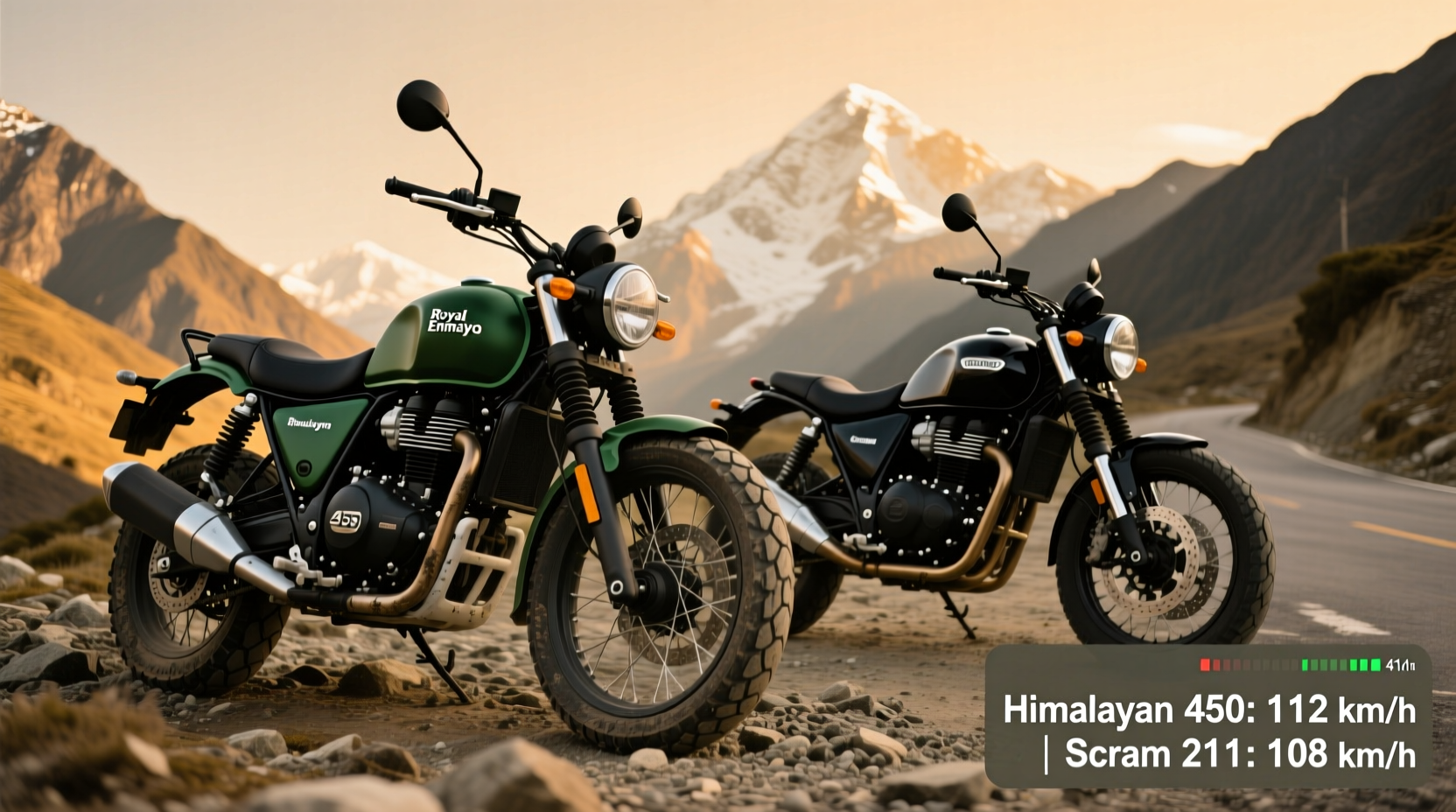
The Himalayan 450 produces 40 bhp and 40 Nm of torque, while the Scram 411 delivers 39.3 bhp and 38.5 Nm. On the surface, the difference seems negligible, but the Himalayan’s slightly higher output translates to a claimed top speed of around 148 km/h compared to the Scram’s 140 km/h. That’s an 8 km/h gap—enough to show up on a spec sheet, but barely noticeable in practice.
Both bikes use a 452cc SOHC single-cylinder engine developed in-house by Royal Enfield, featuring ride-by-wire throttle, switchable riding modes (Urban, Rain, Off-Road), and a six-speed gearbox. The tuning, however, differs subtly to suit their roles. The Himalayan prioritizes low-end grunt and mid-range pull for off-road responsiveness, while the Scram is tuned for smooth, accessible power delivery in city environments.
Real-World Riding: Where Speed Takes a Backseat
In India, few riders consistently operate motorcycles at or near their top speeds. National highways often have speed limits between 80–100 km/h, and rural roads are frequently interrupted by traffic, animals, and potholes. Even on open stretches, sustained high-speed cruising demands focus, fatigue management, and ideal road conditions—rarely the norm.
For the average rider, what matters more is how quickly a bike reaches 60–80 km/h—the typical overtaking range—and how stable it feels at 90–100 km/h during highway runs. Both the Himalayan 450 and Scram 411 excel here. They hit 80 km/h effortlessly in third gear and maintain 100 km/h comfortably without vibration or wind buffeting.
A rider commuting from Pune to Lonavala (about 80 km) shared his experience: “I’ve ridden both bikes on that route. The Himalayan felt slightly more planted at 110 km/h, but honestly, the Scram was just as capable. I didn’t feel limited at all.” This echoes a broader trend—real satisfaction comes from predictability, not peak velocity.
“Top speed is a headline number, but real-world confidence comes from balance—handling, visibility, and control.” — Arvind Mehta, Motorcycle Journalist & Long-Distance Rider
Comparative Analysis: Himalayan 450 vs Scram 411
| Feature | Himalayan 450 | Scram 411 |
|---|---|---|
| Engine | 452cc, liquid-cooled, single | 452cc, liquid-cooled, single |
| Power | 40 bhp @ 8000 rpm | 39.3 bhp @ 7500 rpm |
| Torque | 40 Nm @ 5500 rpm | 38.5 Nm @ 5500 rpm |
| Top Speed (Claimed) | ~148 km/h | ~140 km/h |
| Seat Height | 825 mm | 805 mm |
| Weight (kerb) | 188 kg | 182 kg |
| Tyre Type | Tubeless dual-purpose | Tubeless street-focused |
| Suspension Travel | 150mm front/rear | 130mm front/rear |
| Primary Use Case | Adventure touring, light off-road | Urban riding, weekend getaways |
The data shows that while the Himalayan holds a slight edge in performance, the Scram 411 compensates with lighter weight, lower seat height, and sharper urban agility. These factors often outweigh a marginal gain in top speed for city-based riders.
When Top Speed Actually Matters
There are scenarios where higher top speed can be beneficial, though they’re niche:
- Long intercity highway travel: Riders covering distances like Delhi to Jaipur or Bengaluru to Mysore may appreciate the extra 8 km/h for smoother overtaking and reduced journey time.
- High-altitude routes: On mountain passes like Rohtang or Sela, where thin air reduces engine efficiency, the Himalayan’s stronger mid-range helps maintain momentum.
- Two-up touring: With a pillion and luggage, the extra torque reserve gives better hill-climbing ability and stability at higher speeds.
But even in these cases, the difference remains subtle. As one Himalayan owner noted after a Leh trip: “The bike felt capable, but I rarely went above 100 km/h. It’s the suspension and ground clearance that saved me on broken roads, not the top speed.”
Choosing Based on Purpose, Not Peak Numbers
Selecting between the Himalayan 450 and Scram 411 should hinge on lifestyle, not specs. Ask yourself:
- Do you ride mostly in cities or on mixed terrain?
- Do you plan weekend adventures or daily commutes?
- Is off-road capability or comfort more important?
- How much luggage do you typically carry?
If your answer leans toward urban mobility, quick errands, and stylish weekend rides, the Scram 411’s lower seat, relaxed ergonomics, and retro-modern design make it the better fit—even with slightly less top speed.
If you dream of Himalayan trails, monsoon rides on gravel, or solo expeditions across Rajasthan’s desert tracks, the Himalayan 450’s longer suspension, taller gearing, and rugged stance justify its existence beyond just speed figures.
Frequently Asked Questions
Is the Himalayan 450 significantly faster than the Scram 411?
No. While the Himalayan has a higher claimed top speed (148 km/h vs 140 km/h), the real-world difference is minimal. Both bikes perform similarly in everyday riding, especially in the 60–100 km/h range where most overtaking happens.
Can the Scram 411 keep up on highways?
Absolutely. The Scram 411 cruises comfortably at 90–110 km/h with minimal vibration. Its engine is well-tuned for sustained highway runs, and the upright seating position enhances long-distance comfort.
Does the top speed affect fuel efficiency?
Yes, but only at sustained high speeds. Both bikes return similar fuel economy—around 28–32 km/l—under normal riding. However, consistently riding above 110 km/h reduces efficiency due to increased wind resistance.
Conclusion: Speed Isn’t the Story—Purpose Is
The Royal Enfield Himalayan 450 and Scram 411 represent two distinct philosophies within the same engineering framework. One is built for exploration, the other for expression. The 8 km/h difference in top speed is real, but irrelevant for the vast majority of riders navigating Indian roads.
What truly defines your experience is how the bike fits your life—its comfort, versatility, and emotional appeal. The Himalayan invites you to go farther, off the map. The Scram encourages you to enjoy the ride, wherever it leads.
Instead of chasing numbers, focus on what each machine enables. Whether you're carving coastal highways or tackling forest trails, the right choice isn't the faster bike—it's the one that matches your journey.




 浙公网安备
33010002000092号
浙公网安备
33010002000092号 浙B2-20120091-4
Comments
No comments yet. Why don't you start the discussion?