
Choosing between AMD’s Radeon RX 7800 XT and NVIDIA’s GeForce RTX 4070 is one of the most debated decisions in mid-to-high-end PC gaming today. Both cards deliver strong 1440p performance and competitive frame rates in modern titles, but they approach gaming differently—especially when it comes to ray tracing. The RTX 4070 carries a higher price tag, largely due to NVIDIA’s superior ray tracing implementation and AI-powered DLSS upscaling. But is that premium justified? For many gamers, the answer depends on how much they value visual fidelity versus raw performance and value.
This comparison dives deep into real-world performance, power efficiency, feature sets, and long-term value to help you decide whether the extra cost of NVIDIA’s ray tracing ecosystem is truly worth it—or if AMD’s brute-force rasterization advantage offers better bang for your buck.
Performance at 1440p: Raw Speed vs Visual Fidelity
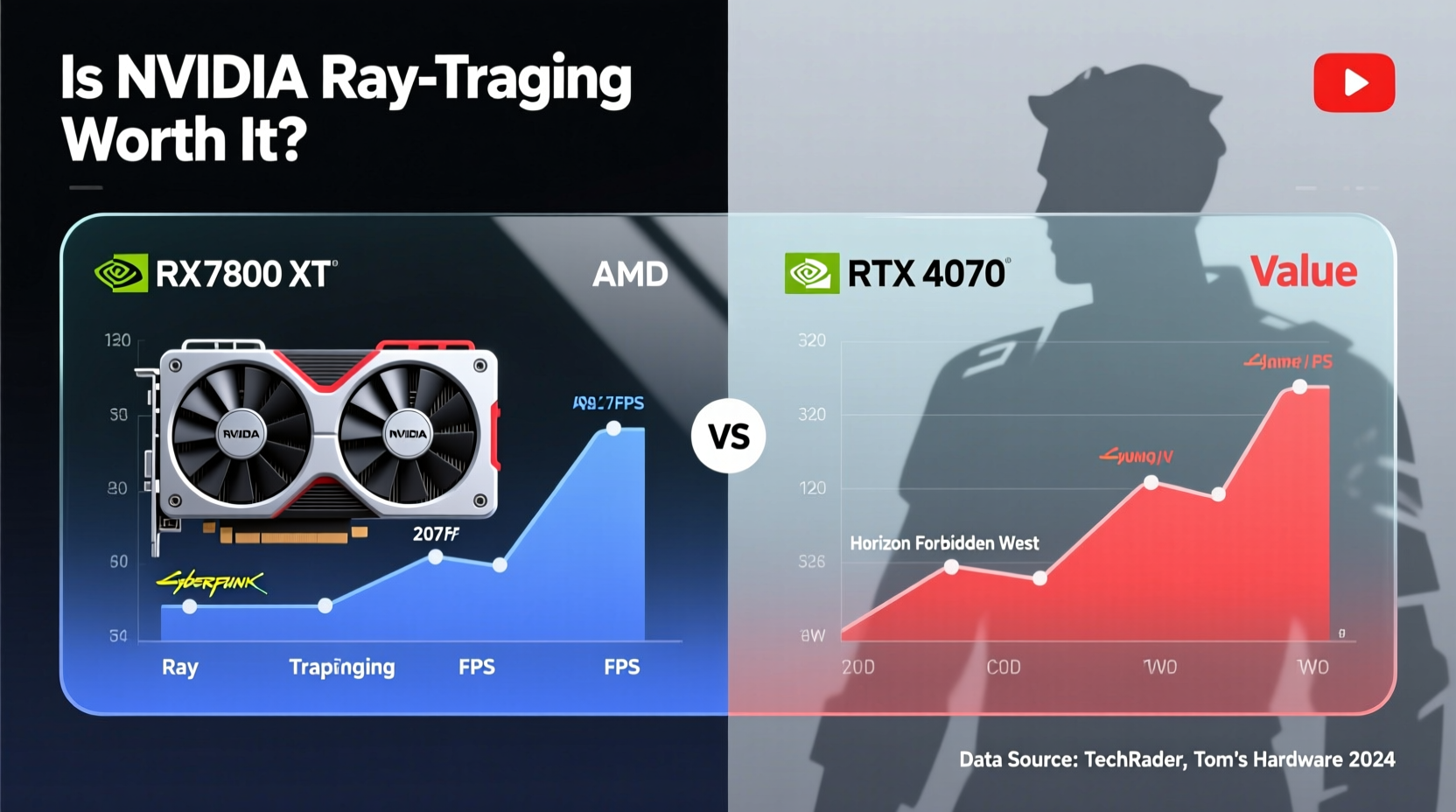
The RX 7800 XT and RTX 4070 are both positioned as high-refresh 1440p GPUs. In traditional rasterization—where lighting and shadows are faked using pre-calculated effects—the 7800 XT typically outperforms the 4070 by 10–15% in most AAA titles. This edge comes from AMD’s more aggressive memory bandwidth (256-bit, 384 GB/s) and higher compute unit count (60 CUs vs 46 SMs), giving it an advantage in GPU-intensive workloads without ray tracing enabled.
However, the gap narrows—and often reverses—when ray tracing is enabled. NVIDIA’s dedicated RT cores and tighter integration with game engines allow the RTX 4070 to maintain playable frame rates even in heavily ray-traced scenes. In games like Cyberpunk 2077, Alan Wake 2, and Resident Evil Village, the 4070 frequently matches or exceeds the 7800 XT’s performance when path tracing or full RT modes are active.
Ray Tracing: NVIDIA’s Defining Advantage
Ray tracing simulates the physical behavior of light, creating realistic reflections, shadows, and global illumination. While AMD has made strides with RDNA 3, NVIDIA still holds a significant lead in ray tracing efficiency. The RTX 4070 features third-gen RT cores and fourth-gen Tensor cores, enabling faster ray intersection calculations and AI-assisted rendering.
In practical terms, this means:
- Better reflection quality in puddles, windows, and metallic surfaces.
- More accurate shadow softening and ambient occlusion.
- Smoother performance drops when RT is enabled—often staying above 60 FPS with DLSS.
AMD’s ray tracing, while functional, often requires lowering settings significantly to maintain smooth gameplay. In Control with RT Ultra, the 7800 XT can dip below 50 FPS at 1440p, whereas the 4070 maintains ~65 FPS with DLSS Balanced.
“NVIDIA’s multi-year head start in ray tracing hardware and software integration gives them a clear edge in realism and performance under load.” — Mark Serrels, Senior Editor, CNET
Upscaling Technology: DLSS vs FSR
With ray tracing demanding so much from modern GPUs, upscaling technologies like DLSS and FSR are essential for maintaining high frame rates. This is where the divide between the two cards becomes most apparent.
NVIDIA’s DLSS 3 (available on RTX 40-series) includes Frame Generation—a feature that creates entirely new frames using AI, effectively boosting performance by 40–70% in supported titles. Even DLSS 2, which only does spatial upscaling, consistently delivers sharper image quality than AMD’s FSR 2/3 at equivalent settings.
FSR is open-source and works across both AMD and NVIDIA hardware, but its quality varies more between games. FSR 3’s Frame Generation is promising but lags behind DLSS in responsiveness and artifact handling. Input lag can increase noticeably, especially in fast-paced shooters.
| Feature | RTX 4070 | RX 7800 XT |
|---|---|---|
| Native 1440p Performance | Strong | Stronger (10–15% faster) |
| Ray Tracing Performance | Excellent | Moderate (requires FSR) |
| Upscaling Tech | DLSS 3 (Frame Gen + AI) | FSR 3 (Open, but less refined) |
| VRAM | 12GB GDDR6X | 16GB GDDR6 |
| Power Consumption | 200W TDP | 263W TDP |
| Price (MSRP) | $599 | $499 |
Real-World Example: Building a Future-Proof Gaming Rig
Consider Alex, a gamer building a new system focused on 1440p 144Hz gaming. He plays a mix of competitive shooters and story-driven RPGs, some of which support ray tracing. His budget allows for either card, but he wants longevity.
He initially leans toward the RX 7800 XT for its higher VRAM and lower price. It handles Call of Duty: Modern Warfare III and Elden Ring effortlessly at max settings. However, when he tries Alan Wake 2 with full ray tracing, performance drops to 48 FPS. Enabling FSR helps, but image clarity suffers.
After testing a friend’s RTX 4070 setup, Alex sees the same game running at 63 FPS with DLSS Performance and nearly identical visuals. The difference in smoothness and immersion convinces him that the $100 premium is worth it for titles that leverage NVIDIA’s full stack.
Alex ultimately chooses the 4070—not just for today’s games, but for the growing number of RT-heavy titles expected over the next three years.
Power Efficiency and System Impact
Efficiency matters beyond just electricity bills—it affects noise levels, heat output, and PSU requirements.
The RTX 4070 draws just 200 watts under load, making it compatible with 650W PSUs and allowing for quieter cooling solutions. Its GDDR6X memory is faster but less efficient than the 7800 XT’s 16GB of standard GDDR6, though the latter’s wider bus compensates.
The RX 7800 XT, while powerful, demands 263W and benefits from a 750W+ PSU. Its dual-fan designs often run louder under sustained loads, especially in small cases. However, the extra 4GB of VRAM provides breathing room for texture-heavy games and future titles expected to push past 12GB usage.
Future-Proofing: What Matters Most?
When evaluating long-term value, consider these factors:
- VRAM Capacity: The 7800 XT’s 16GB gives it an edge in upcoming titles like Fable and Avowed, which may require more than 12GB at ultra settings.
- Ray Tracing Adoption: More developers are integrating RT as a core feature. Games like Black Myth: Wukong and remasters of older franchises now include optional RT modes.
- Driver & Software Support: NVIDIA’s Game Ready drivers are updated more frequently and offer better optimization for new releases.
- AI Features: Beyond DLSS, NVIDIA offers Broadcast (for streaming), ShadowPlay, and Reflex (reduced latency), adding utility beyond gaming.
AMD counters with open standards and strong Linux support, appealing to modders and open-source enthusiasts. But for mainstream users, NVIDIA’s ecosystem remains more polished and widely adopted.
Checklist: Choosing the Right GPU for You
- ✅ Do you prioritize maximum frame rates in non-RT games? → RX 7800 XT
- ✅ Do you want the best ray tracing experience with minimal performance loss? → RTX 4070
- ✅ Are you on a tight budget and need the lowest price for high 1440p performance? → 7800 XT
- ✅ Do you plan to play RT-heavy games or future-proof for path tracing? → 4070
- ✅ Do you stream or use creative apps (e.g., Blender, DaVinci Resolve)? → 4070 (better NVENC encoder)
- ✅ Is power efficiency and low heat important in your build? → 4070
FAQ
Is DLSS better than FSR?
Yes, in most cases. DLSS generally produces sharper images and integrates more seamlessly with games. DLSS 3’s Frame Generation is also more responsive and less prone to artifacts than FSR 3’s equivalent. However, FSR is gaining ground and offers broader hardware compatibility.
Can the RX 7800 XT handle ray tracing at all?
Absolutely—but with caveats. In games with moderate RT effects, the 7800 XT performs well when paired with FSR. However, in demanding RT titles like Cyberpunk 2077: Overdrive Mode, performance falls below playable levels without aggressive upscaling.
Does the RTX 4070’s 12GB VRAM limit its lifespan?
Potentially. While 12GB is sufficient for now, several 2024–2025 titles are already approaching that limit at max settings. The 7800 XT’s 16GB provides a buffer, especially for modded games or high-resolution textures.
Final Verdict: Is NVIDIA’s Ray Tracing Worth the Extra Cost?
The answer hinges on your priorities. If you’re a performance-first gamer who values high frame rates and doesn’t care about ray tracing, the RX 7800 XT is the smarter buy. It delivers better rasterization performance, more VRAM, and a $100 discount—all compelling advantages.
But if you care about visual immersion, play story-driven or cinematic games, or want access to NVIDIA’s mature AI-enhanced features, the RTX 4070 justifies its premium. Its superior ray tracing, DLSS 3, and overall system efficiency create a smoother, more future-ready experience—even if raw specs seem weaker on paper.
Ultimately, NVIDIA isn’t just selling a GPU; it’s selling an ecosystem. That ecosystem—built on years of developer partnerships, optimized drivers, and AI innovation—adds tangible value that AMD is still catching up to.
“The difference between these cards isn’t just specs—it’s philosophy. AMD bets on raw power. NVIDIA bets on smart rendering. Your choice depends on which future you want.” — Linus Sebastian, Tech Educator
Take Action: Make Your Choice Count
Don’t just follow benchmarks—think about how you play. Try demo versions of RT-heavy games. Test DLSS and FSR in your favorite titles. Consider your monitor’s capabilities and your willingness to adopt emerging tech.
Whether you go with the value-driven RX 7800 XT or the feature-rich RTX 4070, you’re getting a top-tier 1440p GPU. But understanding what each card excels at ensures you’re not paying for features you won’t use—or missing out on ones that could transform your gaming experience.




 浙公网安备
33010002000092号
浙公网安备
33010002000092号 浙B2-20120091-4
Comments
No comments yet. Why don't you start the discussion?