
Choosing between the Samsung Galaxy S20 FE and the S21 Plus isn't just about specs—it's about real-world value. One launched as a fan edition with flagship ambitions; the other arrived as a refined mid-tier powerhouse. Both devices occupy a similar price range today, especially on the resale or carrier upgrade market. So, if you're holding an S20 FE and eyeing the S21 Plus, or deciding between them secondhand, the question stands: is the upgrade truly worthwhile, or can the older model still deliver?
The answer depends on your priorities—be it camera quality, software longevity, display smoothness, or future-proofing. Let’s break down the key differences and similarities to help you make a confident decision.
Design and Build: Subtle Evolution, Same DNA
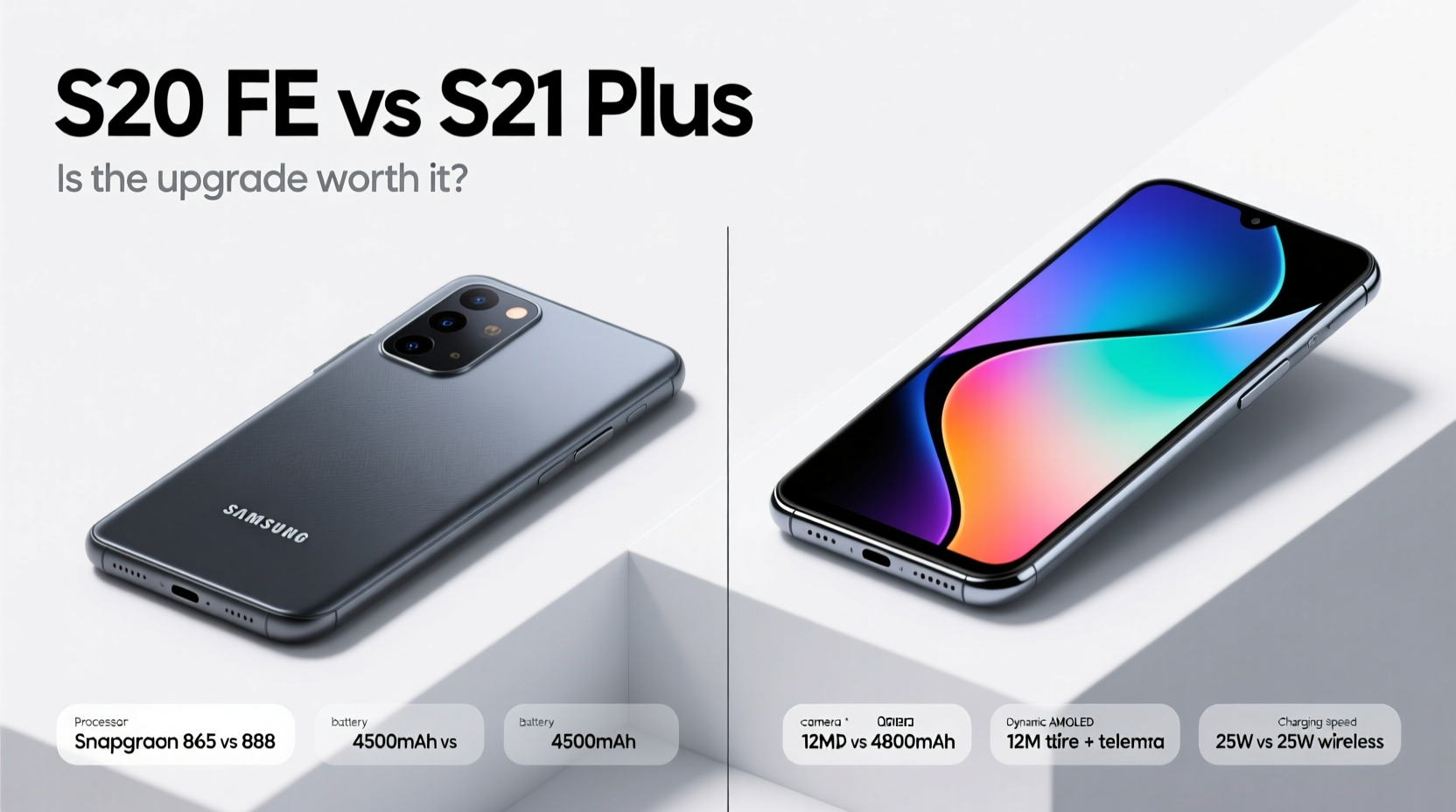
At first glance, both phones share Samsung’s modern aesthetic language. The S20 FE features a polycarbonate back with colorful finishes and a distinctive triple-camera hump. It’s lightweight at 190g and comfortable for long-term use, though the plastic build may feel less premium than glass.
The S21 Plus steps up slightly with a matte plastic finish (Glasstic) that mimics glass but resists fingerprints. It's marginally heavier at 207g and slightly larger in footprint, but both phones feature IP68 water resistance and similar button layouts. The most notable design change is the unified camera module that blends into the metal frame—a sleeker look favored by many.
Display and Performance: Smoother vs. Still Smooth Enough
The S20 FE sports a 6.5-inch Super AMOLED display with a 120Hz refresh rate—an impressive feature for its original price point. Colors are vivid, blacks are deep, and scrolling feels fluid. However, the screen brightness peaks around 800 nits, which can struggle in direct sunlight compared to newer models.
The S21 Plus improves on this with a larger 6.7-inch Dynamic AMOLED 2X panel, also at 120Hz, but with adaptive refresh rate technology (10–120Hz). This means the phone intelligently adjusts the refresh rate based on content, conserving battery without sacrificing smoothness. Peak brightness hits 1300 nits, making outdoor visibility significantly better.
Under the hood, the S20 FE uses either the Snapdragon 865 or Exynos 990 (depending on region), both capable chips for daily tasks and gaming. The S21 Plus upgrades to the Snapdragon 888 (or Exynos 2100), offering roughly 20–25% better CPU and GPU performance. For most users, the difference won’t be dramatic in everyday use, but it shows in sustained gaming, multitasking, and app launch speed.
“While the S20 FE holds up well in 2024, the S21 Plus’s adaptive display and newer chipset offer tangible benefits in efficiency and responsiveness.” — David Kim, Mobile Tech Analyst at TechPulse Weekly
Camera Comparison: Refinement Over Revolution
Both phones feature triple rear cameras, but tuning and hardware improvements make the S21 Plus the clear winner in consistency.
The S20 FE has a 12MP main sensor (f/1.8), 12MP ultra-wide (f/2.2), and an 8MP telephoto (f/2.4) with 3x optical zoom. It captures decent daylight photos and handles low light reasonably well, though dynamic range can be inconsistent.
The S21 Plus keeps the same 12MP main and 64MP telephoto (hybrid zoom up to 30x), but Samsung improved image processing. HDR handling is better, night mode is faster, and autofocus is more reliable. Video recording remains capped at 8K@24fps on both, but the S21 Plus offers better stabilization and audio focus.
In real-world use, the S21 Plus produces more balanced exposures, truer colors, and sharper details—especially in mixed lighting. Portrait mode edge detection is also more accurate.
Real Example: Weekend Photographer’s Dilemma
Consider Maya, a casual photographer who documents her travels. She upgraded from the S20 FE to the S21 Plus after noticing her sunset shots often had blown-out skies. With the S21 Plus, she found that HDR+ automatically preserved highlights without underexposing shadows. On a hike in Banff, she captured clearer wildlife shots using hybrid zoom, thanks to improved AI enhancement. While the S20 FE wasn’t bad, the S21 Plus gave her confidence to shoot more creatively.
Battery Life and Charging: Similar Endurance, Different Efficiency
The S20 FE packs a 4,500mAh battery, while the S21 Plus has a slightly larger 4,800mAh unit. In practice, both last a full day with moderate to heavy use. However, the S21 Plus benefits from a more power-efficient display and processor, translating to about 10–15% better battery life under identical conditions.
Charging speeds differ too. The S20 FE supports 25W wired and 15W wireless charging. The S21 Plus, surprisingly, ships with only 15W wired charging out of the box (though it supports 25W with compatible chargers sold separately). Wireless charging remains at 15W, and both support reverse wireless charging.
If fast charging is critical, the S20 FE actually wins here—provided you own or buy a compatible charger. Otherwise, the S21 Plus compensates with longer screen-on time.
Software and Longevity: Where the Upgrade Matters Most
This is perhaps the most decisive factor. The S21 Plus launched with Android 11 and is guaranteed up to four generations of OS updates (up to Android 15) and five years of security patches. The S20 FE, despite being a 2020 device, also received an extended update promise—but in practice, official support ends in 2024 or early 2025.
If you plan to keep your phone beyond two years, the S21 Plus offers better long-term software support, ensuring access to new features, security fixes, and app compatibility. This makes it a smarter investment for users who don’t upgrade annually.
Comparison Table: S20 FE vs S21 Plus at a Glance
| Feature | Samsung Galaxy S20 FE | Samsung Galaxy S21 Plus |
|---|---|---|
| Release Year | 2020 | 2021 |
| Display | 6.5\" FHD+ Super AMOLED, 120Hz | 6.7\" FHD+ Dynamic AMOLED 2X, Adaptive 120Hz |
| Processor | Snapdragon 865 / Exynos 990 | Snapdragon 888 / Exynos 2100 |
| Rear Cameras | 12MP (main) + 12MP (ultra-wide) + 8MP (telephoto) | 12MP (main) + 12MP (ultra-wide) + 64MP (telephoto) |
| Front Camera | 32MP | 10MP |
| Battery | 4,500mAh | 4,800mAh |
| Charging | 25W wired, 15W wireless | 15W wired (supports 25W), 15W wireless |
| Software Support | Up to Android 14 (ending 2024–2025) | Up to Android 15 (through 2026) |
| Weight | 190g | 207g |
Is Upgrading Worth It? A Practical Checklist
Ask yourself these questions before deciding:
- Are you experiencing slowdowns or app crashes on your S20 FE?
- Do you want better outdoor visibility and smoother display performance?
- Do you plan to keep your phone for more than 18 months?
- Are you frustrated with inconsistent photo quality or limited zoom?
- Have you stopped receiving major OS updates?
If you answered “yes” to two or more, upgrading to the S21 Plus is likely worth it. The improvements in display, camera processing, and software longevity add up to a noticeably better experience over time.
Frequently Asked Questions
Can the S20 FE still handle modern apps and games?
Yes. The Snapdragon 865 remains capable for most tasks, including streaming, social media, and even demanding games like Genshin Impact at medium settings. However, loading times and thermal throttling may become noticeable over extended use.
Is the S21 Plus camera significantly better in low light?
It’s not revolutionary, but yes—the S21 Plus applies more aggressive noise reduction and better HDR balancing in dark environments. Night mode activates faster and produces more natural-looking results, especially in cityscapes or indoor dim lighting.
Should I wait for a newer model instead?
If budget allows, consider the S22 or S23 series for even better efficiency, camera systems, and longer software support. But if you’re choosing strictly between the S20 FE and S21 Plus, the latter offers a meaningful upgrade at a modest price difference in the used market.
Final Verdict: Balance Value and Future Needs
The Samsung Galaxy S20 FE remains a strong device. For users on a tight budget or those who don’t need cutting-edge features, it’s still perfectly usable in 2024. Its 120Hz display, solid main camera, and large battery ensure it doesn’t feel outdated.
However, the S21 Plus delivers meaningful refinements: a brighter adaptive display, better camera processing, longer software support, and slightly superior performance. These aren’t flashy upgrades, but they contribute to a more polished, reliable experience over time.
If you can find the S21 Plus at a reasonable price—within $100–$150 of the S20 FE—it’s the smarter long-term choice. But if you already own the S20 FE and aren’t facing performance issues or update cutoffs, holding onto it is completely rational.




 浙公网安备
33010002000092号
浙公网安备
33010002000092号 浙B2-20120091-4
Comments
No comments yet. Why don't you start the discussion?