
For users still holding onto the Samsung Galaxy S20 Ultra, the arrival of the S22 Plus presents a tempting proposition. On paper, the newer model boasts improved efficiency, refined design, and next-gen software support. But does it deliver enough meaningful upgrades to justify swapping a flagship that was once at the top of its class? The answer depends on your priorities—whether you value raw power, camera versatility, longevity, or everyday usability.
The S20 Ultra launched in 2020 as a technological marvel, packing a 108MP main sensor, 100x Space Zoom, and a massive 5,000mAh battery. Fast forward to 2022, and the S22 Plus arrived with a more balanced approach: sleeker form, better efficiency, and enhanced low-light photography. While both are premium devices, the decision to upgrade isn't automatic. Let’s break down the key differences to see whether the S22 Plus truly outshines its predecessor in real-world use.
Design and Build: Smaller, Lighter, More Refined
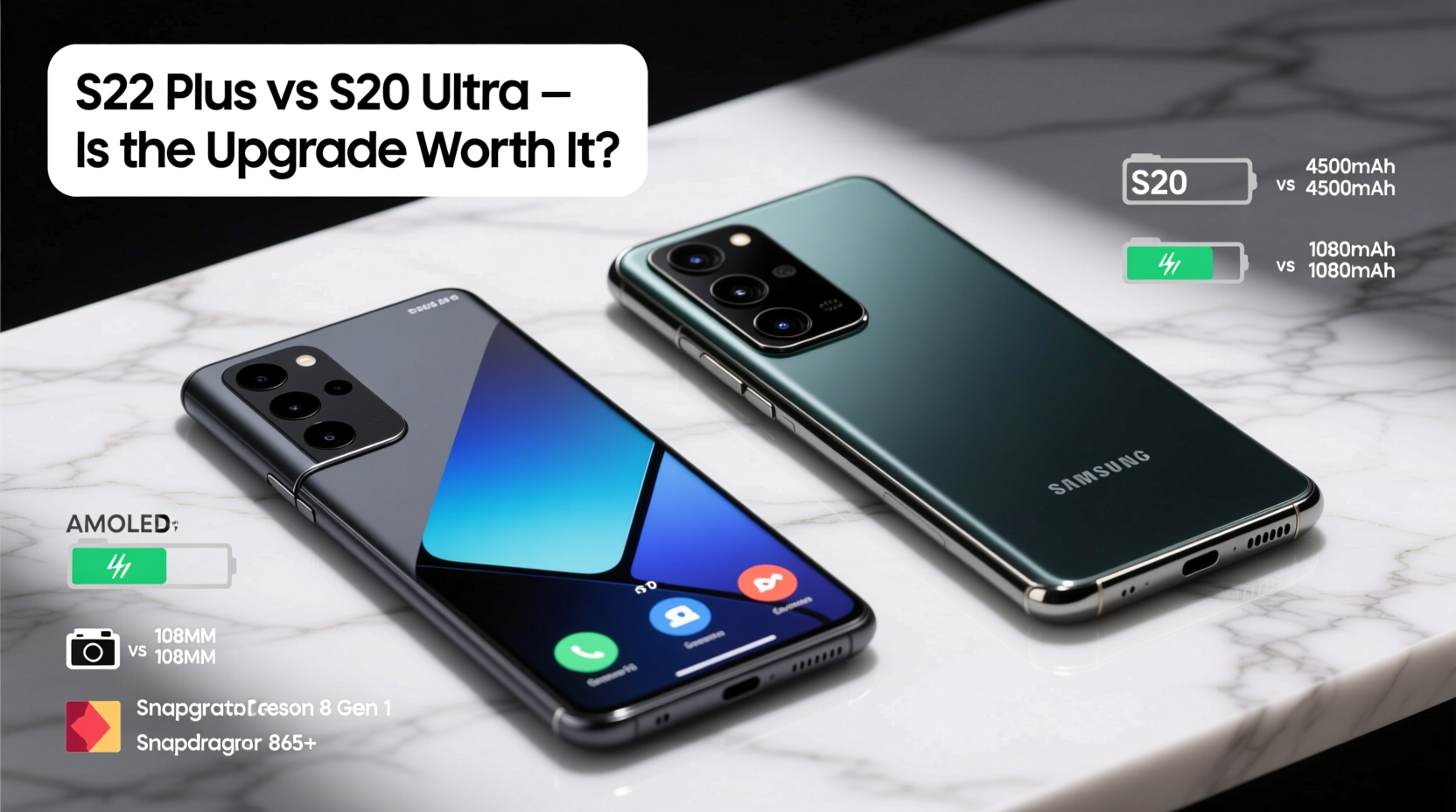
The most immediate difference between the two phones is their physical footprint. The S20 Ultra is a beast—measuring 166.9 x 76.0 x 8.8 mm and weighing 220 grams. It’s large, heavy, and can be awkward for one-handed use. In contrast, the S22 Plus measures 157.4 x 75.8 x 7.6 mm and weighs just 195 grams. That may not sound like a huge drop, but in hand, the difference is noticeable. The newer device feels more compact and balanced, especially during extended use.
Both phones feature Gorilla Glass 6 and aluminum frames, so durability remains strong. However, the S22 Plus benefits from a flatter display edge, which reduces accidental touches and improves screen protector compatibility. The S20 Ultra’s curved edges, while visually striking, were often criticized for ghost touches and fragility.
Display Quality: Brightness and Efficiency Take Center Stage
Both models feature Dynamic AMOLED 2X panels with 120Hz refresh rates and QHD+ resolution. However, the S22 Plus introduces improvements in peak brightness and adaptive refresh rate logic. The older S20 Ultra reaches up to 1,300 nits peak brightness, which was excellent for its time. The S22 Plus pushes that further to 1,750 nits, making outdoor visibility significantly better under direct sunlight.
Beyond brightness, the S22 Plus uses an updated LTPO panel that dynamically adjusts the refresh rate between 48Hz and 120Hz based on content. This results in better battery efficiency compared to the S20 Ultra, which typically runs at 60Hz or 120Hz without finer intermediate steps. For example, when scrolling through static text, the S22 Plus can drop to 48Hz, conserving energy without sacrificing smoothness.
“The shift from rigid 120Hz to variable-rate displays marks a turning point in balancing performance and battery life.” — David Kim, Mobile Display Analyst at TechInsight Group
Performance and Software: Generational Leap in Efficiency
Under the hood, the S22 Plus runs on either the Snapdragon 8 Gen 1 (U.S.) or Exynos 2200 (international), depending on region. The S20 Ultra used the Snapdragon 865. While the 865 was a powerhouse in 2020, the 8 Gen 1 delivers around 30–40% better CPU performance and nearly double the GPU performance in synthetic benchmarks.
But raw speed isn’t the full story. The newer chipset is built on a 4nm process, compared to the 7nm of the 865. This translates into better thermal management and reduced power consumption. Users upgrading from the S20 Ultra will notice faster app launches, smoother multitasking, and less heat buildup during gaming or video editing.
Software support is another critical factor. The S20 Ultra launched with Android 10 and received updates up to Android 13. Samsung has since committed to four major OS upgrades for select models. The S22 Plus launched with Android 12 and is eligible for updates up to Android 16, giving it longer security and feature support by at least two years.
Camera Comparison: Evolution Over Revolution
The S20 Ultra made headlines with its 108MP main sensor and 100x Space Zoom. While impressive on spec sheets, the extreme zoom often produced blurry, over-processed images. The S22 Plus takes a different approach—retaining a 50MP main sensor (with pixel binning to 12.5MP) but focusing on computational photography and stabilization.
In daylight, both phones capture vibrant, detailed photos. The S22 Plus edges ahead with more natural color tuning and slightly better dynamic range. Where it truly shines is in low-light conditions. Thanks to larger pixels (1.8µm vs 1.4µm effective after binning) and improved AI processing, night shots are cleaner, brighter, and retain more detail.
The telephoto systems differ significantly. The S20 Ultra features a 48MP periscope lens with 4x optical zoom and digital extension to 10x hybrid and 100x digital. The S22 Plus uses a 10MP sensor with 3x optical zoom and 30x space zoom. While the max zoom is lower, the 3x lens delivers sharper mid-range shots, and the AI-enhanced 10x zoom is more usable than the S20 Ultra’s 10x output.
Front cameras are comparable: both have 10MP sensors. The S22 Plus benefits from improved skin tone rendering and better HDR handling in backlit selfies.
Camera Feature Comparison
| Feature | S20 Ultra | S22 Plus |
|---|---|---|
| Main Sensor | 108MP (f/1.8) | 50MP (f/1.8) |
| Telephoto | 48MP periscope (4x optical) | 10MP (3x optical) |
| Ultra-Wide | 12MP (f/2.2) | 12MP (f/2.2) |
| Max Zoom | 100x digital | 30x space zoom |
| Low-Light Performance | Good | Excellent (improved Night Mode) |
Battery Life and Charging: Less Capacity, Better Efficiency
The S20 Ultra packs a 5,000mAh battery—the largest in any S-series at the time. The S22 Plus has a slightly smaller 4,500mAh cell. Yet, in real-world usage, battery life is remarkably similar due to the efficiency gains from the newer processor and display.
On average, both phones last a full day with moderate to heavy use. However, the S22 Plus tends to maintain performance longer over time thanks to better thermal control. The older S20 Ultra, especially on later software versions, can experience throttling during prolonged tasks.
Charging speeds remain identical: 25W wired, 15W wireless, and reverse wireless charging. Neither includes a charger in the box. However, the S22 Plus supports USB Power Delivery 3.0 with Programmable Power Supply (PPS), enabling slightly more efficient fast charging with compatible adapters.
Mini Case Study: A Photographer’s Upgrade Decision
Mark, a travel photographer, used his S20 Ultra for three years, relying on its high-zoom capability for distant landscapes. When considering an upgrade, he was hesitant—his current phone still took great photos and held a charge well. After testing the S22 Plus, he noticed immediate improvements in low-light cityscapes and faster processing when shooting bursts. Though he missed the 100x zoom, he realized he rarely used it meaningfully. The S22 Plus’s superior stabilization and Night Mode allowed him to capture clearer handheld shots in dim environments, ultimately making it a worthwhile upgrade despite the smaller battery and lower max zoom.
Upgrade Checklist: Should You Make the Switch?
- ✅ Your S20 Ultra shows signs of battery degradation or slow performance
- ✅ You want longer software support (Android 16 vs Android 13)
- ✅ You value a lighter, more comfortable design
- ✅ Low-light photography is important to you
- ✅ You prefer improved screen visibility in sunlight
- ❌ You rely heavily on 10x+ zoom and don’t mind softer results
- ❌ You’re satisfied with current performance and don’t need new features
Frequently Asked Questions
Is the S22 Plus waterproof like the S20 Ultra?
Yes, both phones have an IP68 rating, meaning they can withstand submersion in up to 1.5 meters of water for 30 minutes.
Does the S22 Plus support expandable storage?
No, neither the S22 Plus nor the S20 Ultra supports microSD cards. Both rely solely on internal storage options.
Can I expect better gaming performance on the S22 Plus?
Absolutely. The Snapdragon 8 Gen 1 provides significantly better GPU performance and sustained frame rates, especially in graphics-intensive games like Genshin Impact or Call of Duty Mobile.
Final Verdict: Who Should Upgrade?
The Samsung Galaxy S22 Plus isn’t a revolutionary leap over the S20 Ultra, but it represents meaningful evolution. If you're still using an S20 Ultra and experiencing slowdowns, battery wear, or frustration with low-light photos, the upgrade makes sense. The combination of a more manageable size, superior display efficiency, longer software support, and better camera processing adds up to a noticeably smoother daily experience.
However, if your S20 Ultra is still performing well and you’re happy with its capabilities, the improvements may not feel urgent. The S22 Plus excels in refinement rather than reinvention.
Ultimately, this isn’t about whether the S22 Plus is better—it clearly is—but whether those gains matter to you. For users who prioritize longevity, modern software, and consistent performance, the answer is yes. For others, patience might still be the smarter move.




 浙公网安备
33010002000092号
浙公网安备
33010002000092号 浙B2-20120091-4
Comments
No comments yet. Why don't you start the discussion?