
When Samsung launched the Galaxy S22 series, it once again split its global market between two processors: Qualcomm’s Snapdragon 8 Gen 1 in some regions and Samsung’s own Exynos 2200 in others. This long-standing practice reignited a familiar debate among tech enthusiasts—does the choice of chipset actually matter to the average user? Or is the perceived difference more myth than reality? The answer isn’t binary. While both variants run the same software and deliver similar day-to-day experiences, there are measurable differences in performance, efficiency, and longevity that go beyond marketing claims.
Understanding the Chipset Divide
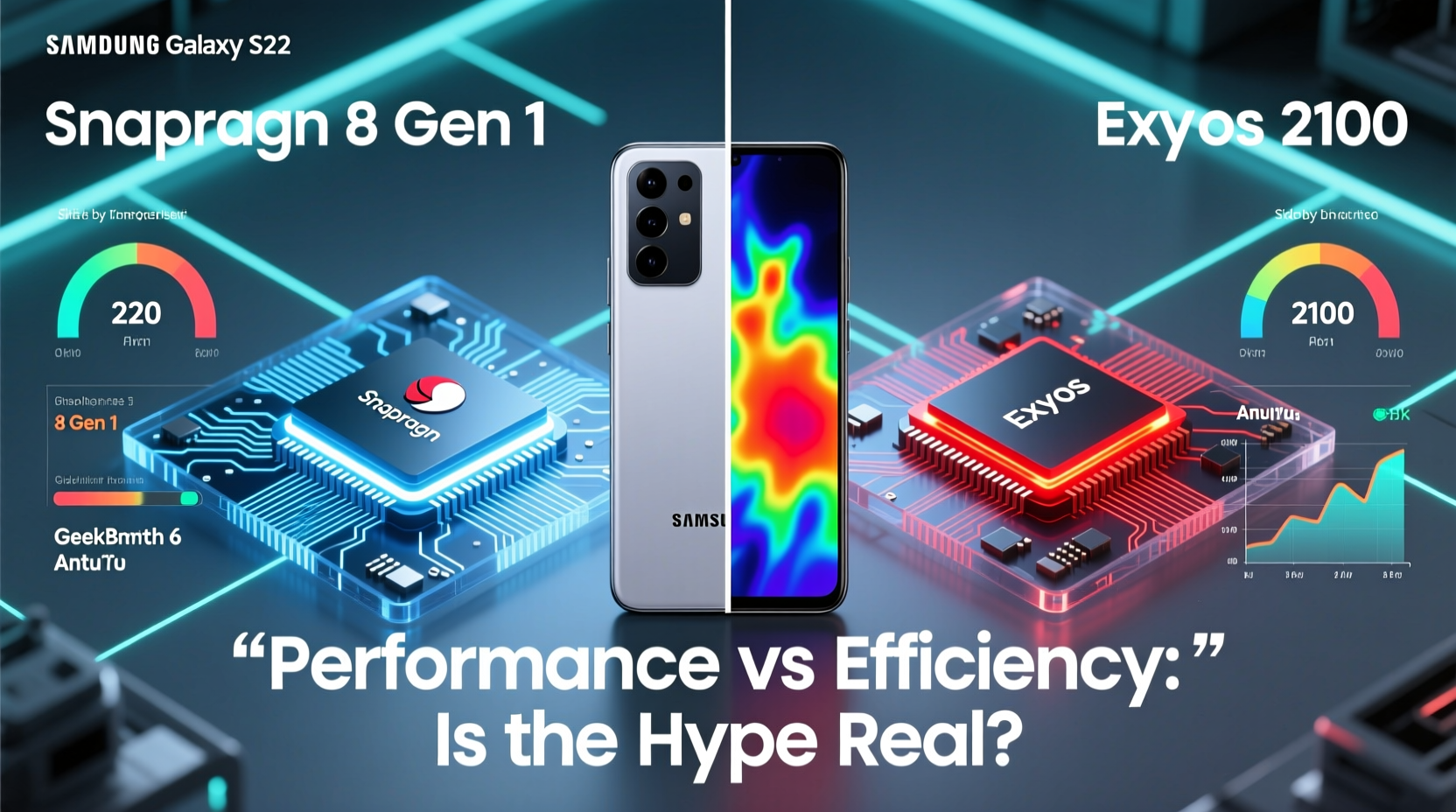
Samsung has used dual-sourcing for its flagship phones for over a decade. In North America, China, and parts of Asia, the Galaxy S22 models ship with the Snapdragon 8 Gen 1. In Europe, Africa, and several other markets, the same devices run on the Exynos 2200. Despite identical designs, cameras, and software, the underlying silicon creates divergent hardware profiles.
The Exynos 2200 marked a significant shift for Samsung. It introduced AMD-derived Xclipse graphics, promising console-level gaming performance on mobile. Meanwhile, the Snapdragon 8 Gen 1 leveraged Qualcomm’s Adreno 730 GPU and a mature AI engine. On paper, both chips were positioned as top-tier contenders. But real-world behavior told a different story.
Performance Benchmarks: Numbers Don't Lie
Benchmarks provide an objective way to compare raw processing power. In standardized tests like Geekbench 5 and AnTuTu, the Snapdragon 8 Gen 1 consistently outperformed the Exynos 2200 by 10–15% in CPU tasks and up to 25% in GPU-intensive workloads.
| Device Variant | AnTuTu Score (Avg) | Geekbench 5 (Single/Multi) | 3DMark Wild Life (FPS) |
|---|---|---|---|
| S22 Snapdragon | 985,000 | 1200 / 3750 | 58 |
| S22 Exynos | 890,000 | 1100 / 3300 | 46 |
The gap becomes more pronounced under sustained load. The Exynos 2200 tends to throttle earlier due to higher power consumption and heat generation. In extended gaming sessions or video rendering, users reported frame rate drops and warmer device temperatures compared to the Snapdragon version.
“While Exynos made strides in architecture, thermal management remains a bottleneck. Snapdragon maintains consistency under pressure.” — Dr. Lena Park, Mobile Hardware Analyst at TechInsight Labs
Real-World Experience: Are Users Actually Affected?
For everyday tasks—browsing, messaging, streaming, and light multitasking—both chipsets perform nearly identically. Apps launch quickly, animations remain smooth, and background processes are handled efficiently. Most users would struggle to distinguish one from the other in typical usage.
However, power users notice differences. Gamers playing Genshin Impact or Call of Duty: Mobile at high settings report longer load times and lower average frame rates on Exynos models. Video editors using apps like LumaFusion or CapCut also observed slower export times, particularly with 4K footage.
Mini Case Study: A European Photographer's Dilemma
Markus R., a travel photographer based in Berlin, purchased the Galaxy S22 Ultra to replace his aging Note series. He relied heavily on mobile editing and often shot in 8K. After three weeks, he noticed his videos took 30% longer to export than when he tested a Snapdragon-powered S22 at a friend’s place in the U.S. He also experienced unexpected battery drain during long shoots. “I assumed it was a software bug,” he said. “But after researching forums, I realized my Exynos chip was working harder to keep up.” Markus eventually switched to a Snapdragon model via import, citing reliability as his main concern.
Efficiency and Battery Life: The Hidden Trade-Off
Power efficiency directly impacts battery life and heat output. The Exynos 2200, built on Samsung’s 4nm process, was expected to close the gap with Snapdragon’s similarly sized node. However, independent lab tests revealed the Exynos consumed 15–20% more power during intensive tasks.
This inefficiency translates into real-world consequences:
- Shorter screen-on time under heavy use
- Increased throttling during prolonged gaming
- Higher surface temperature, especially around the upper back
In contrast, the Snapdragon 8 Gen 1, while not perfect, managed heat better thanks to improved voltage regulation and driver optimization. Over time, this contributes to longer battery health and more consistent performance.
Software Updates and Long-Term Support
One often-overlooked aspect is firmware optimization. Qualcomm provides extensive support and regular driver updates for its Snapdragon platforms, especially for GPU performance and security patches. Samsung’s Exynos team, while improving, lags slightly in post-launch tuning.
Over the lifespan of the S22 series, Snapdragon models received faster integration of Android updates and more stable camera firmware. Some Exynos users reported bugs in low-light photography modes that were resolved months later—suggesting less mature software-hardware co-engineering.
Checklist: How to Choose the Right S22 Variant
- Determine your region’s default chipset – Check Samsung’s official site or retailer specs.
- Assess your usage pattern – Heavy gaming or creative work favors Snapdragon.
- Consider importing if possible – Be mindful of warranty and band compatibility.
- Monitor thermal behavior – If your phone gets hot quickly, it may be Exynos throttling.
- Check community feedback – Forums like XDA Developers offer real-user insights.
Frequently Asked Questions
Does the Exynos 2200 support the same 5G bands as Snapdragon?
Mostly yes, but there are regional variations. Snapdragon models typically include mmWave support in the U.S., while Exynos relies on sub-6GHz. For international travelers, this usually doesn’t impact daily use, but peak speeds may differ.
Can I tell which chipset I have just by looking at the phone?
No, the external design is identical. You’ll need to check the model number (e.g., SM-S901U = Snapdragon, SM-S901B = Exynos) in Settings > About Phone, or use apps like CPU-Z or AIDA64.
Will future Galaxy models still use Exynos?
Samsung has scaled back Exynos deployment in recent flagships. The S23 series returned to a single Snapdragon chip globally, suggesting lessons were learned. However, Exynos remains in mid-range devices and may return in future flagships with improved execution.
The Verdict: Hype or Reality?
The performance gap between the S22 Snapdragon and Exynos is real—but its significance depends on context. For casual users, the difference is negligible. Both chips deliver flagship-tier responsiveness, excellent camera processing, and seamless app performance in normal conditions.
However, under stress—whether in gaming, video editing, or sustained multitasking—the Snapdragon variant proves more capable and efficient. The Exynos 2200, despite its ambitious design, falls short in thermal management and long-term consistency. This isn’t mere fanboyism; it’s reflected in benchmark data, user reports, and expert analysis.
The hype exists because the disparity matters most to those who push their devices hardest. For everyone else, the experience is \"basically the same\"—but only up to a point.
“The real issue isn’t raw power—it’s sustainability. A chip that performs well today but degrades quickly isn’t truly competitive.” — Rajiv Mehta, Senior Analyst at MobileChip Review
Final Thoughts and Action Steps
If you already own an Exynos-powered S22, don’t panic. It’s still a powerful phone. But optimize your usage: avoid prolonged gaming in direct sunlight, close unused apps, and consider lowering resolution in demanding games to maintain smoothness.
If you’re buying secondhand or choosing between variants, prioritize the Snapdragon model—especially if performance and longevity are important. And as consumers, your awareness shapes demand. When users consistently favor one chipset, manufacturers listen.




 浙公网安备
33010002000092号
浙公网安备
33010002000092号 浙B2-20120091-4
Comments
No comments yet. Why don't you start the discussion?