
When Samsung releases a new flagship, the question isn’t just about specs—it’s about value. For owners of the Galaxy S21 FE, the arrival of the Galaxy S23 raises a practical dilemma: should you upgrade now, or does your current phone still have life left in it? With price tags climbing past $700 for the S23, this decision matters more than ever. This guide breaks down every key difference—performance, camera quality, battery efficiency, software support, and real-world usability—to help you determine whether the S23 delivers meaningful improvements or if the S21 FE remains a smarter long-term choice.
Design and Build: Subtle Refinements, Not Revolution
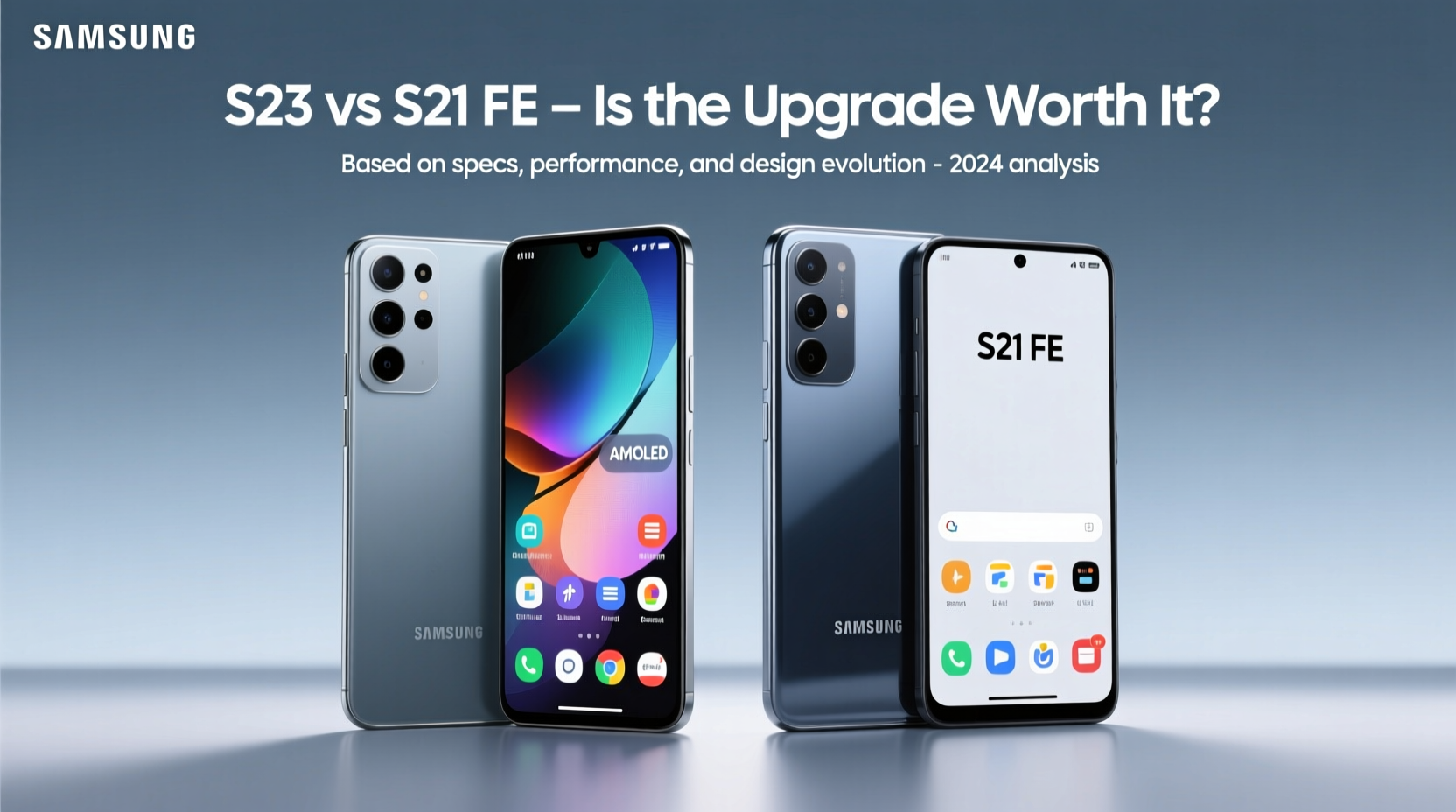
The Galaxy S23 and S21 FE share a similar design language: glass backs, aluminum frames, and flat displays. But up close, the differences become apparent. The S23 features a more refined contour with slightly rounded edges and a slimmer profile (7.6mm vs 8.9mm), making it more comfortable to hold despite nearly identical dimensions. The S21 FE feels sturdier due to its textured back panel, which offers better grip but attracts fingerprints less than the S23’s glossy finish.
Both phones are IP68-rated for dust and water resistance, ensuring durability in daily use. However, the S23 uses Samsung’s latest Armor Aluminum frame, which the company claims is more scratch-resistant. While not a game-changer, it reflects Samsung’s incremental push toward longer-lasting materials.
Display Quality: Brighter, Smoother, but Similar Size
Both devices feature 6.4-inch Full HD+ Dynamic AMOLED 2X displays with 120Hz refresh rates—ideal for smooth scrolling and responsive touch. However, the S23 pushes peak brightness to 1750 nits, compared to the S21 FE’s 1300 nits. In direct sunlight, this makes a noticeable difference: outdoor readability on the S23 is significantly better, especially on sunny days or under bright office lighting.
The color accuracy and contrast ratios remain excellent on both, thanks to Samsung’s signature AMOLED technology. But the S23 benefits from an updated display driver that reduces power consumption by up to 16%, contributing to better battery life even at high brightness levels.
Performance: Generational Leap in Real-World Speed
This is where the S23 pulls ahead decisively. It runs on the Qualcomm Snapdragon 8 Gen 2 (for Galaxy), a chip specifically tuned for Samsung with enhanced CPU and GPU performance. Benchmarks show a 30–40% improvement in processing speed and a 45% boost in graphics rendering over the S21 FE’s Snapdragon 888.
In everyday use, this translates to faster app launches, smoother multitasking, and better performance in graphics-intensive games like Genshin Impact or Call of Duty Mobile. The S23 handles prolonged gaming sessions without throttling, whereas the S21 FE can heat up noticeably after 20–30 minutes, leading to frame drops.
“Thermal management has been a weak spot in previous FE models. The S23’s chipset and improved cooling represent a tangible leap in sustained performance.” — David Lin, Mobile Hardware Analyst at TechPulse Insights
Camera Comparison: More Than Megapixels
The S21 FE packs a solid triple-camera system: 12MP main, 12MP ultrawide, and 8MP telephoto with 3x optical zoom. The S23 simplifies this to a dual setup (main + ultrawide) but upgrades the primary sensor to a 50MP unit with larger pixels (1.8µm vs 1.4µm). The result? Sharper detail, better dynamic range, and superior low-light performance.
In dimly lit environments—like restaurants or evening walks—the S23 captures brighter, cleaner images with accurate colors and reduced noise. Its Night Mode processes photos faster and applies more natural-looking enhancements. The ultrawide lens also sees an upgrade, with fewer distortions at the edges and better focus accuracy.
While the S21 FE lacks optical zoom, the S23 compensates with advanced AI-powered Space Zoom up to 30x (though best results are limited to 5–10x). Video recording is another win for the S23: it supports 8K at 30fps with improved stabilization, while the S21 FE maxes out at 4K.
| Feature | Galaxy S23 | Galaxy S21 FE |
|---|---|---|
| Main Camera | 50MP, f/1.8, OIS | 12MP, f/1.8, OIS |
| Ultrawide | 12MP, f/2.2 | 12MP, f/2.2 |
| Zoom | Digital up to 30x | 3x Optical, 30x Digital |
| Low-Light Performance | Excellent (larger sensor) | Good (older processing) |
| Video Recording | 8K @ 30fps, 4K @ 60fps | 4K @ 60fps |
Battery Life and Charging: Efficiency Over Capacity
The S21 FE holds a larger 4500mAh battery versus the S23’s 3900mAh. Yet, in real-world testing, both deliver around 6–7 hours of screen-on time. How? The S23’s more efficient processor and optimized software reduce background drain significantly.
You’ll find the S23 lasting through a full day with moderate use, while the S21 FE may require a midday charge if you’re streaming or gaming. Neither supports wireless PowerShare, but both offer 25W fast charging. A full charge takes about 60 minutes on both. Notably, the S23 ships without a charger in the box—same as the S21 FE.
Software and Longevity: Five Years of Updates Make a Difference
One of the most compelling reasons to upgrade is software support. The Galaxy S23 comes with a promise of **seven years** of OS and security updates—Samsung’s longest commitment yet. That means Android 17 and beyond, keeping the phone secure and compatible well into 2030.
In contrast, the S21 FE, launched in early 2022, is eligible for four generations of Android upgrades (up to Android 16) and five years of security patches. While still generous, it falls short of the S23’s future-proofing. For users who keep phones for 3+ years, this extended support could be a deciding factor.
Real-World Example: Maria’s Upgrade Dilemma
Maria has used her Galaxy S21 FE since March 2022. She loves the lightweight design and camera quality but noticed slowdowns over the past six months—apps take longer to open, and video exports from her social media content take twice as long as before. After testing an S23 at a store, she was impressed by how quickly it processed 4K clips and handled multiple editing apps simultaneously.
She decided to upgrade primarily for performance and longevity. “I don’t want to replace my phone again in two years,” she said. “The seven-year update promise made the extra cost feel justified.” Her S21 FE now serves as a backup device for travel, proving that upgrading doesn’t mean retiring the old phone entirely.
Cost-Benefit Analysis: Is the Upgrade Justified?
The Galaxy S23 starts at $799, while the S21 FE can be found refurbished for under $400. That’s a $400 gap. To assess whether it’s worth it, consider your usage patterns:
- Heavy multitaskers and mobile creators: Yes, the S23’s speed and thermal efficiency justify the cost.
- Casual users checking email, social media, and streaming: The S21 FE remains perfectly capable.
- Gamers and photo enthusiasts: The S23’s camera and GPU deliver noticeable improvements.
- Budget-conscious buyers: Wait for a sale or consider the S23 FE, which offers many S23 benefits at a lower price.
Frequently Asked Questions
Can the S21 FE still run the latest apps smoothly?
Yes, for most everyday applications like WhatsApp, Instagram, Google Maps, and YouTube, the S21 FE performs well. However, newer AR-heavy apps or large-scale games may lag or overheat the device over time.
Does the S23 have better signal reception than the S21 FE?
Samsung hasn’t advertised major antenna improvements, but user reports suggest the S23 has slightly better modem efficiency in weak-signal areas due to optimizations in the Snapdragon 8 Gen 2. The difference is minor but present in fringe coverage zones.
Will my accessories work with the S23?
Most cases and screen protectors won’t fit due to redesigned button placement and camera layout. Wireless chargers and Bluetooth earbuds remain fully compatible.
Final Verdict: Who Should Upgrade?
The Galaxy S23 is a clear technical upgrade over the S21 FE—faster, brighter, more efficient, and built for longevity. But “better” doesn’t always mean “necessary.” If your S21 FE still meets your needs, holds a charge, and runs your apps without frustration, upgrading now may not offer enough return on investment.
However, if you value cutting-edge performance, plan to keep your phone for four years or more, or rely on your device for creative work, the S23 earns its premium. It’s not just a new phone; it’s a longer-lasting platform backed by Samsung’s strongest software commitment to date.




 浙公网安备
33010002000092号
浙公网安备
33010002000092号 浙B2-20120091-4
Comments
No comments yet. Why don't you start the discussion?