
Choosing between the Samsung Galaxy S5 and the Galaxy S6 Edge isn’t just about specs—it’s about lifestyle. The S5 represented peak practicality in 2014: rugged, expandable, and battery-efficient. The S6 Edge, released a year later, was a bold leap into premium design with its dual-edge display and glass-metal build. But for users still loyal to the S5, the question remains: does the visual drama and innovation of the curved screen justify leaving behind a trusted device?
This isn't merely an upgrade decision; it's a shift in philosophy. The S6 Edge trades user-replaceable batteries and microSD support for elegance and cutting-edge tech. Understanding what you value most—durability and flexibility or sleekness and innovation—will determine whether the curved screen is truly worth it.
Design and Build: From Utility to Elegance
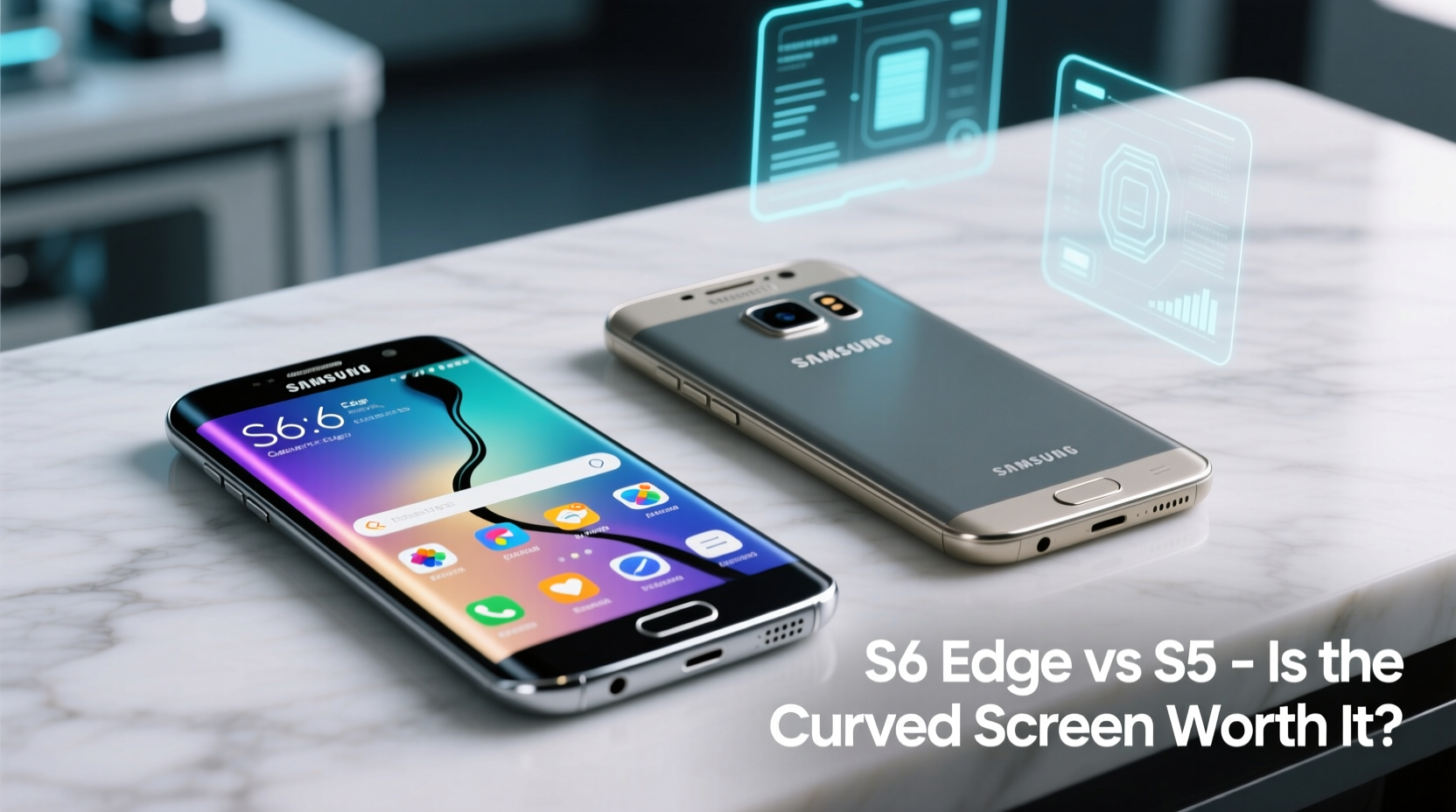
The Galaxy S5 was engineered for endurance. Its textured polycarbonate back provided grip, resisted fingerprints, and housed a removable 2,800mAh battery. With IP67 water and dust resistance, it could survive drops, rain, and even brief submersion. It felt substantial—not flashy, but dependable.
In contrast, the S6 Edge marked Samsung’s pivot toward luxury. It featured a glass front and back with an aluminum frame, exuding sophistication. But this came at a cost: no waterproof rating (despite rumors), non-removable battery, and zero expandable storage. The curved edges weren’t just aesthetic—they were structural, making repairs harder and increasing fragility.
Display and Usability: Curved for Function or Fashion?
The centerpiece of the S6 Edge is its 5.1-inch Quad HD Super AMOLED display with dual curved edges. Unlike flat screens, the curve wraps around both sides, enabling unique features like the Edge Panel—a customizable sidebar that shows contacts, apps, or notifications without unlocking the phone.
While visually striking, the practical benefits are limited. Scrolling near the edge can trigger accidental swipes, and some apps don’t fully optimize for the curvature. However, when used intentionally—such as assigning frequent contacts to the Edge or using Night Clock mode—the feature adds subtle convenience.
The S5’s 5.1-inch Full HD display, while less vibrant, was more than sufficient for daily tasks. It lacked the deep blacks and color saturation of AMOLED but offered better outdoor visibility under direct sunlight due to its higher peak brightness and anti-reflective coating.
“Curved displays represent a transitional phase in smartphone evolution—more experimental than essential.” — Mark Liu, Former CTO of Samsung Electronics
Performance and Battery Life Comparison
Under the hood, the S6 Edge was a significant upgrade. It introduced Samsung’s first Exynos 7420 octa-core processor (or Snapdragon 810 in select regions) paired with 3GB of RAM. This allowed smoother multitasking, faster app launches, and improved gaming performance over the S5’s quad-core Snapdragon 801 and 2GB of RAM.
However, the S6 Edge’s 2,600mAh battery struggled to keep up. Despite hardware efficiency gains, the high-resolution display and always-on Edge features drained power quickly. In real-world use, heavy users often needed midday charging. The S5, with its larger 2,800mAh battery and lower-resolution screen, consistently delivered one-and-a-half to two full days on a charge.
Another major trade-off: wireless charging. The S6 Edge supported Qi and PMA standards, a feature absent in the S5. For users invested in wireless charging pads or furniture, this alone could be a compelling reason to upgrade.
| Feature | Samsung Galaxy S5 | Samsung Galaxy S6 Edge |
|---|---|---|
| Display | 5.1\" FHD LCD | 5.1\" QHD AMOLED (Curved) |
| Processor | Snapdragon 801 | Exynos 7420 / Snapdragon 810 |
| RAM | 2GB | 3GB |
| Battery | 2,800mAh (Removable) | 2,600mAh (Non-removable) |
| Storage | 16/32GB + microSD | 32/64/128GB (No SD) |
| Water Resistance | IP67 Rated | None |
| Charging | Standard Micro USB | Fast & Wireless Charging |
Real-World Example: Sarah’s Upgrade Dilemma
Sarah had used her Galaxy S5 for nearly two years. She worked as a field technician, visiting construction sites daily. Her phone survived rain, falls, and constant glove use. When coworkers praised the S6 Edge’s beauty, she considered upgrading.
She bought one during a sale. Within three weeks, the glass back cracked after slipping off a truck dashboard. No spare battery meant downtime when power ran low. While she loved the speed and camera quality, the lack of durability frustrated her. After six months, she reverted to a ruggedized version of the S5, keeping the S6 Edge as a weekend device.
Her experience underscores a key truth: context matters. For office workers or those who prioritize aesthetics, the S6 Edge shines. For active lifestyles, the S5 remains surprisingly relevant.
Should You Make the Switch? A Practical Checklist
Before abandoning your reliable S5, evaluate these factors:
- Do you value design over durability? The S6 Edge looks stunning but scratches and cracks easily.
- Is fast charging or wireless charging important? These are exclusive to the S6 Edge.
- Do you need expandable storage? The S5 supports microSD; the S6 Edge does not.
- How critical is battery life? The S5 lasts longer and allows battery swaps.
- Are you excited by novel features? The Edge Panel offers minor conveniences but isn’t essential.
- Will you use a case? Most cases cover the curved edges, negating their visual impact.
Frequently Asked Questions
Does the curved screen improve productivity?
Marginally. The Edge Panel lets you assign shortcuts, but most functions are accessible through standard widgets or launchers. It’s more novelty than necessity unless heavily customized.
Can I still get replacement batteries for the S5?
Yes. Third-party vendors continue to sell compatible batteries, and replacement is simple with basic tools. This extends the S5’s lifespan significantly compared to sealed devices like the S6 Edge.
Is the S6 Edge camera noticeably better?
Yes. The S6 Edge features a 16MP f/1.9 rear sensor with improved low-light performance and faster autofocus. It also introduced real-time HDR and richer color reproduction, making it superior for photography enthusiasts.
Conclusion: Weigh Innovation Against Real Needs
The Galaxy S6 Edge was a statement device—one that pushed boundaries in design and materials. Its curved screen captured attention, symbolizing a future where form and function merge seamlessly. Yet, for many, it sacrificed too much practicality for spectacle.
The S5, though older, offered reliability, flexibility, and resilience that many modern phones still struggle to match. Upgrading solely for the curved screen risks prioritizing aesthetics over utility. But if you crave faster performance, superior photo quality, and enjoy small luxuries like wireless charging, the S6 Edge delivers a meaningful step forward.
Ultimately, the decision hinges on how you use your phone. If your device is a tool, the S5 holds up remarkably well. If it’s a personal accessory reflecting taste and tech enthusiasm, the S6 Edge earns its place—even if that place is occasionally in a repair shop.




 浙公网安备
33010002000092号
浙公网安备
33010002000092号 浙B2-20120091-4
Comments
No comments yet. Why don't you start the discussion?