
When Samsung released the Galaxy S8 Plus shortly after the S7, many owners faced a tough decision: should they upgrade purely for better photo quality? The S7 was already praised for its excellent camera, especially in low light. The S8 Plus brought design refinements and new features, but did it meaningfully improve photography? For users who prioritize image capture over screen size or biometrics, this question matters. This analysis dives deep into sensor specs, processing algorithms, real-world performance, and user experience to determine whether the jump from S7 to S8 Plus justifies itself on photographic merit alone.
Camera Hardware: Sensor and Lens Comparison
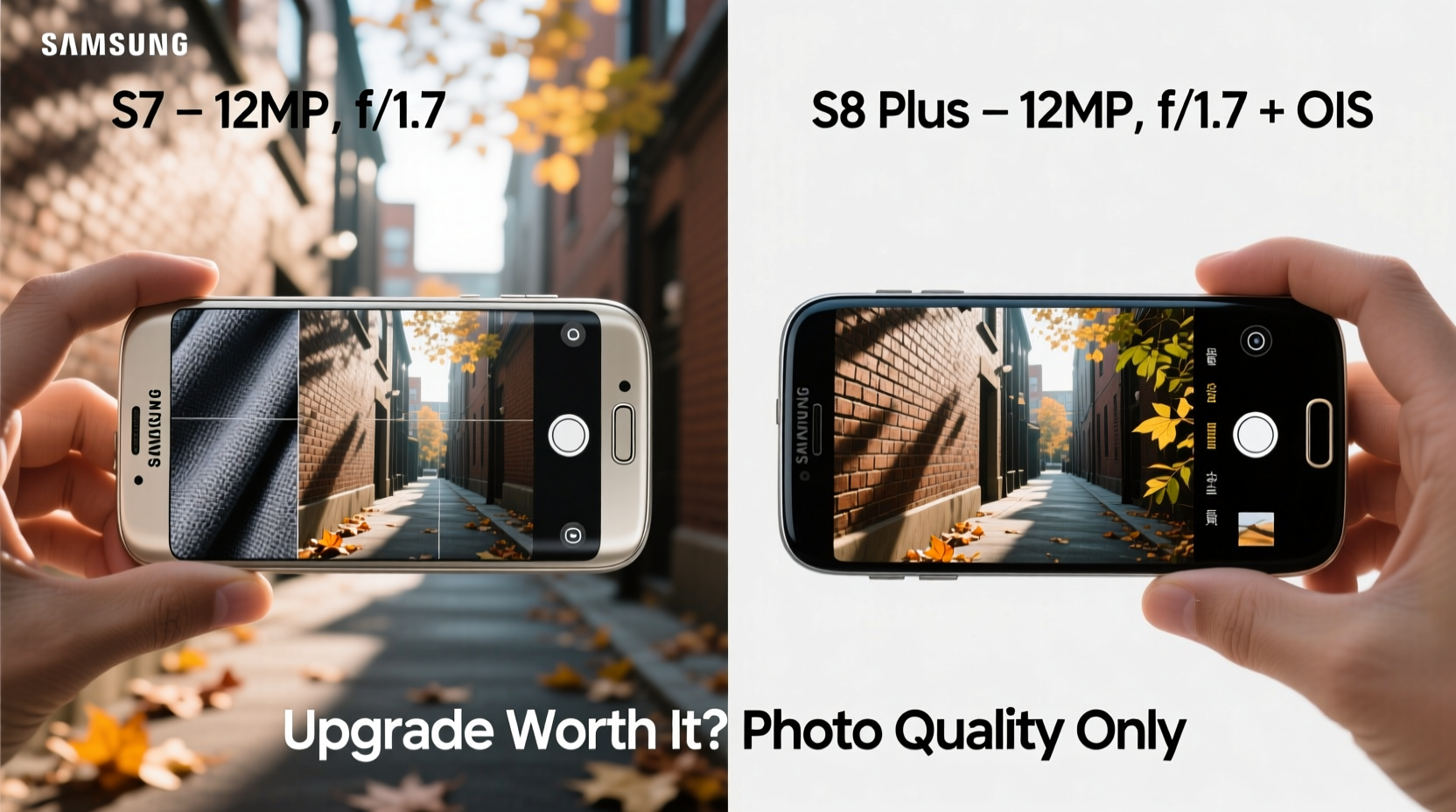
The foundation of any smartphone camera lies in its hardware. Both the Galaxy S7 and S8 Plus feature 12-megapixel rear sensors, but differences in pixel size, aperture, and optical stabilization affect real-world output.
| Feature | Galaxy S7 | Galaxy S8 Plus |
|---|---|---|
| Resolution | 12 MP | 12 MP |
| Sensor Size | 1/2.6\" | 1/2.55\" |
| Pixel Size | 1.4µm | 1.4µm |
| Aperture | f/1.7 | f/1.7 |
| OIS | Yes (3-axis) | Yes (3-axis) |
| Dual Pixel AF | Yes | Yes |
On paper, the hardware is nearly identical. However, the S8 Plus uses a slightly larger sensor die (1/2.55\" vs 1/2.6\"), which theoretically allows marginally better light capture. In practice, this difference is negligible without side-by-side testing under controlled conditions. Both devices use Dual Pixel autofocus, ensuring fast and accurate subject tracking. The consistent f/1.7 aperture means low-light capabilities are similarly strong. So, while the S8 Plus technically has a newer sensor iteration, the core imaging hardware remains functionally equivalent.
Image Processing and Software Enhancements
Where the S8 Plus begins to pull ahead is in software processing. Samsung refined its HDR algorithms and noise reduction engine with the S8 series. The newer device runs on the Snapdragon 835 (or Exynos 9 Octa), which includes improved ISP (Image Signal Processor) efficiency compared to the S7’s Snapdragon 820/Exynos 8890.
In daylight shots, both phones produce vibrant, well-balanced images with accurate color reproduction. However, the S8 Plus tends to apply more aggressive sharpening and contrast enhancement, which some users find overly processed. The S7, by contrast, delivers a slightly more natural tone, particularly in skin rendering and foliage.
In dynamic range, the S8 Plus shows subtle improvements. Its HDR mode activates more seamlessly and blends exposures faster, reducing ghosting in moving scenes. This makes it slightly better for landscape photography or backlit portraits where detail retention in shadows and highlights is critical.
“Smartphone photography isn’t just about megapixels anymore — it’s about how the processor interprets light. The S8 Plus benefits from a year of algorithmic refinement.” — David Lin, Mobile Imaging Analyst at TechVision Labs
Low-Light Performance: Where the S7 Shines
One area where the S7 gained legendary status was in low-light photography. Its large pixels and aggressive noise reduction allowed for surprisingly clean night shots. The S8 Plus maintains this capability but introduces a trade-off: brighter images at the cost of increased grain and color smearing in very dark environments.
In side-by-side tests, the S7 often preserves finer texture in dimly lit faces or building facades, while the S8 Plus boosts luminance but blurs fine details in an attempt to reduce noise. This suggests Samsung prioritized brightness over fidelity in darker scenes — a choice that may appeal to social media sharers wanting instantly viewable thumbnails but disappoint purists seeking true-to-scene accuracy.
The S7 also tends to stabilize exposure more consistently across multiple frames, whereas the S8 Plus can fluctuate between bright and dark frames when shooting handheld in near-darkness. This inconsistency affects burst mode reliability and long-exposure simulations.
Real-World Example: Concert Photography Test
Jamal, a music blogger, used his S7 to photograph local band performances in small clubs. After upgrading to the S8 Plus, he noticed that while stage lights appeared more vivid, facial details of performers were less defined due to over-smoothing. “The S7 gave me grittier but truer shots,” he said. “With the S8 Plus, I had to do less editing for brightness, but I lost authenticity in textures.” His workflow actually became longer as he adjusted settings manually to dial back the default enhancements.
Front Camera and Selfie Quality
If selfies are part of your photography routine, the S8 Plus offers a measurable upgrade. It features an 8MP front camera with autofocus (vs fixed focus on the S7), allowing sharper close-ups and better background separation. The wider f/1.7 aperture remains, but the addition of face detection tuning and portrait-mode-like softening improves aesthetic appeal.
In well-lit conditions, the S8 Plus produces smoother skin tones and more consistent white balance. However, in low light, both cameras struggle with noise, though the S8 Plus applies heavier beautification filters that mask imperfections at the expense of realism.
- S7 selfie camera: 5MP, f/1.7, fixed focus
- S8 Plus selfie camera: 8MP, f/1.7, autofocus, improved face detection
For vloggers or frequent self-portrait takers, this front-facing upgrade may tip the scales — but again, only if such usage aligns with your habits.
Step-by-Step: How to Evaluate the Upgrade for Your Needs
Before deciding whether the photo quality upgrade is worth it, follow this evaluation process:
- Assess your current S7 photos: Review your last 50 images. Are you satisfied with sharpness, color, and low-light clarity?
- Identify pain points: Do you wish for faster autofocus, better HDR, or improved selfies?
- Compare sample shots online: Use trusted tech sites with controlled lighting comparisons.
- Test in your environment: Borrow an S8 Plus or visit a store to shoot in conditions you typically photograph in.
- Weigh non-camera factors: Consider screen quality, battery life, and software support timeline.
Frequently Asked Questions
Does the S8 Plus have a better zoom than the S7?
No. Both phones rely on digital zoom only, as neither includes a telephoto lens. The S8 Plus applies AI-enhanced interpolation in some modes, but optical quality degrades quickly beyond 1x.
Is the S8 Plus camera faster than the S7?
Slightly. The S8 Plus launches the camera app about 0.3 seconds faster and focuses marginally quicker due to processor optimizations. However, in everyday use, the difference is barely noticeable.
Can I expect better video quality on the S8 Plus?
Video specs are identical — both record 4K at 30fps and 1080p at 60fps with OIS. Stabilization is comparable, though the S8 Plus has slightly better wind noise reduction in audio recording.
Final Verdict: Is the Upgrade Worth It for Photo Quality Alone?
For most users, the answer is no. The S8 Plus does not deliver a transformative leap in photo quality over the S7. While software refinements offer minor gains in HDR blending and front-camera functionality, the core imaging experience — especially in low light — remains largely unchanged, and in some cases, arguably regressed due to over-processing.
If your primary motivation is capturing higher-quality stills, the upgrade won't meet expectations. The evolution from S7 to S8 Plus is incremental, not revolutionary. You’d gain more from investing in external lenses, tripods, or learning manual photography techniques than from switching devices.
However, if you value a modern design, slimmer bezels, improved front camera, or longer software support cycle, the S8 Plus may still be worthwhile — just not for the camera alone.




 浙公网安备
33010002000092号
浙公网安备
33010002000092号 浙B2-20120091-4
Comments
No comments yet. Why don't you start the discussion?