
When choosing between two budget smartphones like the Samsung Galaxy A01 and A10s, it’s easy to assume they’re nearly identical—after all, they share similar design language and price points. But beneath the surface, there are meaningful differences that could influence your daily experience. For users on a tight budget or those replacing an aging device, understanding these distinctions is critical. This detailed comparison breaks down performance, display, camera, battery, software, and real-world usability to answer the central question: Is upgrading from the A01 to the A10s (or vice versa) actually worth it?
Design and Build Quality: Subtle but Meaningful Differences
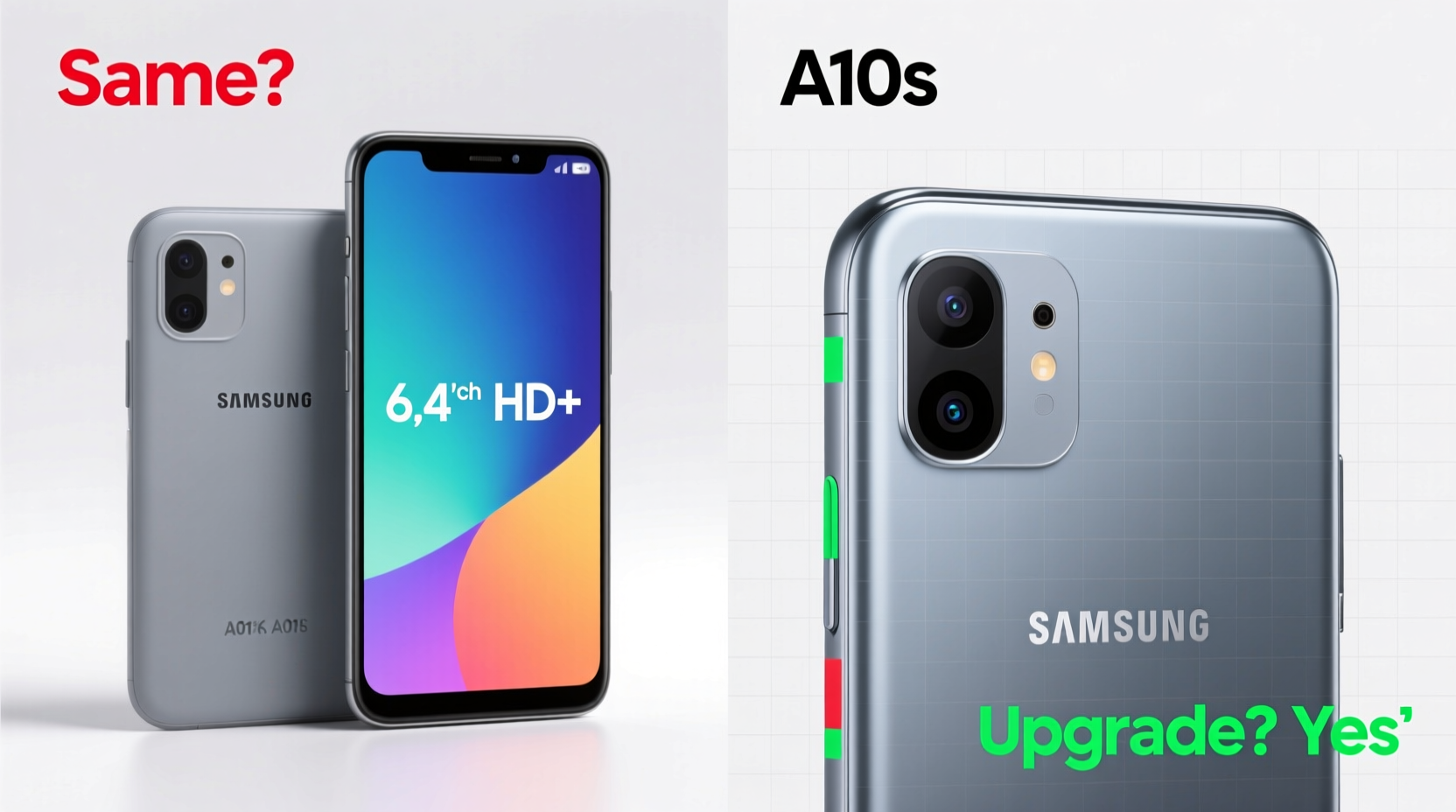
At first glance, both phones look almost indistinguishable. They feature plastic bodies, glossy finishes, and rear-mounted fingerprint sensors. However, the A10s has a slightly more modern aesthetic with its dual-tone back panel and gradient finish options, giving it a more premium appearance than the A01’s plain matte or glossy back.
The A10s is marginally larger and heavier (168g vs 140g), which contributes to better grip but may feel less comfortable for one-handed use. Both devices lack water resistance and are prone to smudges, but the A10s includes a dedicated microSD card slot alongside the dual SIM trays—a small but practical advantage over the A01’s hybrid slot setup.
Display and Screen Experience
Both phones use 6.2-inch PLS LCD displays with HD+ resolution (720 x 1520), so clarity and color reproduction are comparable. However, the A10s edges ahead with a teardrop notch housing the front camera, whereas the A01 uses a more dated-looking punch-hole cutout that interrupts the screen space slightly more.
In real-world use, brightness levels are modest on both, making outdoor visibility challenging under direct sunlight. The A10s offers marginally better contrast and viewing angles, likely due to minor panel tuning improvements. Neither supports adaptive refresh rates, but for casual browsing, messaging, and video streaming, both screens perform adequately within their price range.
Performance and Hardware Comparison
This is where the most significant differences emerge. The Galaxy A01 runs on the Qualcomm Snapdragon 439 processor with 2GB of RAM and 16GB of internal storage. It's functional for basic tasks like calling, texting, and light app usage, but multitasking is sluggish, and app switching often requires reloading.
In contrast, the A10s uses the slightly older but more capable MediaTek MT6762V/WD Helio P22 chip, paired with either 2GB or 3GB of RAM depending on the variant. With 3GB models, users experience noticeably smoother navigation and better background app retention. While benchmarks show only a modest lead for the P22, real-world responsiveness favors the A10s, especially when using social media apps or streaming music.
“Even in entry-level devices, RAM allocation can be more impactful than raw processor speed.” — Lin Zhao, Mobile Hardware Analyst at TechPulse Asia
| Feature | Samsung A01 | Samsung A10s |
|---|---|---|
| Processor | Qualcomm Snapdragon 439 | MediaTek Helio P22 |
| RAM Options | 2GB | 2GB or 3GB |
| Internal Storage | 16GB (expandable) | 32GB (expandable) |
| Battery Capacity | 3000 mAh | 4000 mAh |
| Rear Camera Setup | Dual: 13MP + 2MP | Dual: 13MP + 2MP |
| Front Camera | 5MP | 8MP |
| OS (Launch) | Android 10 (Go Edition) | Android 9 Pie |
Camera and Multimedia Capabilities
On paper, both phones list a 13MP main sensor and 2MP depth sensor, but actual photo quality varies due to software optimization and processing. The A10s generally produces sharper images in daylight with better dynamic range. Its 8MP front camera also outperforms the A01’s 5MP shooter, delivering clearer selfies and better video calls.
Night photography remains weak on both devices. Without night mode or advanced HDR, low-light shots are grainy and lack detail. Video recording is capped at 1080p on both, but the A10s handles stabilization slightly better during handheld clips.
If you frequently take photos or use video chat, the A10s offers tangible benefits. For users who rarely use the camera, this difference may not justify an upgrade.
Battery Life and Charging
Battery capacity is one of the clearest differentiators. The A01’s 3000 mAh battery struggles to last a full day with moderate use, often requiring a midday charge. In contrast, the A10s packs a 4000 mAh cell, which reliably lasts 1.5 to 2 days under light-to-moderate usage.
Neither supports fast charging, topping up at 5W via micro-USB. However, the larger battery in the A10s means fewer charges overall, reducing long-term wear on the port and power adapter. Users who travel frequently or rely on their phone off-grid will find the A10s significantly more dependable.
Software and Long-Term Usability
The A01 launched with Android 10 (Go Edition), a lightweight OS optimized for devices with limited RAM. Go Edition includes stripped-down versions of Google apps and built-in memory management, resulting in faster app launches and improved system stability.
The A10s shipped with Android 9 Pie without Go optimizations. While it received an update to Android 10, it lacks the efficiency enhancements of Go Edition. As a result, even with 3GB RAM, the A10s can feel slower over time as cached data accumulates.
Security updates have ceased for both models, limiting their longevity. However, the A01’s cleaner software environment may offer a more consistent experience in the final stages of support.
Real-World Example: Maria’s Upgrade Decision
Maria used a Galaxy A01 for 18 months and found herself frustrated by constant app reloads, short battery life, and poor selfie quality during family Zoom calls. When her cousin offered her a used A10s with 3GB RAM, she decided to switch.
Immediately, she noticed improvements: her WhatsApp stayed logged in across reboots, videos loaded faster, and her daughter’s school video submissions were clearer thanks to the better front camera. Most importantly, she no longer needed to carry a power bank during weekend outings. While the interface wasn’t dramatically faster, the combination of extra RAM, larger battery, and better display made daily use noticeably smoother.
For Maria, the upgrade was absolutely worth it—even with secondhand hardware.
Is Upgrading Worth It? A Practical Checklist
Use this checklist to determine if moving from the A01 to the A10s (or choosing between them) makes sense for your needs:
- ✅ Do you need longer battery life? → A10s wins with 4000 mAh
- ✅ Do you use multiple apps daily (e.g., social media, maps, banking)? → A10s with 3GB RAM handles multitasking better
- ✅ Do you take frequent selfies or video calls? → A10s has superior front camera
- ✅ Are you sensitive to lag and slow response times? → A01 may frustrate with 2GB RAM
- ✅ Do you value software efficiency over raw specs? → A01’s Go Edition offers cleaner performance
- ✅ Are you buying new or used? → A10s is often available secondhand at minimal cost
Frequently Asked Questions
Can the Samsung A01 and A10s run TikTok and Instagram smoothly?
The A01 struggles with smooth scrolling and video loading on TikTok, especially after prolonged use. The A10s performs better, particularly with 3GB RAM, though neither supports high frame rate playback. Expect occasional stutters.
Is internal storage expandable on both phones?
Yes, both support microSD cards up to 512GB. However, the A01 uses a hybrid slot, meaning you must choose between a second SIM or extra storage. The A10s has a dedicated third slot, offering greater flexibility.
Which phone receives software updates now?
Neither model currently receives regular security or OS updates. Samsung ended major support in 2022. Users should consider upgrading to newer A-series models (like A14 or A23) for ongoing patching.
Final Verdict: Are They Basically the Same?
No, the Samsung A01 and A10s are not essentially the same. While they occupy the same budget tier and share core features, the A10s delivers measurable improvements in battery life, camera quality, RAM options, and storage flexibility. The A01 counters with a lighter, more efficient operating system, but its smaller battery and weaker performance limit practicality.
If you already own an A01 and are considering an upgrade, the A10s is worth it—especially if you can get it at low cost. Conversely, if you're choosing between the two new or used, prioritize the A10s unless you specifically need Go Edition software or prefer a lighter device.




 浙公网安备
33010002000092号
浙公网安备
33010002000092号 浙B2-20120091-4
Comments
No comments yet. Why don't you start the discussion?