
When shopping for an affordable smartphone, Samsung’s A-series offers some of the most accessible entry points into Android. The Samsung Galaxy A01 and A03 are two such models that target budget-conscious buyers. Positioned only a year apart, they look similar at first glance—same minimalist design language, modest specs, and sub-$150 price tags. But beneath the surface, key differences emerge. For users currently on the A01, the question isn’t just about specs—it’s whether the upgrade to the A03 brings meaningful improvements or if it's merely incremental tweaks wrapped in marketing.
This article breaks down every critical aspect—from processor performance and battery life to camera quality and software support—to help you decide if moving from the A01 to the A03 is a smart investment or just chasing minor upgrades.
Design and Build: Subtle Refinements, Same DNA
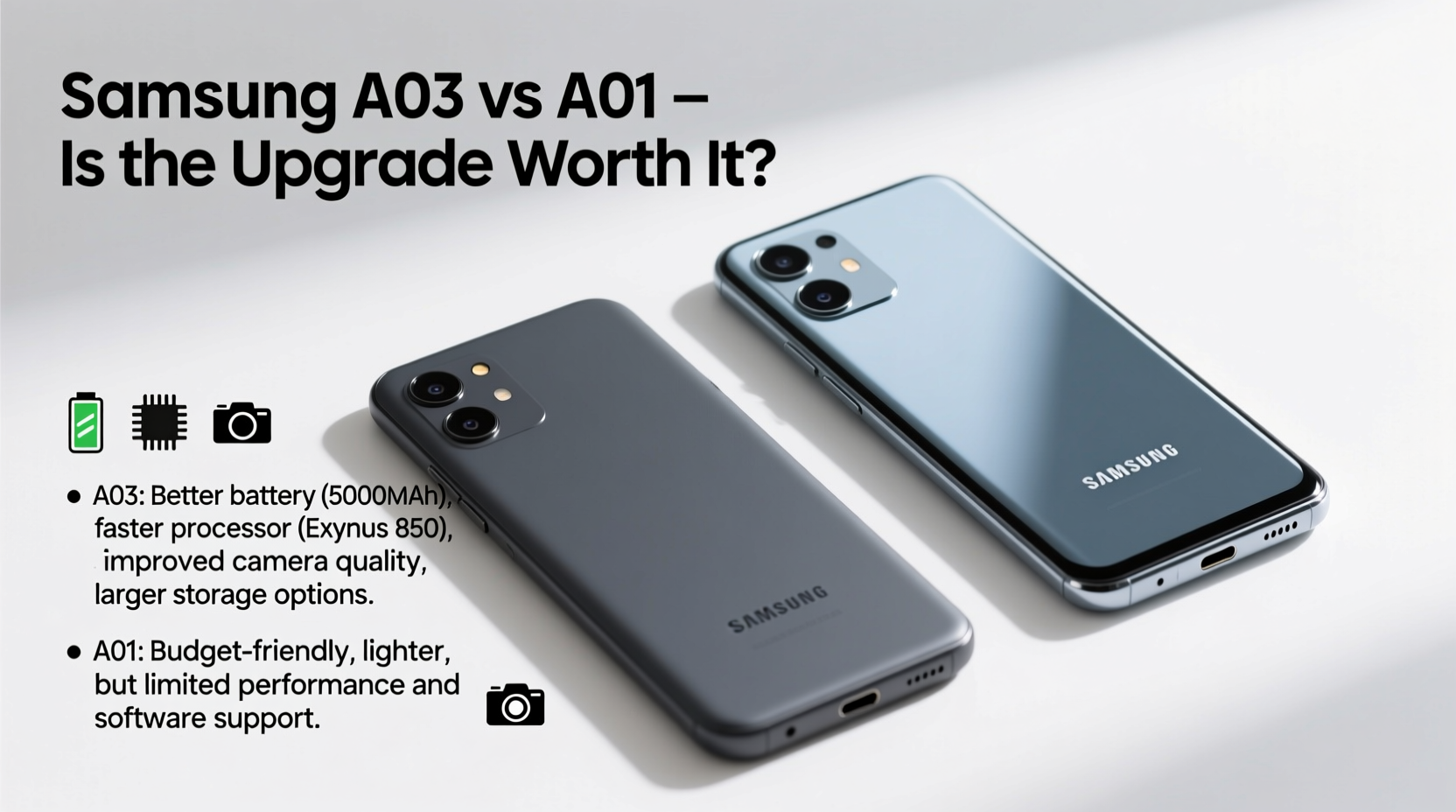
At first glance, both phones share Samsung’s classic entry-level aesthetic: plastic bodies, glossy finishes, and compact dimensions. The A01 measures 140.9 x 67.5 x 8.6 mm and weighs 148g, while the A03 is slightly larger at 164.3 x 77.5 x 9.1 mm and heavier at 196g. This increase reflects a larger display and battery but makes the A03 less pocket-friendly than its predecessor.
The build quality remains functional rather than premium. Both use polycarbonate shells, which resist minor drops but scratch easily. The A03 gains a slight edge with a reinforced back panel design that reduces creaking under pressure—a common complaint with the A01 after prolonged use.
Display and Visibility: Bigger Isn’t Always Better
The A01 features a 5.7-inch HD+ (720 x 1520) PLS LCD with a 19:9 aspect ratio. It’s adequate for basic tasks but struggles in bright sunlight due to low peak brightness (around 400 nits). The A03 steps up to a 6.5-inch HD+ (720 x 1600) display with a taller 20:9 ratio. While resolution remains the same, the larger size improves media consumption and multitasking.
However, the A03’s screen uses a teardrop notch instead of the A01’s punch-hole cutout, reducing usable space slightly. More importantly, both panels have 60Hz refresh rates and mediocre color accuracy. Gamers or frequent video watchers may notice motion blur and washed-out visuals.
“Larger screens on budget phones often sacrifice pixel density and viewing angles. Users should prioritize brightness and readability over size.” — David Lin, Mobile Display Analyst at TechPulse Insights
Performance Comparison: Real-World Speed Matters
Under the hood, the differences become more pronounced. The A01 runs on Qualcomm’s Snapdragon 439 (12nm), paired with 2GB RAM and 32GB storage. It handles WhatsApp, YouTube at 480p, and light web browsing but stutters when switching apps or loading social media feeds.
The A03 replaces this with Samsung’s own Exynos 850 (8nm), also with 2GB/3GB RAM options and 32GB/64GB storage. Though both chips are entry-level, the Exynos 850 delivers roughly 30% better CPU performance and improved power efficiency. In daily use, this translates to smoother app launches, faster boot times, and fewer background app reloads.
Benchmarks confirm this: the A03 scores ~95,000 on AnTuTu v9 versus the A01’s ~65,000. While neither will run Genshin Impact smoothly, the A03 manages casual games like Subway Surfers or Angry Birds Reloaded without frame drops.
| Feature | Samsung A01 | Samsung A03 |
|---|---|---|
| Processor | Qualcomm Snapdragon 439 | Samsung Exynos 850 |
| RAM Options | 2GB | 2GB / 3GB |
| Storage | 32GB (expandable) | 32GB / 64GB (expandable) |
| OS at Launch | Android 10 | Android 11 |
| Battery | 3000 mAh | 5000 mAh |
| Rear Camera | 13MP + 2MP depth | 48MP + 2MP depth |
| Front Camera | 5MP | 5MP |
| Charging | 10W | 10W |
Battery Life and Charging: Where the A03 Shines
If there’s one area where the A03 clearly outperforms the A01, it’s battery longevity. The A01’s 3000 mAh cell lasts about 10–12 hours with moderate use—barely enough for a full day. Heavy users often need a midday charge.
In contrast, the A03 packs a 5000 mAh battery, nearly doubling endurance. With mixed usage (messaging, music, occasional video), it consistently lasts 1.5 to 2 days. Even with screen-on time exceeding 6 hours, the A03 rarely dips below 20% by bedtime.
Both support only 10W charging, meaning a full recharge takes around 2.5 hours. Fast charging isn’t available, but given the price point, this is expected. Still, the sheer capacity advantage makes the A03 far more practical for travelers, students, or anyone without easy access to outlets.
Real-World Example: Maria’s Upgrade Decision
Maria, a delivery rider in Manila, used her A01 for navigation, communication, and logging deliveries. She charged it twice daily—once during lunch, once overnight. After six months, performance degraded noticeably: Google Maps froze, messages delayed, and the battery drained within five hours of GPS use.
She upgraded to the A03 primarily for the larger battery. Now, she completes full 10-hour shifts without charging. The improved processor ensures Maps loads instantly, and the extra 3GB RAM option prevents crashes during multitasking. “It’s not a flagship,” she says, “but it finally feels reliable.”
Camera Quality: Megapixels vs. Reality
The A03 touts a 48MP main sensor compared to the A01’s 13MP. On paper, that’s a major leap. In practice, the difference is less dramatic. Both sensors default to pixel-binning (outputting 12MP images), and image processing remains basic—no night mode, HDR, or portrait enhancements beyond background blur.
Daylight photos from the A03 show slightly better detail and dynamic range. However, low-light shots remain noisy and lack contrast. The front-facing 5MP cameras are identical in hardware and output, producing soft, over-smoothed selfies.
Video recording caps at 1080p@30fps on both devices, though the A03 exhibits marginally better stabilization. For social media updates or scanning documents, both suffice. But users expecting DSLR-like results will be disappointed.
Software and Long-Term Support
The A01 launched with Android 10 and received one major OS update (to Android 11) and limited security patches until late 2022. By 2024, it no longer receives updates, leaving it vulnerable to newer threats and incompatible with updated apps requiring higher API levels.
The A03 shipped with Android 11 and is eligible for one OS upgrade (to Android 12) and four years of security updates (until 2025). This extended support means better app compatibility, enhanced privacy controls, and protection against malware—critical for banking, messaging, and e-commerce apps.
Upgrade Checklist: Should You Move from A01 to A03?
- ✅ Are you struggling with daily battery anxiety?
- ✅ Do apps frequently crash or reload when reopened?
- ✅ Is your current phone no longer receiving security updates?
- ✅ Do you rely on GPS, music streaming, or long calls?
- ✅ Is your budget under $130 for a new device?
If you answered yes to three or more, the A03 upgrade is justified—not because it’s powerful, but because it addresses core usability issues the A01 fails to solve.
Frequently Asked Questions
Is the Samsung A03 waterproof?
No, neither the A01 nor A03 has an IP rating for water or dust resistance. Avoid exposure to moisture and clean with a dry microfiber cloth.
Can the A03 run Netflix in HD?
No. Due to Widevine L3 certification, both phones are restricted to SD (480p) streaming on Netflix, Prime Video, and Disney+. HD playback requires higher-tier devices.
Does the A03 support dual apps or secure folders?
Yes. Like most Samsung devices, the A03 supports Dual Messenger for running two accounts (e.g., WhatsApp) and Secure Folder for encrypting sensitive data.
Final Verdict: Worth It or Just Hype?
The Samsung A03 is not revolutionary. It doesn’t introduce cutting-edge tech or redefine what a budget phone can do. But judged against the A01, it represents a thoughtful evolution: longer battery, better chip, expanded storage, and longer software support. These aren’t flashy upgrades, but they directly impact daily reliability.
The A01 was always a stopgap solution—a phone for emergencies or temporary use. The A03, while still budget-tier, crosses into “usable primary device” territory, especially with the 3GB RAM model. If you’re still using an A01, upgrading eliminates constant charging, lag, and update anxiety.
So no, the A03 isn’t hype. It’s a modest but meaningful step forward—one that matters most to users who depend on their phone as a tool, not a toy.




 浙公网安备
33010002000092号
浙公网安备
33010002000092号 浙B2-20120091-4
Comments
No comments yet. Why don't you start the discussion?