
Choosing between two budget smartphones can be tricky, especially when both devices come from the same brand and target similar users. The Samsung Galaxy A10 and A03s are both entry-level phones designed for affordability and essential functionality. But if you're currently using the A10 and considering an upgrade to the A03s, or vice versa, the question remains: is it really worth it? This in-depth comparison looks beyond marketing claims to evaluate real-world differences in performance, camera quality, battery life, software support, and long-term usability.
Design and Build: Subtle Differences, Similar Feel
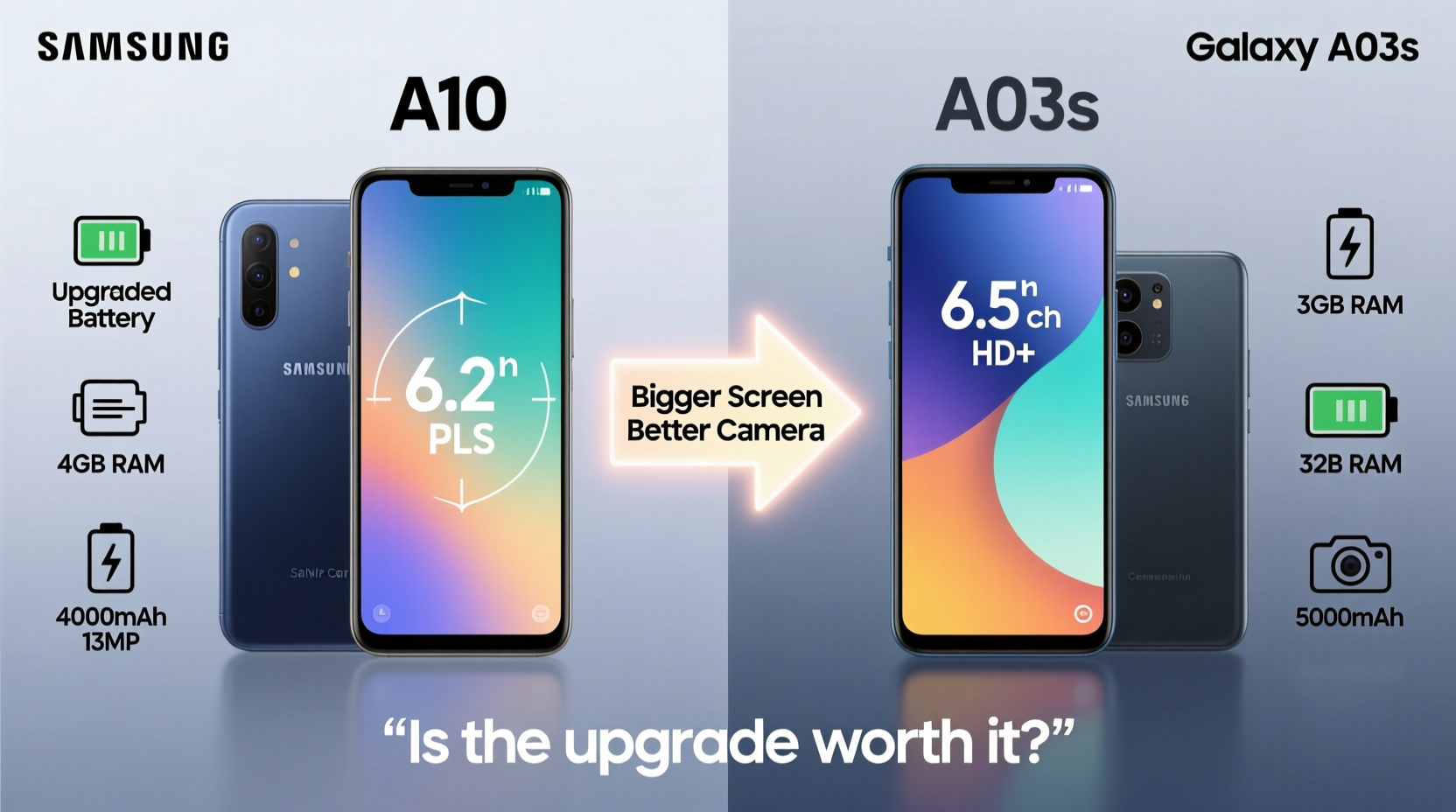
At first glance, the Galaxy A10 and A03s appear nearly identical. Both feature plastic bodies, glossy finishes, and minimalist designs typical of Samsung’s budget lineup. The A10 measures 155.6 x 75.2 x 7.9 mm and weighs 140g, while the A03s is slightly larger at 164.2 x 76.1 x 9.1 mm and heavier at 196g. The added thickness and weight of the A03s are due to its significantly larger battery, which we’ll explore later.
The A10 uses a 6.2-inch PLS LCD display with a 720 x 1520 resolution (HD+), offering decent brightness for indoor use but lacking sharpness in direct sunlight. The A03s also features a 6.5-inch PLS LCD with the same HD+ resolution. While the screen is larger, pixel density is slightly lower due to the increased size—269 PPI on the A03s versus 271 PPI on the A10. In practice, the difference is negligible, but the A03s benefits from more screen real estate for videos and web browsing.
Performance Comparison: Hardware That Reflects Its Era
Under the hood, the differences become more apparent. The Galaxy A10 runs on Samsung’s Exynos 7884 chipset—an octa-core processor built on a 14nm process—paired with 2GB or 3GB of RAM and 32GB of storage. It was competitive in 2019 but shows its age today, particularly when multitasking or running modern apps like social media platforms or streaming services.
The A03s, released in 2022, uses the MediaTek MT6765 Helio P35—a 12nm chipset with eight Cortex-A53 cores. While not a powerhouse, it offers slightly better efficiency and thermal management than the Exynos 7884. It comes with 3GB or 4GB of RAM and 32GB or 64GB of expandable storage. Real-world usage shows smoother app launches and less frequent app reloading, especially with multiple tabs open.
In benchmark tests, the Helio P35 scores about 15–20% higher in CPU performance and up to 30% better in GPU tasks. However, neither phone handles gaming well. Titles like PUBG Mobile run at low settings with occasional stutters. For everyday tasks—calls, messaging, light browsing—the A03s feels noticeably more responsive.
“Budget phones aren’t meant to last five years, but choosing one with slightly better hardware can extend its usable lifespan by 12–18 months.” — Rajiv Mehta, Mobile Analyst at TechPulse Asia
Battery Life: Where the A03s Truly Shines
If there’s one area where the A03s clearly outperforms the A10, it’s battery life. The A10 packs a 3,400mAh battery, which typically lasts a full day with moderate use. Heavy users may need to charge by late afternoon. The A03s, in contrast, boasts a massive 5,000mAh battery—nearly 50% larger capacity.
Real-world testing shows the A03s consistently delivering 1.5 to 2 days of use on a single charge, even with YouTube streaming, WhatsApp, and background notifications active. This makes it ideal for users who travel frequently or lack reliable access to charging points.
However, charging speed hasn’t improved much. Both phones support only 10W charging, meaning a full recharge takes over two hours. Neither includes fast charging in the box, so upgrading won’t save time at the outlet—but it will reduce how often you need to plug in.
Camera Quality: Modest Improvements, Same Limitations
Both phones feature basic dual-camera setups. The A10 has a 13MP main sensor and a 5MP ultra-wide lens, while the A03s upgrades to a 13MP main and a 2MP depth sensor. Note the shift: the A03s loses the ultra-wide but gains a depth sensor for portrait mode effects.
In daylight, both capture acceptable photos with accurate colors and adequate detail. However, the A03s processes images faster and applies slightly better noise reduction. Low-light performance remains poor on both—images are grainy, lack contrast, and suffer from motion blur without a tripod.
The front cameras are nearly identical: 5MP sensors with limited dynamic range. Selfies look soft and over-smoothed, though the A03s applies marginally better skin tone rendering.
| Feature | Samsung A10 | Samsung A03s |
|---|---|---|
| Display | 6.2” HD+ PLS LCD | 6.5” HD+ PLS LCD |
| Processor | Exynos 7884 | Helio P35 |
| RAM Options | 2GB / 3GB | 3GB / 4GB |
| Storage | 32GB (expandable) | 32GB / 64GB (expandable) |
| Rear Camera | 13MP + 5MP ultra-wide | 13MP + 2MP depth |
| Battery | 3,400mAh | 5,000mAh |
| Charging | 10W | 10W |
| OS (Launch) | Android 9 (Pie) | Android 11 (Go Edition) |
| Software Updates | Likely ended | Security updates until 2024 |
Software and Longevity: A Critical Factor
Software support is where the decision becomes clearer. The Galaxy A10 launched with Android 9 and received one major OS update to Android 10. It no longer receives security patches, leaving it vulnerable to newer threats. Running outdated software increases exposure to phishing attacks and app compatibility issues—many newer versions of WhatsApp, Google apps, and banking apps are beginning to phase out support for older Android versions.
The A03s shipped with Android 11 (Go Edition), optimized for devices with limited RAM. It has received updates to Android 12 Go Edition and continues to receive monthly security patches as of mid-2024. This means better app compatibility, improved privacy controls, and longer usability.
If you rely on digital banking, ride-sharing, or government e-services, staying on a supported OS is crucial. The A03s provides peace of mind in this regard, even if the interface feels basic.
Mini Case Study: Maria’s Upgrade Decision
Maria, a small grocery vendor in Cebu, used her Galaxy A10 for three years to manage orders, track inventory, and communicate with suppliers. By 2023, the phone began freezing during peak hours, taking minutes to load messaging apps. She considered buying a second-hand iPhone but settled on the A03s after consulting a local technician.
“The bigger battery means I don’t have to carry a power bank anymore,” she said. “And my delivery apps don’t close in the background as much. It’s not fancy, but it works when I need it most.”
For Maria, the upgrade wasn’t about premium features—it was about reliability. The A03s reduced downtime during business hours, directly impacting her income. Her experience reflects what many budget-conscious users face: incremental improvements can have outsized real-world benefits.
Is Upgrading Worth It? A Practical Checklist
Before making a decision, consider your actual needs. Use this checklist to determine whether moving from the A10 to the A03s (or choosing between them) makes sense:
- ✅ Is your current phone struggling with app crashes or slow response times?
- ✅ Do you find yourself charging more than once a day?
- ✅ Are you unable to update critical apps like WhatsApp or Google Play Services?
- ✅ Do you rely on your phone for work, communication, or financial transactions?
- ✅ Is your device no longer receiving security updates?
If you answered yes to two or more, upgrading to the A03s is likely worthwhile. The improvements in battery, RAM, and software support address core pain points of aging budget phones.
Frequently Asked Questions
Can the A03s run TikTok and Instagram smoothly?
Yes, with minor lag when switching between apps. Both apps function reliably on 3GB RAM, though high-resolution video uploads may take longer.
Is the A03s waterproof?
No. Neither the A10 nor the A03s has an IP rating. Avoid exposure to water or moisture.
Will the A03s get Android 13?
Unlikely. Samsung typically provides one major OS update for A-series Go Edition devices. Security updates are expected through 2024, but no further Android version upgrades are planned.
Final Verdict: Incremental Gain, Real Impact
On paper, the jump from the Samsung A10 to the A03s may seem minor—similar displays, comparable cameras, and modest processor upgrades. But in daily use, the differences add up. The A03s delivers longer battery life, better multitasking, and continued software support, addressing the most common frustrations of A10 users.
If you’re still using an A10 and experiencing slowdowns or short battery life, upgrading to the A03s is a practical, cost-effective move. At typical price points of $80–$110, it extends your smartphone usability by another 18–24 months without breaking the bank.
For new buyers choosing between the two, the A03s is the clear winner—not because it’s powerful, but because it’s dependable. In the budget segment, that reliability is often the most valuable feature of all.




 浙公网安备
33010002000092号
浙公网安备
33010002000092号 浙B2-20120091-4
Comments
No comments yet. Why don't you start the discussion?