
Choosing between the Samsung Galaxy A10e and the Galaxy S10 isn’t just about price tags—it’s about understanding what you’re actually gaining with a premium device. The A10e launched as an entry-level phone with a budget-friendly price, while the S10 represented Samsung’s flagship lineup at the time. But does the jump in cost deliver a proportional leap in experience? Or are consumers simply paying for a logo and legacy?
This comparison dives deep into hardware, software, user experience, and long-term value to help answer whether upgrading from the A10e to the S10 makes practical sense—or if the extra expense only buys prestige.
Design and Build Quality: Plastic vs Premium
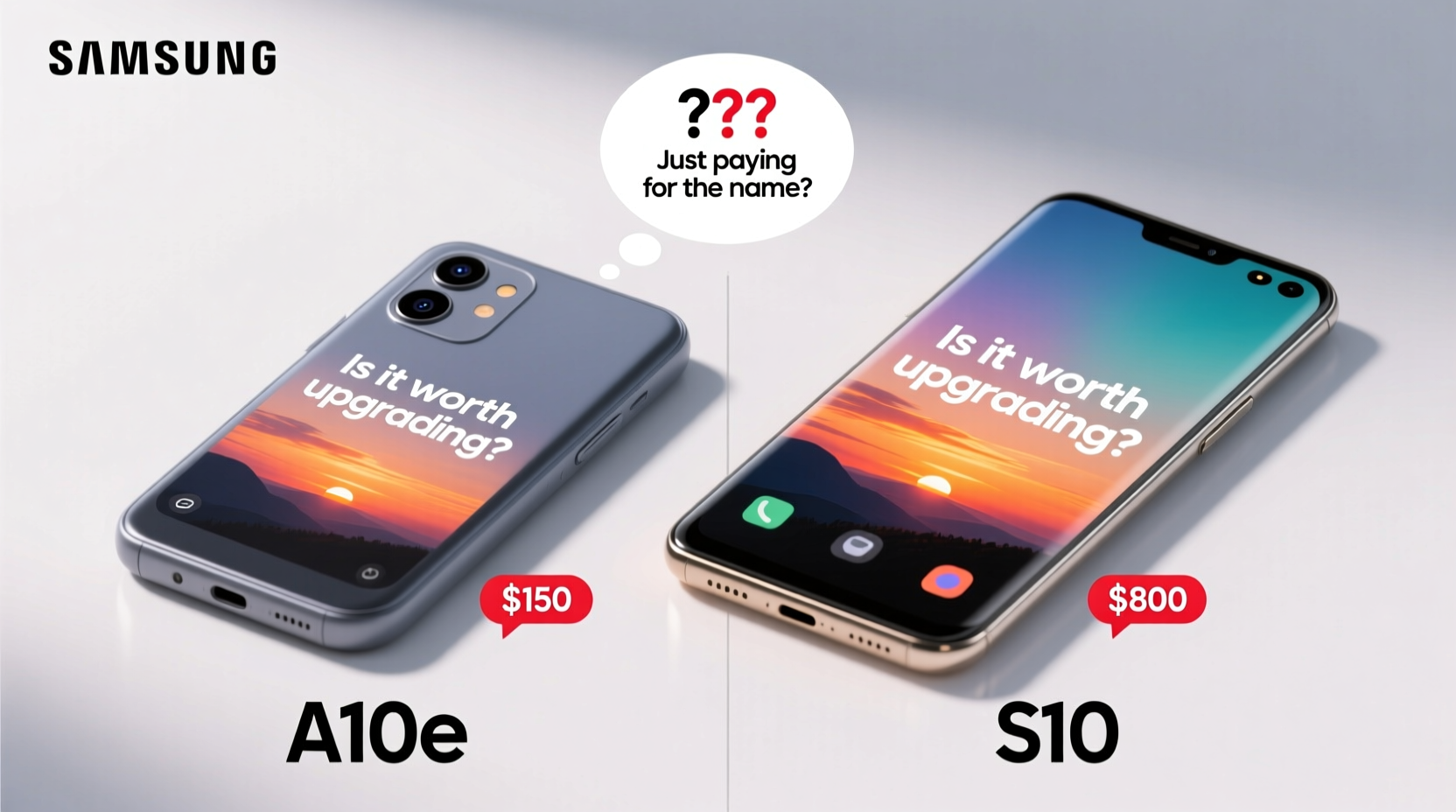
The most immediate difference between the A10e and S10 lies in how they feel in your hand. The A10e uses a polycarbonate (plastic) body with a glossy finish that attracts fingerprints and feels lightweight—sometimes to the point of seeming flimsy. Its 5.8-inch HD+ display is functional but lacks vibrancy and sharpness compared to higher-end models.
In contrast, the S10 features a glass front and back with an aluminum frame, giving it a sleek, high-end aesthetic. It's noticeably lighter than many flagships despite packing more components, thanks to efficient internal design. The 6.1-inch Dynamic AMOLED display supports HDR10+, offers deeper blacks, brighter colors, and a resolution of 1440p—making media consumption significantly more immersive.
Performance Comparison: Entry-Level vs Flagship Power
Under the hood, these phones are worlds apart. The A10e runs on Samsung’s Exynos 7884B—a modest octa-core processor paired with just 2GB of RAM. This setup handles basic tasks like calling, texting, light web browsing, and social media apps adequately, but struggles with multitasking or demanding applications.
The S10, however, uses the Qualcomm Snapdragon 855 (or Exynos 9820 depending on region), one of the top-tier chips of its generation, combined with 8GB of RAM. This enables smooth performance across all scenarios: gaming, photo editing, video streaming, and even early augmented reality experiences. Apps launch faster, animations are fluid, and background processes don’t slow things down.
“Flagship processors aren’t just about speed—they enable longer software support and better optimization over time.” — David Kim, Mobile Hardware Analyst at TechPulse Insights
Real-World Example: Daily Use Differences
Consider Maria, a college student using her A10e for note-taking, online classes, and messaging. She finds herself closing apps repeatedly because the phone freezes when too many are open. Switching between Zoom, Google Docs, and Chrome becomes frustrating. After upgrading to an S10, she notices near-instant app switching, no lag during video calls, and smoother navigation through large PDFs and multimedia files. For her workflow, the upgrade wasn't luxury—it was necessity.
Camera Capabilities: One Lens vs Three That Matter
The A10e comes with a single 13MP rear camera and a 5MP front-facing shooter. While it captures decent daylight photos, low-light performance is poor, dynamic range is limited, and there’s no optical stabilization. There’s also no ultra-wide or depth sensor, restricting creative options.
The S10 introduces a triple-camera system: a 12MP main sensor with dual aperture (f/1.5–f/2.4), a 12MP telephoto lens, and a 16MP ultra-wide lens. This allows users to capture landscapes with dramatic scope, zoom without quality loss, and shoot professional-looking portraits with accurate bokeh effects. Front camera quality is also superior at 10MP with autofocus.
| Feature | Samsung A10e | Samsung S10 |
|---|---|---|
| Rear Cameras | 13MP (Single) | 12MP (Main) + 12MP (Telephoto) + 16MP (Ultra-Wide) |
| Front Camera | 5MP | 10MP with Autofocus |
| Video Recording | 1080p @ 30fps | 4K @ 60fps, HDR10+ |
| Low-Light Performance | Poor, noisy images | Excellent with adaptive aperture |
| Zoom Capability | Digital only | 2x Optical Zoom |
Battery Life and Charging: Efficiency vs Flexibility
The A10e packs a 3,100mAh battery, which lasts about a day with moderate use. However, due to its lower-resolution screen and less powerful processor, it doesn’t drain quickly under minimal load. It charges via microUSB, a dated port by today’s standards.
The S10 has a slightly larger 3,400mAh battery but powers a more advanced display and chipset. Despite this, optimizations in the OS and hardware allow it to match or slightly exceed the A10e in real-world endurance. More importantly, it supports fast charging (15W), wireless charging, and even reverse wireless charging—letting you power up earbuds or another phone from the back of the device.
Software and Longevity: How Long Will Your Phone Last?
One often overlooked factor is software support. The A10e received two major Android updates (from Android 9 to Android 11) and limited security patches. By 2023, it no longer receives official updates, leaving it vulnerable and incompatible with newer app requirements.
The S10, as part of Samsung’s flagship line, enjoyed four years of OS upgrades (up to Android 13) and ongoing monthly security updates until late 2024. This extended lifecycle means better app compatibility, improved privacy features, and access to new tools like enhanced digital wellbeing and Knox security enhancements.
Checklist: Should You Upgrade from A10e to S10?
- Are you frustrated by slow app launches or frequent crashes? → Yes? S10 helps.
- Do you take photos regularly, especially in varied lighting? → S10’s camera system excels.
- Is wireless charging or fast charging important to your routine? → Only available on S10.
- Do you plan to keep your phone for more than two years? → S10 offers longer software support.
- Are you constantly running out of storage? → S10 starts at 128GB vs A10e’s 32GB.
Frequently Asked Questions
Is the S10 still worth buying in 2024?
Yes, if purchased secondhand or refurbished at a discounted price. While not cutting-edge, the S10 still handles daily tasks efficiently, supports modern apps, and delivers excellent camera quality. Just ensure it hasn’t degraded battery-wise and runs at least Android 12.
Can the A10e handle social media and streaming?
Absolutely—for basic usage. Facebook, Instagram, YouTube, and Spotify work fine, provided you don’t multitask heavily. However, expect occasional stutters, slower loading times, and reduced video clarity on its HD screen.
Does the S10 justify its original price tag?
At launch, yes. As a 2019 flagship, it introduced several firsts for Samsung: ultrasonic fingerprint sensor, hole-punch display, and pro-grade cameras. Today, its value lies in resale affordability and proven reliability—not in being “new.”
Conclusion: Paying for Name or Real Value?
The gap between the A10e and S10 goes well beyond branding. While Samsung’s name carries weight, the S10 backs it up with tangible improvements: superior materials, responsive performance, versatile photography, and meaningful longevity. You're not just paying for a logo—you're investing in an experience that lasts longer, performs better, and adapts to evolving digital demands.
That said, if your needs are minimal—calls, texts, occasional browsing—the A10e may still suffice. But for anyone who relies on their phone for productivity, creativity, or connectivity, the S10 represents a significant and worthwhile step up.




 浙公网安备
33010002000092号
浙公网安备
33010002000092号 浙B2-20120091-4
Comments
No comments yet. Why don't you start the discussion?