
When Samsung launched the Galaxy S9 in 2018, it was a flagship device with top-tier features for its time—excellent camera, premium build, and powerful internals. Fast forward to 2024, and many users still hold onto their S9s, wondering if they should upgrade. Meanwhile, budget models like the Samsung Galaxy A12 offer modern designs and longer battery life at a fraction of the cost. But how do these two phones truly compare today? And more importantly, is moving from an S9 to an A12—or any newer mid-range phone—actually worthwhile?
This isn’t just about specs on paper. It’s about real-world usability, software support, longevity, and whether the upgrade improves your daily experience enough to justify the cost.
Performance & Hardware: Then vs Now
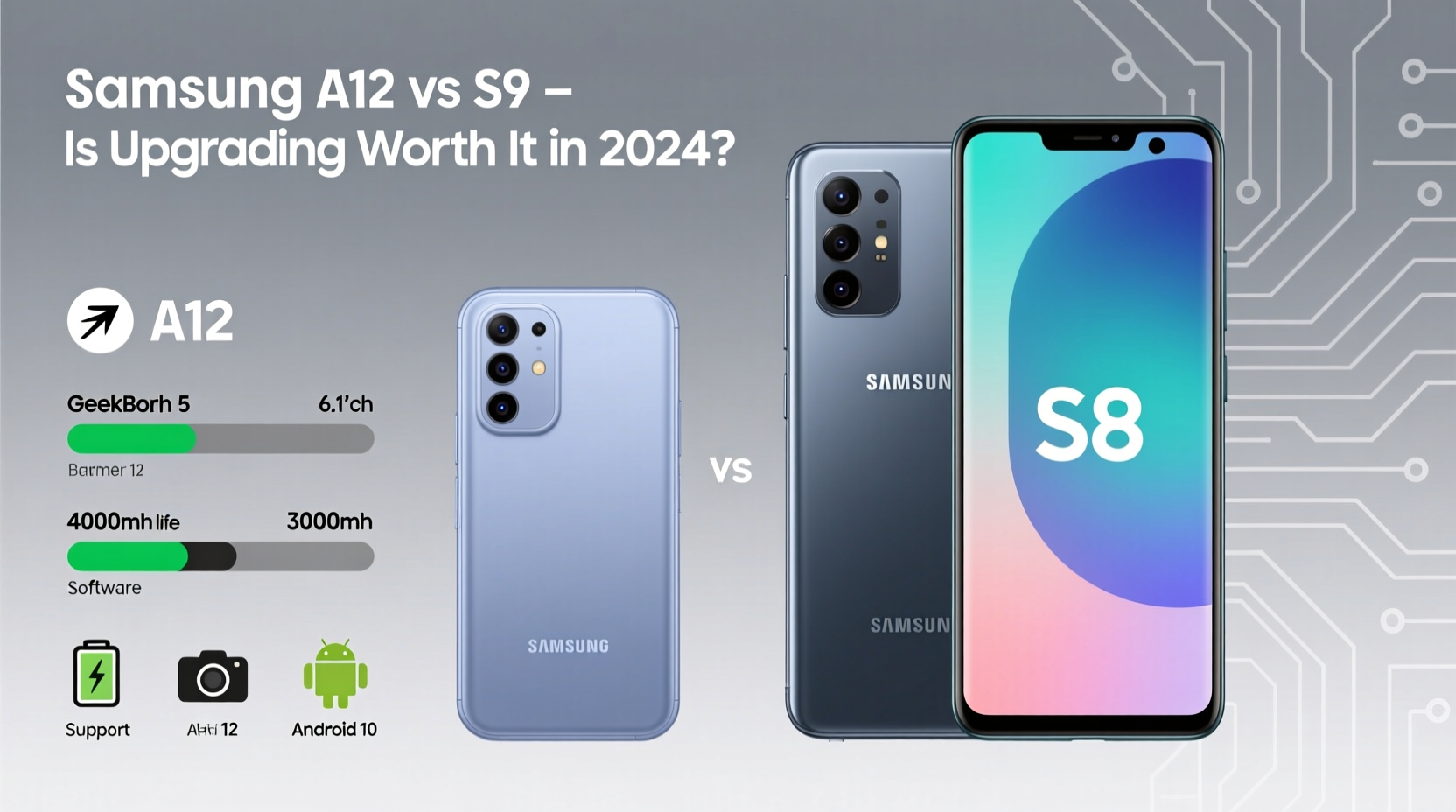
The Galaxy S9 ran on either the Snapdragon 845 (in most global markets) or Exynos 9810, both high-end chips in 2018. Paired with 4GB of RAM, the S9 delivered smooth multitasking, strong gaming performance, and excellent responsiveness. Even in 2024, some users report that the S9 handles basic tasks well—though app launches are slower, and background app reloading is frequent due to outdated hardware.
In contrast, the Galaxy A12 uses the MediaTek Helio P35 or Exynos 850 (depending on region), paired with 3GB or 4GB of RAM. While this chip is built on a more modern process and supports newer connectivity standards like LTE Cat.7 and Bluetooth 5.0, it's significantly less powerful than the S9’s processor. Benchmarks show the S9 outperforming the A12 in CPU and GPU tasks by a wide margin.
However, raw power isn’t everything. The A12 runs Android 11 (upgradable to Android 12), giving it access to newer features, better security patches, and improved system-level optimizations. The S9 officially stopped receiving major OS updates after Android 10, though it got security patches until late 2022. In 2024, it no longer receives any official support.
Camera Comparison: Quality Over Time
The S9 featured a 12MP rear sensor with Dual Pixel autofocus and variable aperture (f/1.5–f/2.4), which allowed impressive low-light photography for its era. Its camera software was refined, with accurate color reproduction and solid dynamic range. In daylight, it still holds up reasonably well compared to entry-level cameras today.
The A12 has a quad-camera setup: 48MP main, 5MP ultrawide, 2MP macro, and 2MP depth sensor. On paper, this sounds superior. However, the higher megapixel count doesn’t translate to better photos. The 48MP sensor uses pixel binning (combining pixels into 12MP output), and the resulting images often lack detail, suffer from oversharpening, and perform poorly in low light. The ultrawide lens is soft at the edges, and the AI enhancements tend to over-saturate colors.
Realistically, the S9 produces more consistent, natural-looking photos in good lighting. But the A12 offers features the S9 lacks: night mode, portrait mode with multiple lenses, and ultrawide shots. For social media sharing or casual snaps, the A12 might feel “newer,” even if image fidelity isn’t better.
“Older flagships often outperform new budget phones in core areas like photo quality and processing speed. Don’t assume newer always means better.” — David Kim, Mobile Tech Analyst at GadgetInsight
Battery Life & Charging: Where the A12 Shines
This is where the A12 clearly wins. With a 5000mAh battery, it typically lasts two days with moderate use. The S9, equipped with a 3000mAh cell, struggled to make it through a full day even when new—and today, after years of charging cycles, most S9 batteries have degraded significantly.
The A12 supports 15W fast charging (though often shipped with a 10W charger), while the S9 supported Quick Charge 2.0 and Adaptive Fast Charging. Neither supports wireless charging. However, the sheer capacity difference makes the A12 far more practical for users who rely on their phone throughout the day without easy access to outlets.
| Feature | Samsung Galaxy S9 | Samsung Galaxy A12 |
|---|---|---|
| Battery Capacity | 3000 mAh | 5000 mAh |
| Fast Charging | Yes (QC 2.0) | Yes (15W max) |
| Wireless Charging | Yes | No |
| Estimated Daily Use | ~1 day (if battery healthy) | 1.5–2 days |
Display & Build: Design Evolution vs Premium Feel
The S9 had a 5.8-inch Quad HD+ Super AMOLED display with vibrant colors, deep blacks, and excellent viewing angles. Its glass-and-metal build felt premium, and it was IP68 water-resistant—a feature still missing on the A12.
The A12 has a larger 6.5-inch HD+ PLS LCD screen. While bigger, it’s noticeably less sharp, has lower contrast, and appears washed out compared to the S9’s OLED panel. The plastic build feels lightweight and less durable, and there’s no water resistance. However, the larger screen suits video streaming and reading, and the taller 20:9 aspect ratio accommodates modern app layouts better.
If you value display quality and craftsmanship, the S9 still impresses. But if you prioritize screen size and don’t mind trading resolution for battery efficiency, the A12 offers a more contemporary form factor.
Software & Long-Term Usability in 2024
This is a critical point. The S9 reached end-of-life for software updates in 2022. It runs Android 10 with One UI 2.5—missing key privacy features, permission controls, and security patches released since then. Many modern apps either run poorly or no longer support such old OS versions. Banking apps, messaging platforms, and even some Google services may display warnings or fail to function properly.
The A12, while not a long-term update champion, received Android 12 and will likely receive security updates into 2024 or early 2025. It supports newer APIs, biometric authentication improvements, and better background app management. For everyday reliability and compatibility, the A12 has a clear edge.
Mini Case Study: Maria’s Dilemma
Maria has used her Galaxy S9 since 2018. By 2023, she noticed her phone struggling: apps crashed frequently, GPS took minutes to lock, and her battery died by noon. She considered buying another used flagship but found prices high for older models. After researching, she bought a Galaxy A12 for $150.
She missed the compact size and sleek design of the S9 but appreciated the all-day battery, larger screen for videos, and smoother performance in WhatsApp, Instagram, and Google Maps. The camera wasn’t as reliable, but she mostly shares photos online, where differences were negligible. Most importantly, her banking app finally worked without constant timeouts.
For Maria, the upgrade wasn’t about getting a “better” phone in every way—but about regaining reliability and peace of mind.
Upgrade Checklist: Are You Ready?
Before deciding whether to move from an S9 to a budget phone like the A12, consider this checklist:
- ✅ Is your S9 battery swollen or lasting less than 4 hours under light use?
- ✅ Are you unable to install critical apps or updates due to OS limitations?
- ✅ Do you frequently charge during the day or carry a power bank?
- ✅ Have repair costs (screen, battery) become recurring expenses?
- ✅ Are you okay with trading premium materials for longer battery life?
If three or more apply, upgrading—even to a budget model—makes practical sense.
Frequently Asked Questions
Can the Galaxy S9 still be used safely in 2024?
Possibly, but not recommended for primary use. Without security updates, it’s vulnerable to exploits. If you must keep it, avoid storing sensitive data, disable unknown sources, and refrain from using financial apps.
Is the Samsung A12 a good replacement for the S9?
It depends on priorities. If you want longer battery life, a larger screen, and current software support, yes. But don’t expect faster performance or better camera quality. Think of it as a functional successor, not a direct upgrade.
Should I spend more for a better mid-range phone instead?
Absolutely. Phones like the Galaxy A34 or A54 offer better processors, brighter displays, longer software support (up to 4 years), and improved cameras. For $250–$350, you gain meaningful upgrades over both the S9 and A12.
Final Verdict: Is Upgrading Worth It?
Upgrading from a Galaxy S9 to a Galaxy A12 in 2024 isn’t about gaining superior performance or photographic prowess—it’s about escaping obsolescence. The A12 won’t outshine the S9 in every category, but it addresses the most pressing issues: battery life, software relevance, and app compatibility.
For users clinging to a dying S9, the A12 represents a low-cost lifeline into the present mobile ecosystem. But if your budget allows, consider spending slightly more for a device with longer update support and better overall balance. The true value of an upgrade lies not in the device itself, but in how much it improves your daily digital life.




 浙公网安备
33010002000092号
浙公网安备
33010002000092号 浙B2-20120091-4
Comments
No comments yet. Why don't you start the discussion?