
Choosing between the Samsung Galaxy A15 and the Galaxy A54 isn’t just about price tags—it’s about understanding what each phone offers in real-world use. While both fall under Samsung’s popular A-series lineup, they serve different audiences. The A15 is an entry-level device designed for budget-conscious users, while the A54 occupies a mid-range position with noticeably better hardware and longevity. At first glance, they might seem similar due to shared design language and software, but beneath the surface, the differences are significant enough to impact daily experience.
This comparison dives deep into build quality, display, performance, camera capabilities, battery life, and software support to answer the core question: Is upgrading from the A15 to the A54—or buying the A54 instead—actually worth it?
Design and Build Quality: Plastic vs Purposeful Premium
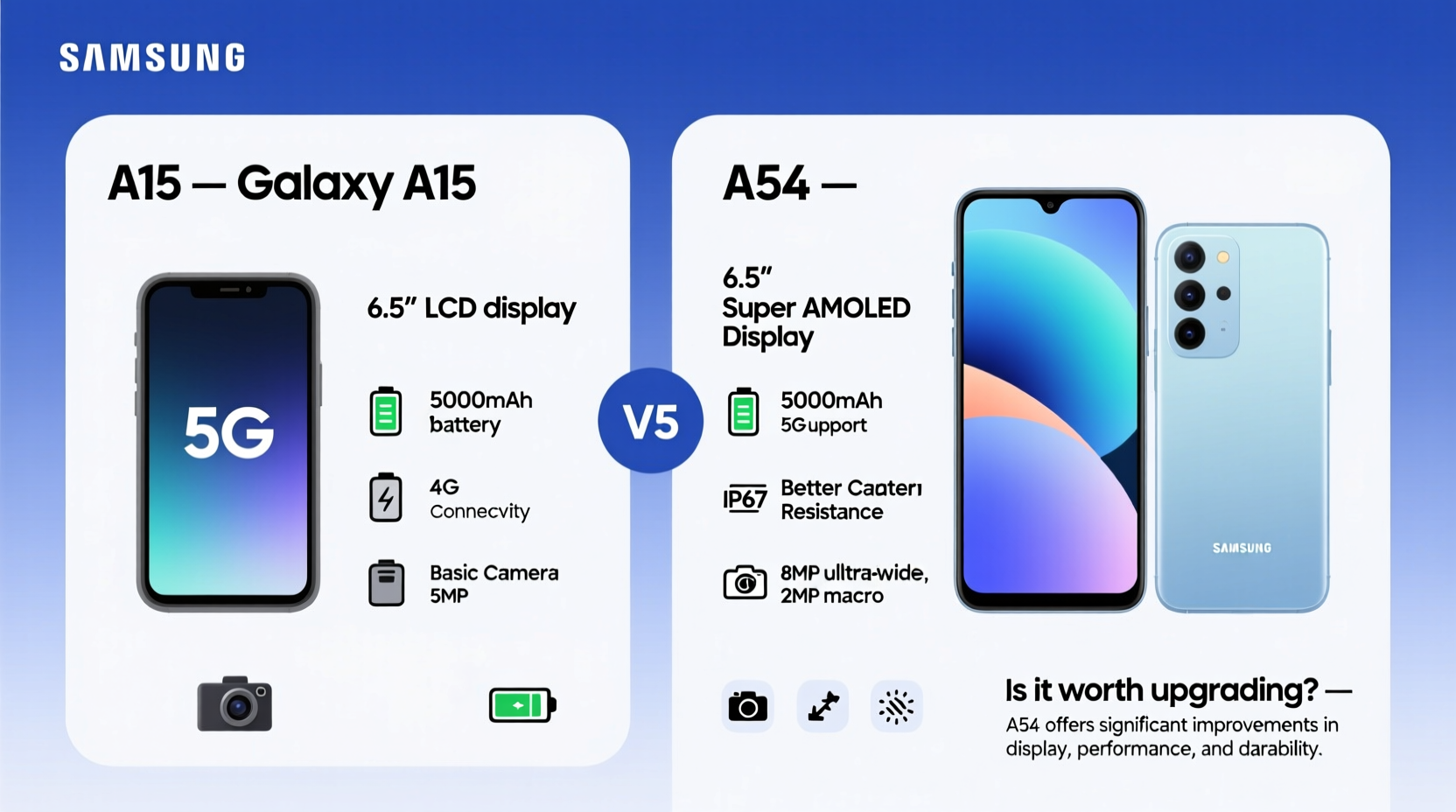
The Galaxy A15 features a traditional plastic build with a glossy finish that attracts fingerprints and scratches easily. It's lightweight at 188g, making it comfortable for long use, but it lacks durability and feels less refined in hand. The back panel is prone to smudges, and the frame doesn’t offer much grip, increasing the risk of drops.
In contrast, the A54 uses a matte-finish polycarbonate back with a more premium texture. While still plastic, the material choice reduces fingerprints and improves grip. It’s slightly heavier at 202g, but that extra heft contributes to a more solid feel. More importantly, the A54 includes IP67 dust and water resistance—a feature absent on the A15. This means the A54 can survive short submersion in water and resist dust ingress, a major advantage for real-world durability.
Display: Brightness and Resolution Matter
Both phones sport 6.5-inch Super AMOLED displays with Full HD+ resolution (1080 x 2340), which is impressive for their categories. However, there are subtle but meaningful differences.
The A15 runs at 60Hz refresh rate, resulting in less fluid scrolling and animations. It peaks at around 800 nits brightness, adequate indoors but struggles in direct sunlight. The A54, on the other hand, supports a 120Hz adaptive refresh rate. This means smoother transitions, faster response times, and a more enjoyable overall visual experience—especially when browsing, gaming, or using social media.
Additionally, the A54 reaches up to 1000 nits peak brightness, making outdoor visibility significantly better. Combined with Corning Gorilla Glass 5 protection (versus unnamed glass on the A15), the A54’s screen is not only sharper in motion but also more durable and readable in daylight.
Performance and Hardware: Entry-Level vs Mid-Range Muscle
The performance gap between these two devices is one of the most decisive factors. The Galaxy A15 is powered by the MediaTek Helio G99, a capable chip for basic tasks like calling, messaging, light web browsing, and streaming video. However, multitasking or running graphically intensive apps—like modern mobile games or photo editing tools—can cause noticeable lag.
The A54 steps up with the Exynos 1380 processor, built on a 5nm process. Paired with options of 6GB or 8GB RAM, this chipset delivers significantly better CPU and GPU performance. Users will notice quicker app launches, seamless switching between apps, and smoother gameplay even in titles like Genshin Impact at medium settings.
Benchmarks reflect this: the A54 scores roughly 40–50% higher in Geekbench tests and nearly double in graphics performance. For anyone who uses their phone beyond passive consumption—such as students, remote workers, or content creators—the A54 offers a far more responsive and future-proof experience.
“Mid-range processors like the Exynos 1380 have closed the gap with flagships in everyday use, making them ideal for users who want longevity without paying premium prices.” — David Kim, Mobile Hardware Analyst at TechPulse Asia
Camera Comparison: From Basic Snaps to Real Versatility
On paper, both phones feature quad-camera setups, but execution differs dramatically.
| Feature | Samsung A15 | Samsung A54 |
|---|---|---|
| Main Sensor | 50MP (f/1.8) | 50MP (f/1.8, OIS) |
| Ultrawide | 5MP (f/2.2) | 12MP (f/2.2) |
| Macro & Depth | 2MP + 2MP | 5MP (micro-macro) + 5MP (depth) |
| Front Camera | 13MP | 32MP |
| Video Recording | 1080p @ 30fps | 4K @ 30fps, 1080p @ 60fps |
The key differentiator is optical image stabilization (OIS) on the A54’s main sensor. This allows for sharper photos in low light and steadier video recording. The ultrawide lens is also vastly superior—12MP versus a blurry 5MP—resulting in detailed wide-angle shots rather than soft, grainy images.
Low-light photography is where the A54 truly shines. Its larger pixel binning, improved processing, and Night Mode algorithms produce cleaner, brighter images with accurate colors. Selfie quality is also elevated thanks to the 32MP front camera, ideal for video calls and social media content.
Real Example: Maria’s Upgrade Experience
Maria, a freelance photographer assistant, used the A15 for over a year. She found herself constantly frustrated during site visits—low-light shots were unusable, and she had to carry a separate compact camera. After upgrading to the A54, she eliminated that extra gear. “The OIS alone changed how I work,” she said. “I can now capture reference shots clients actually appreciate. And shooting 4K video for mood reels? That wasn’t possible before.”
Battery and Software: Longevity Beyond Specs
Both models include a 5,000mAh battery, so endurance is comparable under light use—around 1.5 days. However, the A54’s more efficient Exynos 1380 and optimized 120Hz display (which adjusts based on content) often result in slightly better battery management despite higher performance demands.
Charging speed is identical—25W fast charging supported, though the charger may not be included in-box depending on region.
Where the A54 pulls ahead decisively is software support. Samsung promises **four generations of Android OS upgrades and five years of security patches** for the A54. The A15, being an entry-level model, receives only two OS updates and four years of security updates. Over time, this affects app compatibility, security, and feature availability. For a phone expected to last 3–4 years, that difference is critical.
Is the Upgrade Worth It? A Decision Checklist
Ask yourself the following to determine whether moving from the A15 to the A54 makes sense:
- Do you regularly use your phone for photography or video? → A54 wins
- Do you play mobile games or use productivity apps? → A54 handles them better
- Are you concerned about durability and water exposure? → Only A54 has IP67
- Do you plan to keep your phone for 3+ years? → A54 offers longer software support
- Is your budget under $300? → A15 remains a solid budget option
Frequently Asked Questions
Can the A15 handle everyday tasks like WhatsApp and YouTube?
Yes. For basic communication, social media, and video streaming, the A15 performs adequately. However, expect occasional stutters when switching apps or loading complex web pages.
Does the A54 justify its higher price?
If you value smooth performance, better cameras, and longer software support, yes. The $150–$200 price difference translates into tangible improvements that enhance daily usability and device lifespan.
Are the phones the same size and easy to hold?
They’re very similar in dimensions, but the A54 feels more balanced due to its textured back and symmetrical bezels. The A15’s slippery finish makes one-handed use riskier.
Final Verdict: Not the Same Phone at All
The Samsung Galaxy A15 and A54 may share branding and some superficial similarities, but they are designed for different users with different needs. The A15 is a competent budget phone for those prioritizing cost above all else. The A54, however, is a well-rounded mid-ranger that punches above its weight in performance, camera quality, and long-term reliability.
Upgrading from the A15 to the A54 isn’t just about better specs—it’s about gaining a more responsive, durable, and future-ready device. If your budget allows, the investment pays off in smoother operation, better photos, and extended usability. For many users, especially those relying on their phone for work, creativity, or active lifestyles, the A54 isn’t just worth the upgrade—it’s the smarter long-term choice.




 浙公网安备
33010002000092号
浙公网安备
33010002000092号 浙B2-20120091-4
Comments
No comments yet. Why don't you start the discussion?