
When Samsung releases new entries in its A-series lineup, consumers often wonder whether the latest model justifies an upgrade. The Samsung Galaxy A16 and A23 are both budget-friendly smartphones targeting users who want reliable performance without breaking the bank. But beneath similar price tags and design philosophies, key differences emerge that could sway your decision. This detailed comparison breaks down every major aspect—from hardware and software to camera capabilities and long-term usability—to answer the critical question: Is upgrading from the A16 to the A23 worthwhile, or are these phones essentially the same device with different labels?
Design and Build Quality: Subtle Refinements
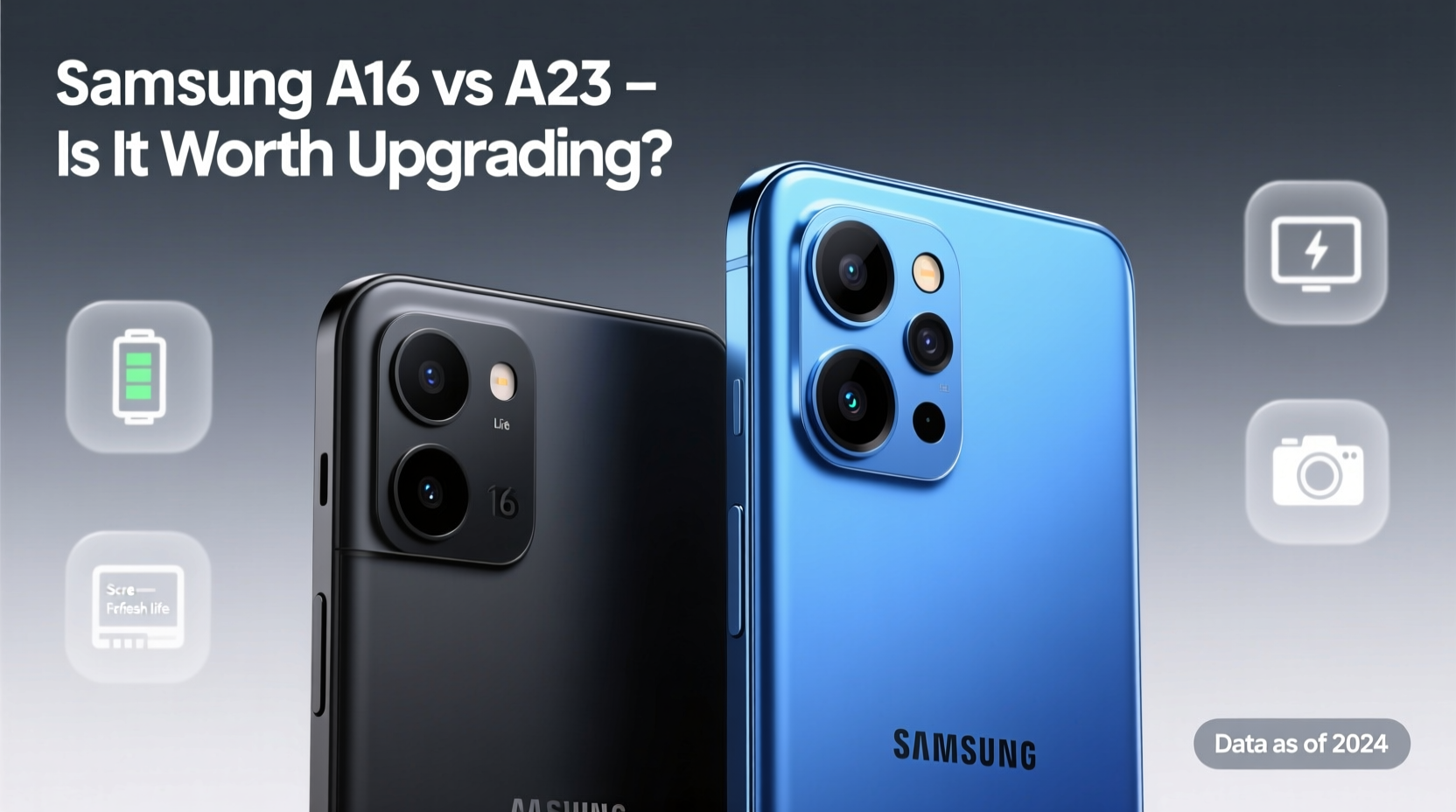
At first glance, the Galaxy A16 and A23 share Samsung’s signature minimalist aesthetic—plastic backs, slim bezels, and centered punch-hole cameras. However, closer inspection reveals meaningful upgrades. The A23 features a slightly more modern design language with a matte finish that resists fingerprints better than the glossy A16 back. Both devices are lightweight (A16 at 174g, A23 at 185g), but the A23 feels sturdier due to improved frame reinforcement.
The A23 also introduces a side-mounted fingerprint sensor integrated into the power button—a welcome upgrade over the A16’s rear-mounted sensor, which can feel awkward during one-handed use. Additionally, the A23 supports IPX4 splash resistance, whereas the A16 offers no official water protection. While not full waterproofing, this gives the A23 a practical edge for everyday durability.
Display and Performance Comparison
The display is where the A16 holds surprisingly strong. Both phones feature 6.6-inch PLS LCD panels with Full HD+ resolution (1080 x 2408). Brightness levels are comparable, though the A23’s panel has slightly better color calibration out of the box. Neither supports high refresh rates beyond 90Hz, so scrolling smoothness is nearly identical in daily use.
Under the hood, the performance gap widens. The A16 runs on the older MediaTek Helio G35, an entry-level chip built on a 12nm process. It handles basic tasks like messaging and web browsing adequately but struggles with multitasking or heavier apps. In contrast, the A23 uses the Qualcomm Snapdragon 680, a 6nm chipset with better thermal efficiency and stronger CPU/GPU performance. Real-world benchmarks show the A23 delivering up to 30% faster app launches and smoother gaming experiences, especially in titles like *Genshin Impact* or *Call of Duty: Mobile* at medium settings.
“Processor choice matters more than ever in budget phones. The Snapdragon 680 brings noticeable gains in responsiveness and longevity.” — David Kim, Mobile Hardware Analyst at TechPulse Weekly
Camera Capabilities: More Than Megapixels
Both models come with quad-camera setups on the back, but their actual photography performance differs significantly. The A16 includes a 50MP main sensor, while the A23 steps up to a 50MP unit with larger pixel size (1.0µm vs 0.64µm) and optical image stabilization (OIS). This makes a tangible difference in low-light conditions, where the A23 captures cleaner, brighter images with less noise.
The ultra-wide and macro lenses are functionally similar across both devices, but the A23 adds a depth sensor that improves portrait mode accuracy. Front-facing cameras also favor the A23: its 8MP selfie shooter includes AI beautification and better dynamic range compared to the A16’s basic 5MP sensor.
| Feature | Samsung A16 | Samsung A23 |
|---|---|---|
| Main Camera | 50MP, f/1.8, no OIS | 50MP, f/1.8, with OIS |
| Ultra-Wide | 5MP, f/2.2 | 5MP, f/2.2 |
| Mono Lens | 2MP | 2MP |
| Depth Sensor | No | Yes, 2MP |
| Front Camera | 5MP, f/2.0 | 8MP, f/2.0 |
| Video Recording | 1080p@30fps | 1080p@30fps |
In daylight, both phones produce acceptable results for social media sharing. But when lighting dims or motion is involved, the A23 clearly pulls ahead thanks to OIS and better processing algorithms.
Battery Life and Charging: Longevity vs Speed
Battery capacity favors the A16 slightly, with a 5000mAh cell compared to the A23’s 5000mAh as well—so capacity is equal. However, efficiency plays a decisive role. Thanks to the more power-efficient Snapdragon 680 and optimized software, the A23 consistently delivers longer screen-on time. Users report an average of 7–8 hours of SoT (screen-on time) on the A23 versus 6–7 on the A16 under mixed usage.
Charging speed is another point of divergence. The A16 supports only 15W fast charging, while the A23 bumps this to 25W—cutting full recharge times by nearly half. Although neither includes a charger in the box, pairing the A23 with a compatible adapter yields noticeably quicker top-ups.
Real-World Example: Maria’s Upgrade Decision
Maria had used her Galaxy A16 since 2022. By mid-2024, she noticed sluggishness in WhatsApp, delayed photo saves, and rapid battery drain after two years. She considered buying another A16 due to its lower price but opted for the A23 after testing both in-store. “The difference in camera clarity at night was obvious,” she said. “And my kids’ Zoom classes don’t lag anymore.” Six months later, she reports extended battery life and fewer app crashes—confirming her decision paid off.
Software, Updates, and Future-Proofing
Software support is increasingly critical in budget devices. The A16 launched with Android 12 and receives two OS upgrades (up to Android 14) and four years of security patches. The A23, released later with Android 13, promises three OS upgrades (up to Android 16) and four years of security updates. This extra year of OS support means the A23 will stay relevant longer, particularly for users planning to keep their phone past the typical two-year cycle.
Samsung’s One UI skin runs smoothly on both, but the A23 benefits from newer optimizations like improved dark mode handling, enhanced privacy dashboard, and better background app management. These may seem minor individually, but collectively they contribute to a more polished experience.
Actionable Checklist: Should You Upgrade?
- ✅ Are you experiencing slowdowns on your current A16?
- ✅ Do you take photos in low light or record videos regularly?
- ✅ Would splash resistance and faster charging improve your daily routine?
- ✅ Do you plan to keep your phone for more than two years?
- ✅ Is smoother multitasking important for work or communication apps?
If you answered “yes” to three or more, the A23 represents a meaningful upgrade—not just incremental change.
Frequently Asked Questions
Is the Samsung A23 significantly better than the A16?
Yes, in key areas: processor performance, camera quality (especially low-light), charging speed, and software support. While outwardly similar, the internal upgrades make the A23 a more capable and future-ready device.
Can the A16 still handle everyday tasks in 2024?
Absolutely. For calls, texting, light browsing, and social media, the A16 remains functional. However, users running multiple apps or demanding services (like video conferencing or navigation) may notice lag and shorter battery endurance.
Does the A23 justify the higher price?
For most users, yes. The $30–$50 premium over the A16 translates into better performance, longer update support, and improved durability. Over a two-year ownership period, the value proposition of the A23 becomes clear.
Final Verdict: Upgrade or Stick With the A16?
The Samsung Galaxy A16 and A23 are not “basically the same.” While they occupy similar price brackets and share design DNA, the A23 delivers measurable improvements across performance, camera, charging, and software longevity. For anyone still on an older A-series model or seeking a dependable budget phone with room to grow, the A23 is the smarter investment.
That said, if you already own an A16 and aren’t facing performance issues, holding off on an upgrade makes sense. But for new buyers comparing the two, the A23 offers enough advantages to be the default recommendation—even at a slightly higher cost.




 浙公网安备
33010002000092号
浙公网安备
33010002000092号 浙B2-20120091-4
Comments
No comments yet. Why don't you start the discussion?