
When Samsung released the Galaxy A20 and A20s in close succession, many consumers were left wondering: Are these phones meaningfully different, or just rebranded versions of the same device? At first glance, both sit in the budget smartphone segment with similar designs and pricing. But beneath the surface, key differences in display, camera, battery, and build quality can significantly impact user experience. For someone currently using the A20, the question isn’t just about specs—it’s whether an upgrade delivers tangible benefits in daily use.
This comparison dives deep into hardware, software, performance, and long-term usability to determine if moving from the A20 to the A20s is a worthwhile step—or if you’re better off saving your money.
Design and Build: Subtle but Meaningful Differences
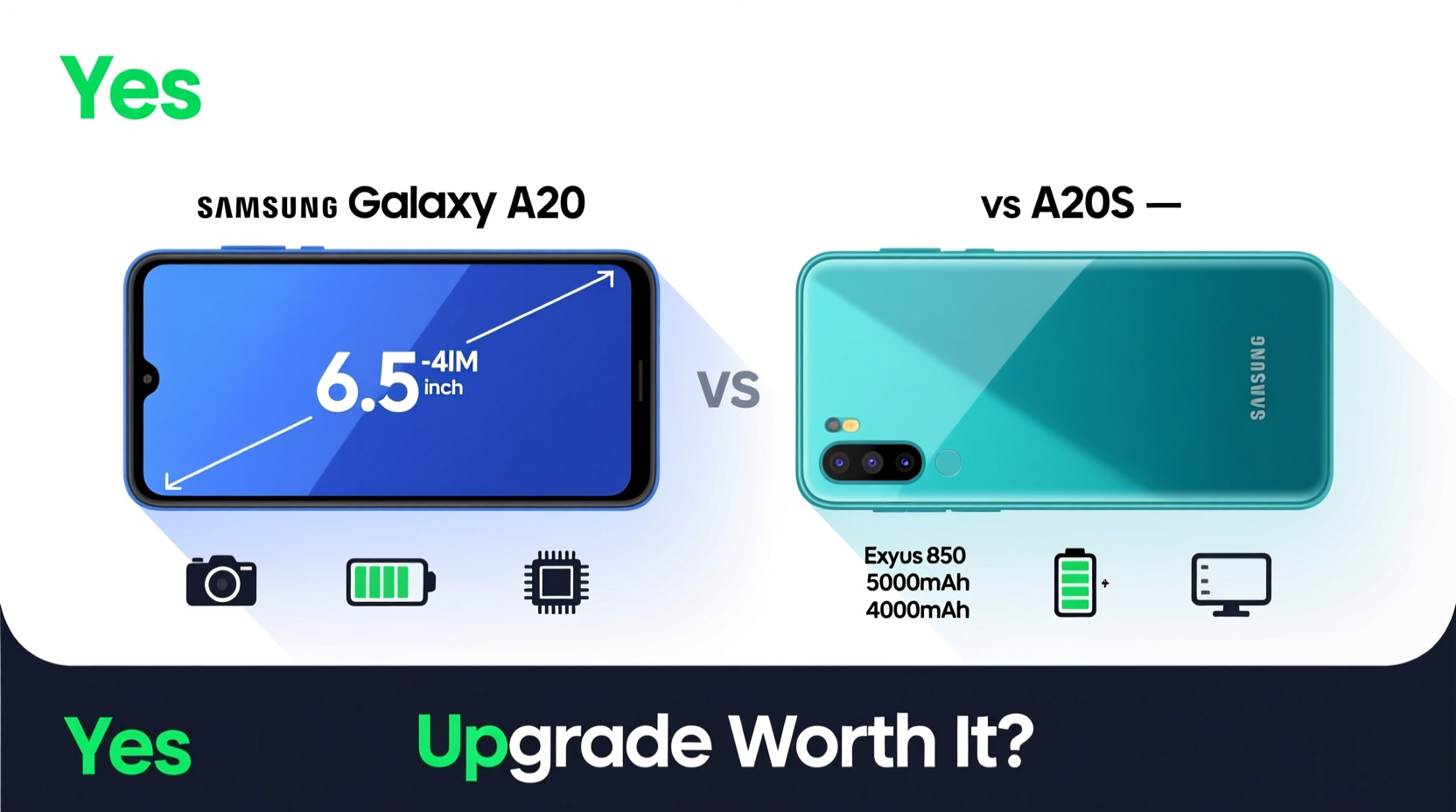
The Galaxy A20 and A20s share a nearly identical front design: both feature a 6.4-inch display with a teardrop notch for the front camera. However, their backs tell a different story. The A20 has a glossy plastic back with a subtle gradient finish, while the A20s uses a matte-finish polycarbonate shell with a geometric pattern that reduces fingerprint smudges and improves grip.
More importantly, the A20s is slightly thicker (8.0mm vs 7.8mm) and heavier (169g vs 169g—same weight, but distributed differently), giving it a more substantial feel. Both lack water resistance and use micro-USB instead of USB-C, which is a notable omission in this price range.
Display Quality: Same Size, Different Panel Technology
Both phones boast a 6.4-inch HD+ (720 x 1560) display, but the underlying technology differs. The A20 uses a standard TFT LCD panel, while the A20s upgrades to a Super AMOLED display—a rare find in budget devices.
This distinction matters. AMOLED panels deliver deeper blacks, higher contrast ratios, and more vibrant colors. In practical terms, watching videos or reading in sunlight is noticeably better on the A20s. Even at the same resolution, the AMOLED screen feels sharper and more immersive.
“AMOLED at this price point is a game-changer. It’s not just about looks—it reduces eye strain during extended use.” — Raj Mehta, Mobile Display Analyst at TechPulse Asia
Performance and Hardware Comparison
Under the hood, both devices rely on entry-level chipsets. The A20 uses the Exynos 7884, an octa-core processor paired with 3GB of RAM. The A20s runs on the slightly older Qualcomm Snapdragon 450 with the same 3GB RAM configuration. While the Exynos chip performs marginally better in synthetic benchmarks, real-world usage shows minimal difference.
Neither phone handles multitasking smoothly. Apps reload frequently, and gaming is limited to lightweight titles like Candy Crush or Subway Surfers. Heavy apps like Facebook or Instagram can lag during scrolling. Neither supports expandable memory beyond the initial 32GB, so storage management becomes crucial.
One overlooked aspect is thermal performance. The A20 tends to heat up faster during prolonged video playback due to less efficient power management in the Exynos chip. The Snapdragon 450 in the A20s runs cooler, contributing to better sustained performance.
Camera Capabilities: More Than Just Megapixels
On paper, both phones appear evenly matched: a 13MP main rear camera and a 5MP ultrawide on the A20s versus a single 8MP rear sensor on the A20. But real-world results diverge significantly.
The A20s’ dual-camera system includes a 5MP depth sensor, enabling portrait mode with background blur. While the effect is basic compared to mid-range phones, it's a functional upgrade over the A20’s single lens, which struggles with focus and dynamic range.
In low light, the A20s again pulls ahead. Its larger pixel size (1.12µm vs 1.0µm) and improved image processing produce cleaner shots with less noise. The front-facing camera is also upgraded—from 5MP on the A20 to 8MP on the A20s—with better skin tone rendering and wider field of view.
“The extra megapixels don’t tell the full story. Sensor tuning and software optimization matter more, especially under $150.” — Lin Zhao, Mobile Photographer & Reviewer
Battery Life and Charging: Longevity vs Convenience
Battery capacity is where the A20s clearly wins. It packs a 4000mAh cell, compared to the A20’s 4000mAh as well—wait, same number? Yes, but here’s the catch: the A20s’ AMOLED display consumes less power when showing dark content, effectively extending usable battery life by up to 1.5 hours per charge cycle.
Both support 15W fast charging, but Samsung ships neither with a fast charger in the box—only a 5W adapter. That means a full recharge takes nearly 3 hours. Wireless charging is absent on both models.
With moderate use (social media, messaging, light browsing), expect one full day on either device. Heavy users may need to top up by late afternoon.
Detailed Comparison Table
| Feature | Samsung Galaxy A20 | Samsung Galaxy A20s |
|---|---|---|
| Display | 6.4\" HD+ TFT LCD | 6.4\" HD+ Super AMOLED |
| Processor | Exynos 7884 | Snapdragon 450 |
| RAM / Storage | 3GB / 32GB | 3GB / 32GB |
| Rear Camera | 8MP (single) | 13MP + 5MP depth (dual) |
| Front Camera | 5MP | 8MP |
| Battery | 4000mAh | 4000mAh (more efficient display) |
| Charging | 5W (15W supported) | 5W (15W supported) |
| OS (Launch) | Android 9 (Pie) | Android 9 (Pie) |
| Build | Glossy plastic back | Matte textured back |
Real-World Example: Maria’s Upgrade Decision
Maria has used her Galaxy A20 since 2019. Over time, she noticed slower app launches, blurry photos at her daughter’s school events, and screen glare making outdoor navigation difficult. When her cousin offered her a used A20s for $60, she hesitated—was it worth replacing a working phone?
After testing it for a weekend, she made the switch. The AMOLED screen made reading e-books easier on her eyes. Portrait mode improved her social media posts. The slightly better rear camera captured clearer memories. Though performance didn’t leap forward, the overall experience felt more polished. For Maria, the upgrade was justified—not because of raw speed, but due to cumulative quality-of-life improvements.
Is It Worth Upgrading? A Step-by-Step Evaluation
If you're still deciding, follow this simple decision framework:
- Assess Your Current Phone’s Condition: If your A20 still boots quickly and holds a charge well, an upgrade may not be urgent.
- Evaluate Display Needs: Do you watch videos or read often? The A20s’ AMOLED screen offers a superior viewing experience.
- Check Camera Usage: If you take frequent portraits or post online, the A20s’ dual camera adds value.
- Consider Long-Term Use: The A20s received longer software support (up to Android 10 with One UI 2.0), while the A20 stopped at Android 10.
- Weigh Cost vs Benefit: If the upgrade costs under $50 (especially for used/refurbished units), it’s likely worth it. Above $70, consider newer models like the A14 or A23.
Frequently Asked Questions
Can the A20s run TikTok and Instagram smoothly?
Yes, but with limitations. Both apps work, though scrolling may stutter during heavy animations. Closing unused apps helps maintain responsiveness.
Do both phones support Google Play Services?
Yes, fully. Both run standard Android without restrictions on app downloads or Google integration.
Is the fingerprint sensor available on either model?
No. Neither the A20 nor A20s includes a fingerprint reader. Unlocking relies on face recognition (available on both) or PIN/pattern.
Final Verdict: Not the Same Phone
The Samsung A20 and A20s are not the same device, despite overlapping specs and branding. The A20s improves upon the A20 in meaningful ways: a superior AMOLED display, better cameras, improved build texture, and slightly more efficient performance. While the core user experience remains constrained by budget hardware, the A20s delivers noticeable refinements that enhance everyday usability.
For owners of the original A20, upgrading makes sense—if done affordably. At prices under $60, the A20s offers a fresher look, better photos, and a more enjoyable screen. But if you’re spending more than $70, or already own a functioning A20, redirecting funds toward a newer model with 4G LTE+, better processors, or modern features like USB-C might offer greater long-term satisfaction.




 浙公网安备
33010002000092号
浙公网安备
33010002000092号 浙B2-20120091-4
Comments
No comments yet. Why don't you start the discussion?