
When Samsung launched the Galaxy A20 and A50 as part of its mid-range A-series lineup, they targeted different segments of budget-conscious users. While both phones share a similar design language and Android experience, their underlying hardware, features, and long-term usability differ significantly. For users currently on the A20 wondering whether an upgrade to the A50 makes sense, the answer isn't just about specs—it's about how those differences translate into daily use.
This comparison dives deep into performance, camera quality, display, battery life, software support, and overall value to determine if the A50 is truly worth the extra investment—or if, for most users, the A20 remains \"basically the same\" in practice.
Design and Build Quality: Subtle but Meaningful Differences
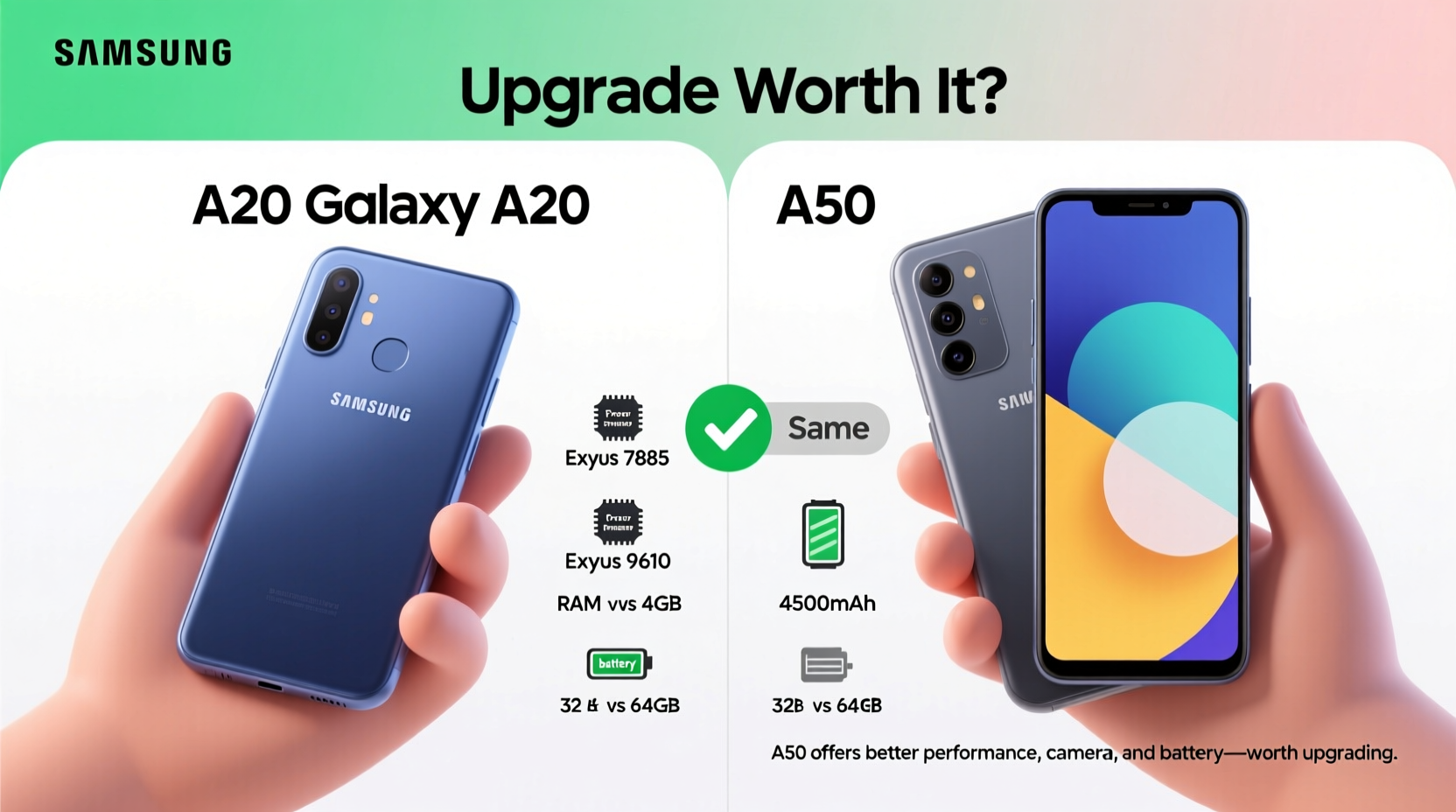
At first glance, the Galaxy A20 and A50 look strikingly similar. Both feature a tall 6.4-inch Infinity-U display with a teardrop notch and a plastic back. However, closer inspection reveals that the A50 feels more premium. It uses a gloss-finish polycarbonate back with a subtle gradient effect, while the A20 has a flat, matte finish that attracts fewer fingerprints but lacks visual appeal.
The A50 also includes a side-mounted fingerprint sensor—a feature absent on the A20, which relies solely on facial recognition for unlocking. This may seem minor, but in low-light conditions or when wearing masks, facial unlock can be frustrating. The fingerprint sensor on the A50 adds reliability and convenience.
Display and Screen Experience
Both phones sport a 6.4-inch Super AMOLED display with a resolution of 720 x 1560 pixels. On paper, this suggests parity, but real-world usage tells a different story. The A50’s screen is brighter, more vibrant, and supports higher contrast ratios thanks to better panel calibration. Outdoor visibility is noticeably improved on the A50, making it easier to read messages or navigate in sunlight.
While the A20’s screen is adequate for casual browsing and video playback, the A50 delivers a richer media experience. Gamers and frequent streamers will appreciate the deeper blacks and smoother color transitions.
Performance: Where the Gap Widens
The core difference between these two devices lies in their processors and RAM configurations. The A20 runs on Samsung’s Exynos 7884, paired with 3GB of RAM. This chipset handles basic tasks like calling, texting, and light social media use but struggles with multitasking and modern apps like Instagram Reels or TikTok.
In contrast, the A50 packs the Exynos 9610 with 4GB or 6GB of RAM (depending on the model). This octa-core processor is built on a 10nm process—more efficient and powerful than the A20’s 14nm chip. Apps launch faster, background processes stay active longer, and gaming performance improves dramatically. Titles like PUBG Mobile run at medium settings on the A50, whereas the A20 stutters even at low graphics.
“Mid-range phones live or die by their processors. The jump from Exynos 7884 to 9610 isn’t generational—it’s transformative for user experience.” — Raj Mehta, Mobile Hardware Analyst at TechPulse Asia
Camera Comparison: More Than Just Megapixels
On paper, both phones list dual rear cameras, but the execution varies greatly. The A20 features a 13MP main sensor and a 5MP depth camera. In good lighting, photos are acceptable, but detail is lacking, and low-light shots are grainy with poor dynamic range.
The A50 steps up with a 25MP main sensor and a 5MP ultra-wide lens. The higher-resolution primary sensor captures sharper images with better color accuracy. The addition of an ultra-wide lens opens creative possibilities—ideal for landscapes, group shots, or tight indoor spaces.
Front cameras also differ: the A20 has an 8MP selfie shooter, while the A50 upgrades to 25MP. Selfies on the A50 show finer skin texture, better edge detection, and improved HDR processing.
| Feature | Samsung A20 | Samsung A50 |
|---|---|---|
| Processor | Exynos 7884 | Exynos 9610 |
| RAM | 3GB | 4GB / 6GB |
| Rear Camera | 13MP + 5MP depth | 25MP + 5MP ultra-wide |
| Front Camera | 8MP | 25MP |
| Fingerprint Sensor | No | Yes (side-mounted) |
| Battery | 4000mAh | 4000mAh |
| Fast Charging | No (15W max) | Yes (15W supported) |
| Software Updates | Limited (Android 9 → 10) | Better support (Android 9 → 11, One UI 3) |
Battery and Charging: Same Capacity, Different Efficiency
Both phones pack a 4000mAh battery, so endurance depends heavily on efficiency. The A50’s Exynos 9610 is not only faster but also more power-efficient due to its advanced manufacturing process. Users report up to 1.5 hours more screen-on time on the A50 under mixed usage.
More importantly, the A50 supports fast charging out of the box. With a 15W charger, it reaches 50% in about 40 minutes. The A20 lacks official fast charging support, meaning full charges take closer to 2.5–3 hours—even with a high-wattage adapter.
Real-World Example: Maria’s Upgrade Journey
Maria had used her Galaxy A20 since 2019. By 2022, she noticed constant app crashes, slow WhatsApp loading, and difficulty recording clear videos for her small business. She considered buying a new budget phone but opted for a used A50 instead.
The change was immediate. Her social media apps stayed logged in, videos exported faster, and she could finally use editing tools without lag. Most importantly, the ultra-wide camera helped her showcase products from multiple angles—boosting engagement on her posts. For Maria, the upgrade wasn’t just about speed; it extended the usefulness of her phone by years.
Is It Worth Upgrading? A Step-by-Step Decision Guide
If you're still on the fence, follow this practical decision path:
- Evaluate your current pain points: Does your A20 freeze often? Are apps slow to open? Do photos come out blurry?
- Assess your usage: Do you use navigation, streaming, or social media heavily? These benefit from better processors and screens.
- Check your budget: If the A50 costs less than $120 used or refurbished, it’s a strong value proposition.
- Consider longevity: The A50 received more software updates and will likely support newer apps longer.
- Test responsiveness: Try using an A50 in-store or through a friend. Notice how quickly apps resume from the background.
Frequently Asked Questions
Can the Samsung A20 handle everyday tasks in 2024?
Yes, but barely. Basic calling, texting, and light web browsing work. However, modern versions of YouTube, Facebook, and Google Maps may lag or crash frequently due to limited RAM and outdated software support.
Does the A50 support 5G?
No, neither the A20 nor the A50 supports 5G. Both are limited to 4G LTE networks. If future-proofing for 5G matters, consider newer models like the A34 or A54.
Is the camera difference really noticeable?
Yes, especially in variety and low-light performance. The A50’s ultra-wide lens adds flexibility, and its 25MP sensor captures significantly more detail. Night mode is also available on the A50, which the A20 lacks entirely.
Final Verdict: Not the Same at All
Despite surface similarities, the Samsung A20 and A50 are not “basically the same.” The A50 offers tangible improvements in processing power, camera versatility, display quality, and security features. These aren’t just spec sheet wins—they translate into smoother scrolling, faster photo capture, reliable unlocking, and longer usability.
For anyone still using an A20 and experiencing slowdowns, the upgrade to an A50—especially at a discounted price—is absolutely worth it. You’re not just getting a newer phone; you’re gaining a device that can keep up with modern app demands for another two to three years.
Technology evolves quickly, and small hardware gaps today can become major usability chasms tomorrow. Choosing the A50 over sticking with the A20 isn’t indulgence—it’s practical foresight.




 浙公网安备
33010002000092号
浙公网安备
33010002000092号 浙B2-20120091-4
Comments
No comments yet. Why don't you start the discussion?