
Choosing between Samsung’s budget-friendly Galaxy A20 and its slightly more premium sibling, the A50, can be tricky. At first glance, both devices share design DNA and run on similar software, but beneath the surface, the differences are significant. For users considering an upgrade from the A20 to the A50—or deciding between the two secondhand—understanding these distinctions is crucial. This breakdown goes beyond marketing claims to examine real-world performance, longevity, and value.
Design and Build Quality
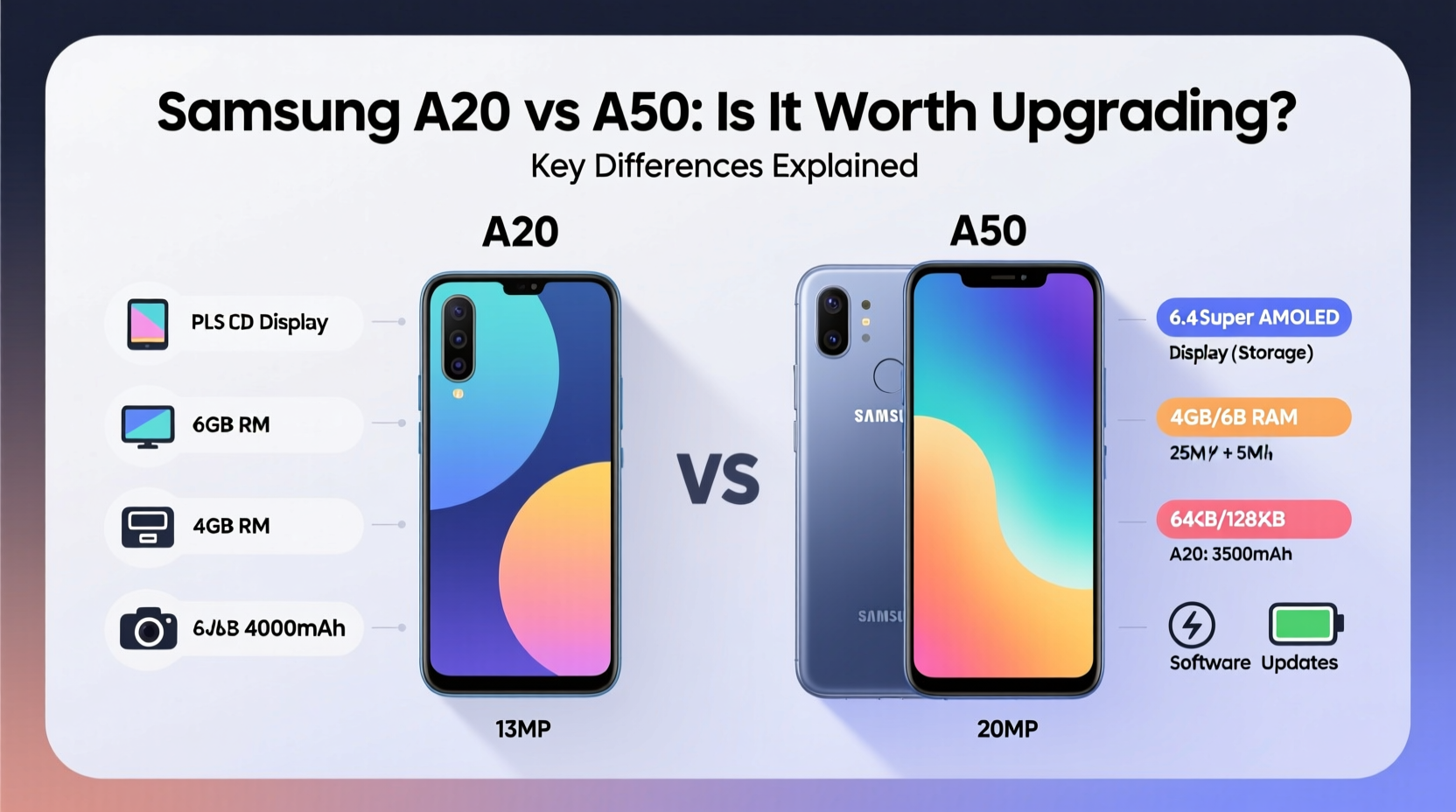
The Galaxy A20 and A50 may look similar in promotional images, but holding them reveals clear differences in craftsmanship. The A20 features a basic polycarbonate (plastic) back with a glossy finish that attracts fingerprints and scratches easily. Its 6.4-inch display uses a PLS TFT panel, which delivers adequate brightness but lacks vibrancy and viewing angles compared to AMOLED.
In contrast, the A50 steps up significantly with a glass-like plastic back and a 6.4-inch Super AMOLED display. This screen technology offers deeper blacks, richer colors, and better outdoor visibility. It also supports Always-On Display and is easier on the eyes during prolonged use thanks to lower blue light emission.
Performance and Hardware Comparison
Under the hood, the gap widens. The A20 runs on Samsung’s older Exynos 7884B processor, paired with 3GB of RAM and 32GB of storage. While sufficient for basic tasks like calling, texting, and light browsing, it struggles with multitasking and modern apps. Users often report lag when switching between apps or using social media platforms with heavy media content.
The A50, however, is powered by the Exynos 9610 chipset with 4GB or 6GB RAM options and 64GB/128GB storage. This octa-core processor handles gaming, video editing, and app-heavy workflows much more smoothly. Benchmark tests show the A50 performing nearly 2.5 times faster in CPU-intensive tasks than the A20.
“Mid-range phones like the A50 bridge the gap between entry-level and flagship experiences. The hardware leap here isn’t incremental—it’s transformative for daily usability.” — David Lin, Mobile Performance Analyst at TechPulse Insights
Camera Capabilities: Night Shots, Selfies, and Video
Both phones feature dual rear cameras, but their capabilities differ sharply. The A20 has a basic 8MP main sensor and a 5MP depth camera, which produces soft, grainy photos even in daylight. Low-light photography is particularly poor, with minimal detail and excessive noise.
The A50 includes a 25MP primary sensor and a 5MP depth lens, supported by advanced software processing. It captures sharper images with accurate color reproduction and performs decently in dim lighting thanks to scene optimizer and dynamic tone mapping. Its front-facing 25MP selfie camera also outperforms the A20’s 8MP shooter, especially in portrait mode.
Video recording sees a major divergence: the A20 maxes out at 1080p at 30fps with shaky stabilization, while the A50 supports steady Full HD video and AI-powered scene detection that adjusts settings automatically.
| Feature | Galaxy A20 | Galaxy A50 |
|---|---|---|
| Display Type | PLS TFT | Super AMOLED |
| Processor | Exynos 7884B | Exynos 9610 |
| RAM Options | 3GB | 4GB / 6GB |
| Main Camera | 8MP | 25MP |
| Front Camera | 8MP | 25MP |
| Battery Capacity | 4000mAh | 4000mAh |
| Charging Speed | 15W Max (adaptive) | 15W Fast Charging Supported |
| Fingerprint Sensor | Rear-mounted | On-screen Optical |
| Software Support | Android 9 → One UI 1.0 (no major updates) | Android 9 → Upgradable to One UI 3.1 (Android 11) |
Real-World Example: Maria’s Upgrade Decision
Maria had used her Galaxy A20 since 2019. By 2022, she noticed her phone freezing during Zoom calls, failing to load Instagram stories, and draining battery within a day despite minimal use. She considered buying another A20 due to its low price but decided to test the A50 at a local store.
She immediately noticed the smoother interface, brighter screen, and faster app launches. After purchasing a refurbished A50 for only $30 more than a new A20, she found her productivity improved—she could edit documents, join video meetings without lag, and take clearer photos for her small business. Two years later, the A50 still receives security patches and runs essential apps efficiently, while her old A20 became nearly unusable.
This case illustrates that while upfront cost matters, long-term usability often favors modest upgrades.
Battery Life and Charging: Are They Equal?
Both phones pack a 4000mAh battery, suggesting similar endurance. In theory, they should last a full day under moderate use. However, real-world usage tells a different story. The A20’s inefficient processor and non-optimized software lead to higher background power draw. Many users report needing midday charges after 12–14 hours of mixed use.
The A50 benefits from a more efficient chipset and better power management through Samsung’s One UI. With adaptive battery and app optimization, it consistently delivers 1.5 days of use on a single charge for average users. Additionally, the A50 supports fast charging (15W), allowing a 50% charge in about 30 minutes—something the A20 lacks despite having the same rated capacity.
Software Experience and Longevity
Software support is where the A50 truly pulls ahead. Launched with Android 9 Pie and One UI 1.0, it received two major OS upgrades, reaching Android 11 with One UI 3.1. This means access to newer features like dark mode system-wide, improved privacy controls, and enhanced multitasking.
The A20, in contrast, remained stuck on Android 9 with only minor security patches. No official upgrade path was provided, leaving users exposed to outdated security protocols and incompatible apps over time. As developers optimize for newer Android versions, older devices like the A20 become increasingly obsolete.
Is It Worth Upgrading? A Step-by-Step Decision Guide
If you're currently using an A20 or considering either model today, follow this decision timeline:
- Assess current pain points: Does your phone freeze, crash, or fail to run WhatsApp, Google Maps, or banking apps?
- Evaluate usage needs: Do you stream videos, take photos, or work remotely? These demand better hardware.
- Check availability and pricing: On the secondhand market, A50s often sell for only 15–20% more than A20s. If the gap is under $30, the A50 wins.
- Verify software status: Can the device receive security updates? Outdated software increases vulnerability.
- Test responsiveness: Try launching five apps in succession. If there's noticeable delay, the hardware isn’t future-proof.
Frequently Asked Questions
Can the Galaxy A20 handle TikTok and YouTube well?
It can play videos, but expect buffering on Wi-Fi, choppy scrolling in feeds, and occasional crashes. The experience is frustrating over time, especially with high-resolution content.
Does the A50 have a headphone jack?
Yes, both the A20 and A50 include a 3.5mm headphone jack and support USB-C audio adapters.
Is the on-screen fingerprint sensor on the A50 reliable?
While not as fast as flagship ultrasonic sensors, the optical scanner on the A50 is responsive in good lighting and works well after initial calibration. It’s a noticeable improvement over the rear-mounted sensor on the A20.
Final Verdict: Are They Basically the Same?
No, the Galaxy A20 and A50 are not basically the same. While they share a similar form factor and battery size, the A50 represents a meaningful generational leap in display quality, processing power, camera performance, and software support. The A20 functions as a bare-minimum smartphone suitable only for emergency use or as a temporary backup device.
For anyone relying on their phone for communication, navigation, entertainment, or remote work, the A50 provides a noticeably smoother, more reliable, and longer-lasting experience. Given the small price difference in the used market, skipping the A20 for the A50 is one of the most cost-effective upgrades available in Samsung’s budget lineup.
“The true cost of a phone isn’t just its price tag—it’s how long it remains useful. The A50 lasts years longer than the A20, making it cheaper per month over time.” — Lena Patel, Consumer Tech Advisor at Digital Horizon
Take Action Today
If you’re still on a phone like the A20, now is the time to consider moving up—even slightly. Technology evolves quickly, and staying on outdated hardware limits what you can do every day. Whether you choose a refurbished A50 or explore other mid-tier options, prioritize processors, RAM, and software support over brand-new models with weak internals. Your future self will thank you for a faster, safer, and more capable device.




 浙公网安备
33010002000092号
浙公网安备
33010002000092号 浙B2-20120091-4
Comments
No comments yet. Why don't you start the discussion?