
When choosing between the Samsung Galaxy A23 4G and its 5G counterpart, consumers often face a dilemma: is the shift from 4G to 5G worth the trade-offs? On paper, both models appear nearly identical—same design, similar camera setup, and matching display specs. But beneath the surface, key differences in network capability, processor performance, and subtle hardware adjustments create divergent user experiences. The real question isn’t just about speed or physical size—it’s about how these factors impact daily use, longevity, and value for money.
For many, the decision comes down to whether future-proofing with 5G outweighs potential compromises like slightly reduced battery efficiency or higher pricing. Others prioritize consistency in performance and are skeptical about the immediate benefits of 5G in areas with limited coverage. This article breaks down the technical distinctions, evaluates real-world implications, and helps you determine what truly matters when picking between these two closely matched devices.
Design and Physical Specifications: Is Size Really Different?
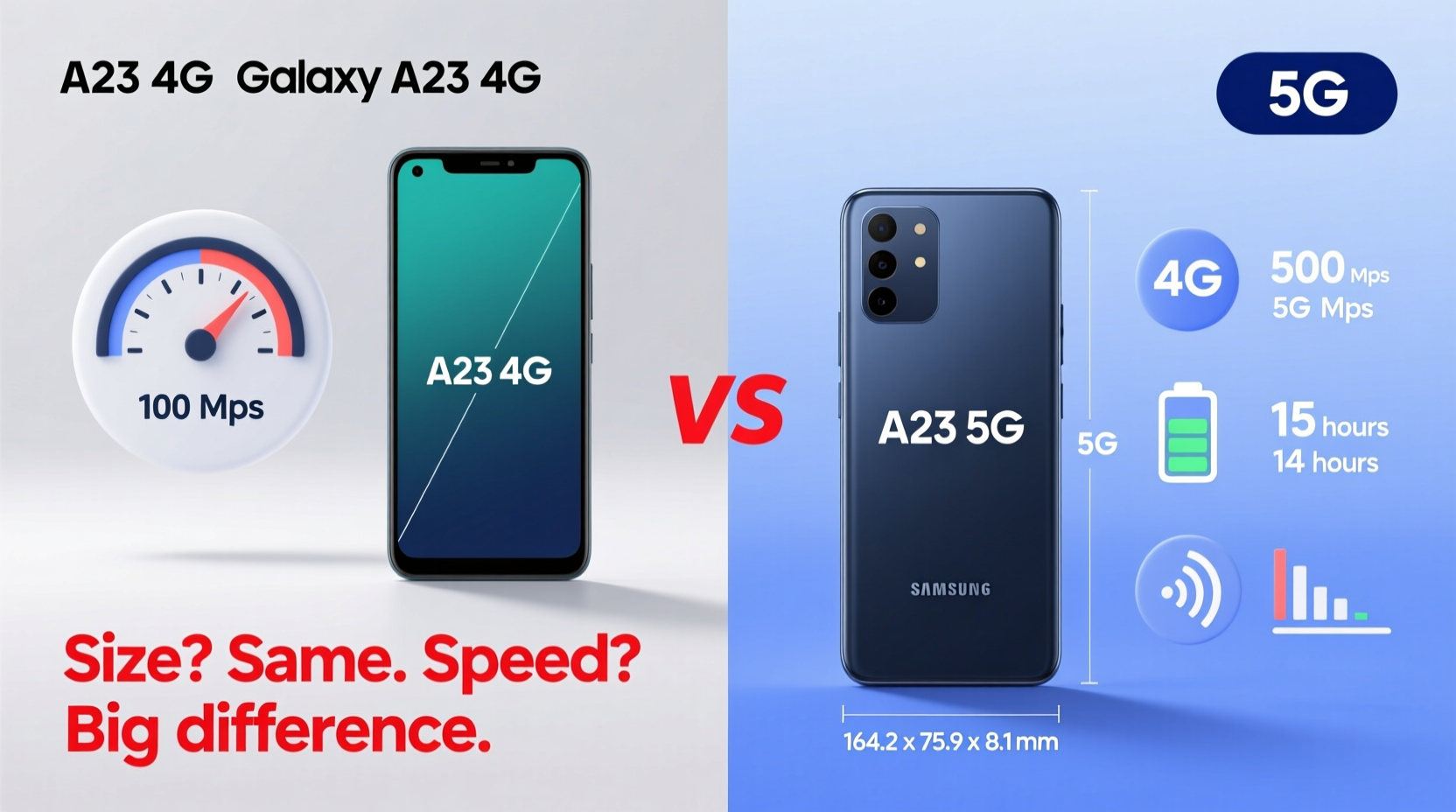
At first glance, the Samsung Galaxy A23 4G and 5G models look almost indistinguishable. Both feature a 6.6-inch PLS LCD Infinity-V display with a 90Hz refresh rate, offering smooth scrolling and responsive touch interaction. The build uses a plastic frame and back panel with a matte finish that resists fingerprints—a practical choice for everyday durability.
However, there are minor dimensional differences:
| Model | Dimensions (mm) | Weight (g) | Thickness |
|---|---|---|---|
| Samsung A23 4G | 164.5 x 76.9 x 8.4 | 203 | 8.4 mm |
| Samsung A23 5G | 164.5 x 76.9 x 8.4 | 195 | 8.4 mm |
The dimensions are identical, but the 4G model is actually heavier by 8 grams. This counterintuitive result stems from internal component variations—the 5G version uses a lighter chipset and different battery configuration. Despite the weight difference, neither phone feels unwieldy in hand, and the shared screen size ensures consistent one-handed usability.
Network Performance: Speed vs Real-World Utility
The most obvious distinction lies in connectivity. The 4G model supports LTE Cat.12/Cat.13, while the 5G variant adds sub-6GHz 5G bands (n1, n3, n5, n8, n28, n41, n77, n78), enabling faster download and upload speeds where coverage exists.
In optimal conditions, the 5G model can achieve download speeds between 300 Mbps to over 1 Gbps, depending on carrier infrastructure. In contrast, the 4G version typically maxes out around 150 Mbps. But raw speed doesn't always translate to better experience.
“5G offers lower latency and higher bandwidth, but its benefits are only noticeable in dense urban areas or high-demand scenarios like cloud gaming or 4K streaming.” — David Lin, Mobile Network Analyst at TechSignal Insights
For average users who browse, stream music, and watch videos on YouTube or Netflix, 4G remains more than sufficient. Buffering is rare even on congested networks, and app loading times show minimal variance. However, if you frequently download large files, use video conferencing apps, or live in an area with robust 5G deployment, the upgrade becomes more compelling.
Another consideration is battery drain. 5G modems consume more power, especially when switching between signal types. Users report up to 10–15% shorter battery life on the 5G model under heavy data use, though adaptive battery modes help mitigate this.
Hardware and Performance: Chipset Differences That Matter
Beneath the surface, the core processors differ significantly:
- A23 4G: Qualcomm Snapdragon 680 (6nm, octa-core, Adreno 610)
- A23 5G: MediaTek Dimensity 700 (7nm, octa-core, Mali-G57 MC2)
While both chips target mid-range efficiency, the Dimensity 700 has a slight edge in CPU benchmarks due to its newer architecture and integrated 5G support. It also handles multitasking more smoothly and delivers better thermal management during prolonged use.
That said, day-to-day performance is remarkably similar. Both phones run One UI Core 4 (upgradable to later versions) with 4GB or 6GB RAM options. App launches, social media navigation, and casual gaming feel responsive on either device. However, intensive tasks like editing HD video or playing graphics-heavy games reveal subtle lags on the Snapdragon 680.
Real-World Example: Two Users, Two Choices
Consider Maria and James—both bought the A23 series last year but made different choices based on lifestyle.
Maria lives in a suburban area with spotty 5G coverage. She opted for the 4G model because it was $30 cheaper and her carrier doesn’t offer unlimited 5G plans. She uses her phone primarily for messaging, online banking, and watching shows during commutes. After ten months, she reports no regrets—battery lasts all day, apps respond quickly, and she hasn’t encountered any limitations due to 4G.
James, a freelance photographer living in downtown Chicago, chose the 5G version. He regularly uploads RAW image batches to cloud storage and joins client Zoom calls from public spaces. With reliable mmWave access near his studio, he consistently achieves fast upload speeds, reducing post-shoot workflow time by nearly half. For him, the 5G capability justified the extra cost and minor battery trade-off.
Their experiences highlight a crucial insight: the best choice depends not on specs alone, but on context.
Key Decision Checklist: Which Model Fits You?
Before purchasing, ask yourself the following:
- Do I live or work in an area with stable 5G coverage?
- Do I frequently transfer large files or stream 4K content on mobile data?
- Am I sensitive to battery degradation under network strain?
- Is future-proofing important, even if current benefits are limited?
- Does the price difference affect my budget significantly?
If you answered “yes” to questions 1 and 2, the 5G model likely offers tangible advantages. If your answers lean toward 3, 4, and 5, the 4G version may be the smarter buy.
Frequently Asked Questions
Can the Samsung A23 4G be upgraded to 5G later?
No. 5G capability requires specific modem hardware built into the device. Software updates cannot add this functionality retroactively.
Does the 5G model heat up more during use?
Slightly. Under sustained 5G data transfers or gaming sessions, the 5G model runs warmer due to increased modem and processor load. However, temperatures remain within safe limits and do not impact long-term reliability.
Are cameras and software identical across both models?
Yes. Both feature the same quad-camera array: 50MP main, 5MP ultrawide, 2MP macro, and 2MP depth sensor. Front-facing is 8MP. Software features, update schedules, and One UI customization are also the same.
Final Verdict: Speed Over Size, Context Over Specs
The phrase “does the size really matter” takes on new meaning here—not in physical dimensions, but in the significance we assign to technological leaps. The Samsung A23 4G and 5G are nearly twins in form, yet their network brains lead them down different paths.
Speed matters—but only when it serves a purpose. If your digital habits revolve around light browsing and occasional streaming, 4G continues to deliver excellent value. But if you're building a mobile-first workflow, rely on cloud tools, or want a phone that stays relevant through 2026 and beyond, 5G offers meaningful headroom.
Ultimately, the decision isn’t about chasing the latest label. It’s about aligning technology with lifestyle. The A23 series proves that even small hardware shifts can carry outsized consequences—depending on how you use your device.




 浙公网安备
33010002000092号
浙公网安备
33010002000092号 浙B2-20120091-4
Comments
No comments yet. Why don't you start the discussion?