
When Samsung releases new mid-range phones in quick succession, it's natural to wonder whether the latest model brings meaningful improvements. The Samsung Galaxy A23 5G and A15 5G sit close in price and positioning, making the upgrade decision tricky. On paper, they appear similar—both support 5G, feature large displays, and promise all-day battery life. But beneath the surface, key differences in performance, camera quality, and software experience can significantly impact daily use.
This comparison dives deep into what sets these two devices apart and whether spending extra on the A23 5G truly pays off—or if the A15 5G offers nearly identical value at a lower cost.
Design and Build: Subtle Differences, Same Feel
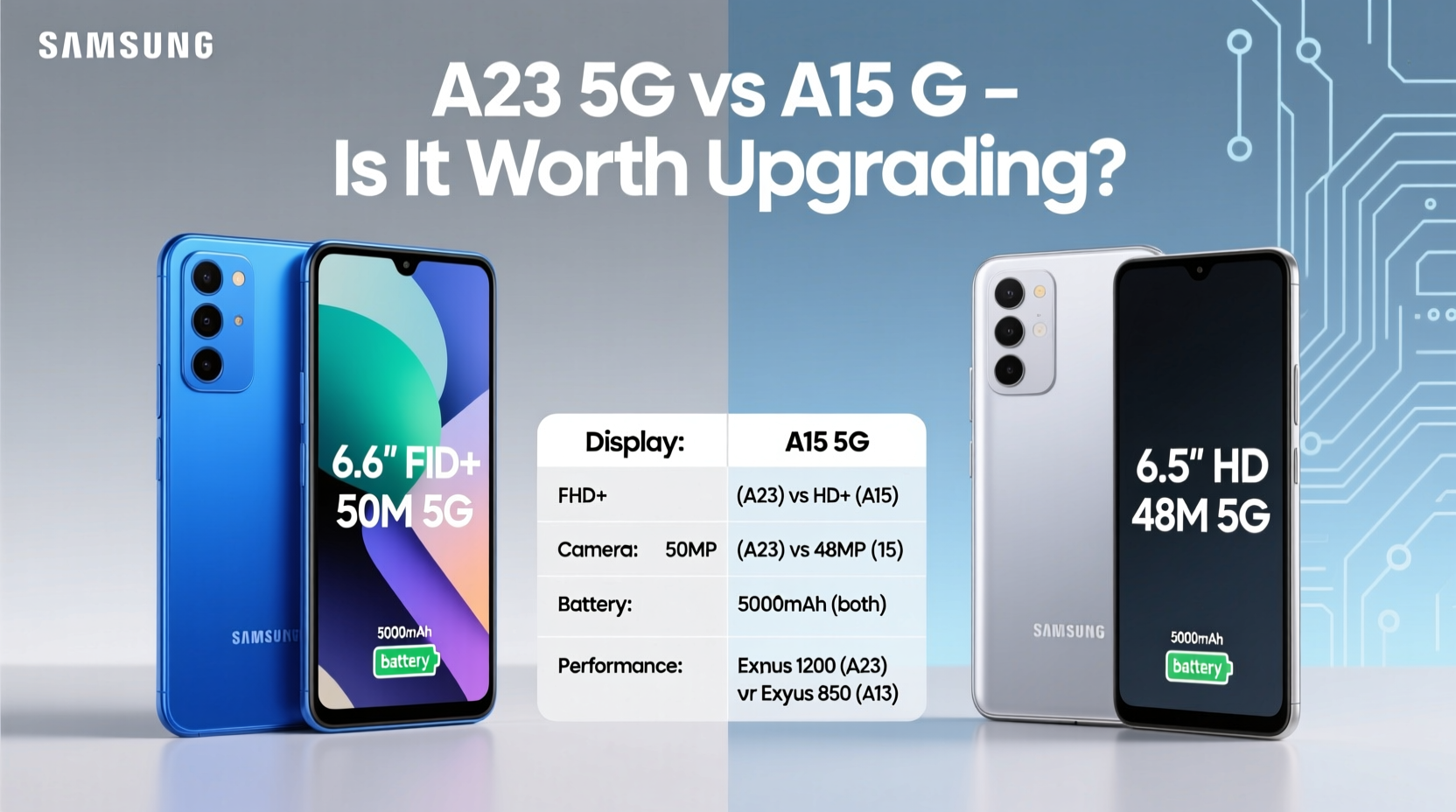
At first glance, both phones share Samsung’s familiar mid-range design language: plastic backs, glossy finishes, and centered punch-hole front cameras. The A23 5G measures 164.5 x 76.9 x 8.4 mm and weighs 195g, while the A15 5G is slightly more compact at 161.4 x 76.1 x 8.2 mm and 188g. The difference in size is minimal but noticeable when held side by side—the A23 feels a bit larger due to its taller display.
Both models are IP67-rated for dust and water resistance, a rare and valuable feature in this price range. This means either phone can survive brief submersion in water or exposure to dusty environments without damage. However, only the A23 5G includes a side-mounted fingerprint sensor integrated into the power button. The A15 5G relies solely on facial recognition, which is less secure and slower in low light.
Display and Screen Experience
The A23 5G features a 6.6-inch PLS LCD with a 90Hz refresh rate, offering smoother scrolling and animations compared to the A15 5G’s 6.5-inch HD+ (720p) display capped at 60Hz. While both screens are LCDs—not OLED—they differ sharply in fluidity and clarity.
The higher resolution (FHD+ vs HD+) and adaptive 90Hz refresh rate on the A23 make a tangible difference during everyday tasks like browsing social media, reading articles, or playing casual games. Text appears sharper, motion feels more natural, and overall visual comfort improves.
That said, neither screen supports HDR10+, and outdoor visibility under direct sunlight is only average. Still, the A23 clearly wins in display quality—a factor often overlooked until experienced firsthand.
Performance: Chipset and Real-World Speed
Under the hood, the distinction becomes even clearer. The A23 5G is powered by the Qualcomm Snapdragon 695 5G, an octa-core processor built on a 6nm process. It’s paired with up to 6GB of RAM and supports expandable storage via microSD.
In contrast, the A15 5G uses the MediaTek Dimensity 700, also an octa-core chip but generally benchmarks 15–20% lower in CPU and GPU performance. Users running multitasking-heavy workflows or playing graphics-intensive games will notice lag on the A15 that the A23 handles more smoothly.
“Mid-tier processors vary widely in thermal efficiency and sustained performance. The Snapdragon 695 holds up better over long sessions.” — Raj Mehta, Mobile Hardware Analyst
Real-world usage reflects this: apps launch faster on the A23, background app retention is stronger, and gaming frame rates are more consistent. For example, titles like *Call of Duty: Mobile* run at medium settings on the A23 with fewer stutters than on the A15.
Camera Comparison: More Than Just Megapixels
Both phones come with quad-camera setups on the rear, headlined by a 50MP main sensor. However, hardware specs don’t tell the full story.
The A23 5G includes a dedicated depth sensor, macro lens, and ultra-wide shooter (5MP, f/2.4), allowing greater creative flexibility. Its main camera also benefits from improved image processing thanks to the Snapdragon platform’s ISP (Image Signal Processor). In daylight, photos from the A23 show better dynamic range, color accuracy, and detail retention.
Night mode performance is where the gap widens. The A23 captures brighter, cleaner low-light images with less noise. The A15 tends to oversharpen and lose shadow detail, especially in mixed lighting.
On the front, the A23 packs a 13MP selfie camera versus the A15’s 13MP as well—but again, processing makes a difference. Selfies on the A23 have more natural skin tones and better background separation in portrait mode.
| Feature | Samsung A23 5G | Samsung A15 5G |
|---|---|---|
| Processor | Snapdragon 695 5G | Dimensity 700 |
| Display | 6.6” FHD+, 90Hz | 6.5” HD+, 60Hz |
| Rear Camera | 50MP + 5MP UW + 2MP Macro + 2MP Depth | 50MP + 5MP UW + 2MP Macro + 2MP Depth |
| Front Camera | 13MP | 13MP |
| Battery | 5000mAh | 5000mAh |
| Charging | 25W Fast Charging | 15W Max (no fast charger included) |
| Fingerprint Sensor | Yes (side-mounted) | No |
| OS & Updates | Android 12, upgradable to Android 14 | Android 13, upgradable to Android 15 |
| IP Rating | IP67 | IP67 |
Battery Life and Charging: Tie with a Twist
Both phones pack 5000mAh batteries, delivering excellent endurance—typically lasting 1.5 to 2 days with moderate use. Video streaming, GPS navigation, and social media apps drain them at similar rates.
Where they diverge is charging speed. The A23 5G supports 25W fast charging (charger sold separately), capable of going from 0 to 50% in about 30 minutes. The A15 5G technically supports up to 15W charging but ships without any fast charger, defaulting users to slow 10W charging unless they purchase one separately.
This may seem minor, but over time, waiting 2+ hours to fully charge versus under 90 minutes impacts convenience—especially for users who rely on quick top-ups during busy days.
Software and Long-Term Support
The A15 5G launched with Android 13 and promises three OS upgrades (up to Android 16) and four years of security patches. The A23 5G debuted on Android 12 and is eligible for updates up to Android 14. While both receive regular patch updates, the A15 has a longer official software lifespan.
However, real-world update delivery speed depends on regional rollout schedules. Historically, newer models like the A15 get priority, meaning it may receive monthly patches weeks ahead of older siblings like the A23.
Mini Case Study: Maria’s Upgrade Dilemma
Maria owns a Galaxy A15 5G purchased six months ago. Her friend recently bought the A23 5G and showed her how much smoother TikTok scrolls and how quickly WhatsApp messages load. Curious, she tested both devices side by side.
She noticed the A23 opened maps faster, took clearer night photos of her kids’ soccer game, and unlocked instantly with the fingerprint sensor. But after checking prices, she realized upgrading would cost $180 with trade-in—nearly half what she paid originally.
After weighing the pros, she decided against upgrading. The improvements were real but not urgent enough to justify the expense. Instead, she invested in a protective case and plans to wait for the A35 or A50 series next year.
Is It Worth Upgrading?
If you currently own the A15 5G, upgrading to the A23 5G isn’t essential. You’ll gain a better display, faster performance, and quicker charging—but not a transformative leap. The core experience remains similar: same battery size, camera megapixels, and build quality.
However, if you're choosing between them brand new and can afford the slight premium, the A23 5G is the better long-term device. Its superior processor, 90Hz screen, and fingerprint sensor offer noticeable daily advantages.
- Choose the A23 5G if: You want smoother performance, faster charging, and a more responsive user experience.
- Stick with the A15 5G if: You’re budget-conscious, prioritize future software updates, and don’t mind slower app switching or no fingerprint unlock.
Checklist: Should You Upgrade?
- Are you frustrated with slow app launches or lag? → A23 5G helps.
- Do you take lots of photos, especially at night? → A23 offers better results.
- Do you hate waiting for your phone to charge? → A23 supports faster charging.
- Do you already own the A15 5G and it works fine? → Hold off on upgrading.
- Is the price difference over $100? → Likely not worth it unless features matter deeply.
FAQ
Can the A15 5G be upgraded to match the A23’s performance?
No. Performance is limited by the chipset and RAM configuration. Software tweaks won’t bridge the hardware gap.
Does the A23 5G have better speakers than the A15?
Both have single bottom-firing speakers with similar audio quality—neither supports stereo sound. Volume and clarity are comparable.
Which phone lasts longer in daily use?
Battery life is nearly identical. However, the A23’s more efficient processor may extend screen-on time slightly under heavy loads.
Conclusion
The Samsung A23 5G and A15 5G are not “basically the same.” While they target the same market and share core features like 5G connectivity and IP67 ratings, the A23 delivers a noticeably better user experience through its faster processor, smoother display, and added biometric security. Yet, the A15 5G counters with longer software support and often a lower price tag.
Your decision should hinge on current ownership and priorities. New buyers should lean toward the A23 5G for its refined performance. Existing A15 5G owners, however, likely won’t find enough improvement to justify the cost of upgrading.




 浙公网安备
33010002000092号
浙公网安备
33010002000092号 浙B2-20120091-4
Comments
No comments yet. Why don't you start the discussion?