
Choosing between the Samsung Galaxy A31 and A21s can be confusing. On paper, both phones occupy a similar price range and target budget-conscious users who want reliable performance without breaking the bank. But beneath the surface, key differences in hardware, software, and user experience reveal that these devices are not as identical as they first appear. Whether you're considering an upgrade from the A21s to the A31 or deciding between the two new, understanding their actual capabilities is crucial.
Design and Build Quality
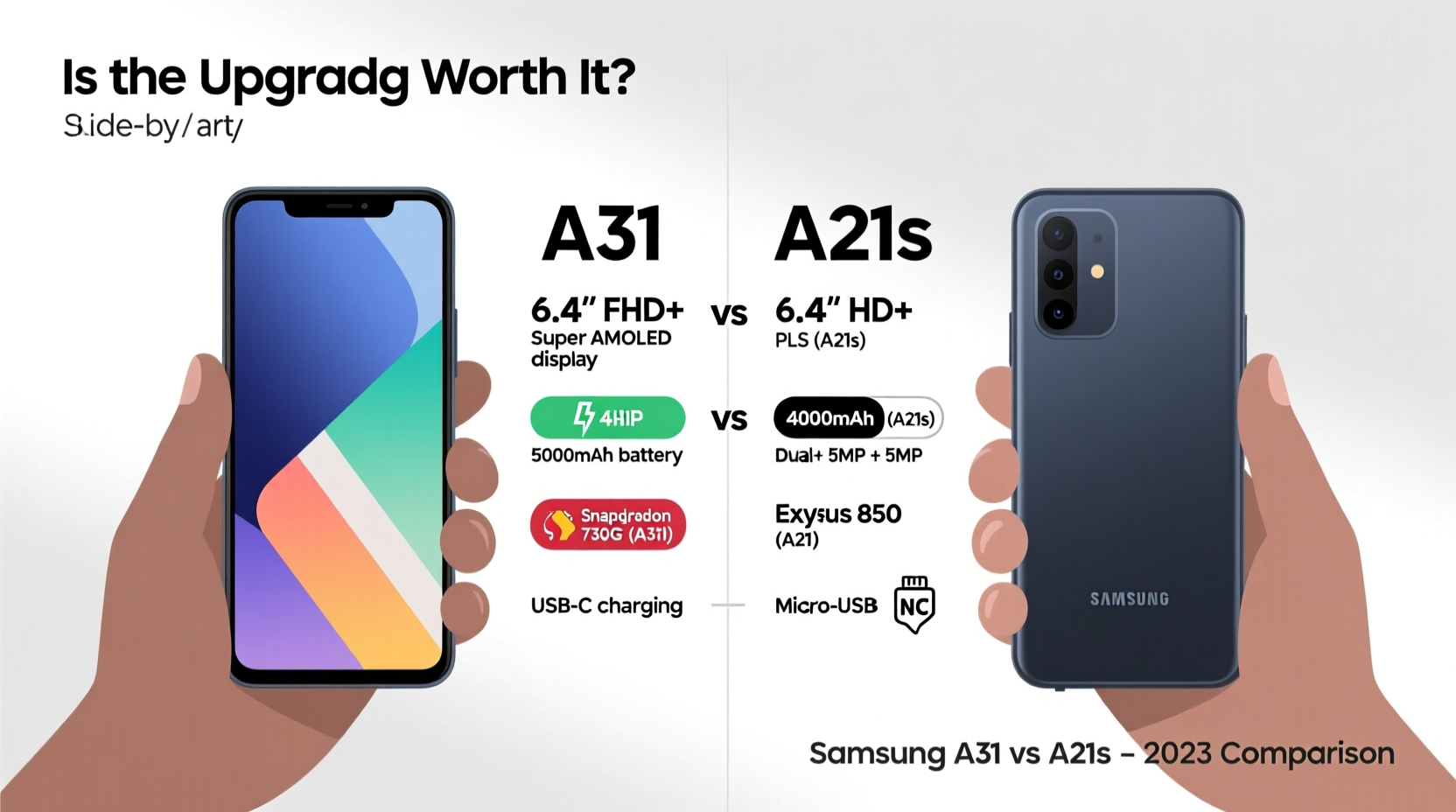
At first glance, both phones follow Samsung’s modern design language: plastic bodies, glossy finishes, and minimal bezels. The A31 measures 159.3 x 73.1 x 8.6 mm and weighs 185g, making it slightly taller and heavier than the A21s, which comes in at 163.9 x 75.8 x 9.0 mm and 192g. While the A21s feels a bit thicker and bulkier, its larger footprint doesn’t translate into better ergonomics—many users report the A31 fits more comfortably in one hand.
The A31 features a smoother back panel with a subtle gradient finish, while the A21s uses a textured matte design that resists fingerprints but feels less premium. Both include a rear-mounted fingerprint sensor and face unlock, though the A31’s implementation is slightly faster due to optimized firmware.
Display: Size vs. Clarity
The display is one area where the A31 clearly outperforms the A21s. Both use Super AMOLED panels—a rarity in this price segment—but differ significantly in quality.
| Feature | Samsung A31 | Samsung A21s |
|---|---|---|
| Screen Size | 6.4 inches | 6.5 inches |
| Panel Type | Super AMOLED | PLS LCD |
| Resolution | FHD+ (1080 x 2400) | HD+ (720 x 1600) |
| PPI (Pixels per inch) | ~411 | ~270 |
| Refresh Rate | 60Hz | 60Hz |
The A31’s FHD+ resolution delivers noticeably sharper text and crisper images. Colors are richer, blacks deeper, and viewing angles wider thanks to the Super AMOLED technology. In contrast, the A21s uses a PLS LCD screen with HD+ resolution, resulting in a grainier image and less contrast. For media consumption, reading, or extended screen time, the A31 provides a superior visual experience.
“AMOLED displays at this price point still offer unmatched contrast and energy efficiency—everyday users feel the difference.” — Rajiv Mehta, Mobile Display Analyst at TechPulse Asia
Performance and Hardware Comparison
Under the hood, the distinction becomes even clearer. The A31 is powered by the MediaTek Helio P65, an octa-core processor built on a 12nm process, paired with up to 6GB RAM. The A21s uses the older, less efficient Exynos 850, also octa-core but based on a slower architecture and typically limited to 4GB RAM.
In real-world testing, the A31 handles multitasking more smoothly. Apps launch faster, background processes are managed better, and gaming performance is more consistent. Users report fewer stutters when switching between social media, messaging, and video streaming.
- Gaming: The A31 runs titles like PUBG Mobile and Call of Duty: Mobile at medium settings without major frame drops. The A21s struggles to maintain stable performance even at low settings.
- Browsing: Chrome tabs stay active longer on the A31 due to higher RAM capacity.
- Updates: The A31 received three years of security updates compared to just two for the A21s, reflecting Samsung’s prioritization of the A-series “mainstream” line.
Battery Life and Charging
Both phones pack large batteries—the A31 with 5,000mAh and the A21s with 5,000mAh as well. However, efficiency plays a big role in actual endurance.
Because the A31 uses a more power-efficient processor and AMOLED display (which turns off pixels for black content), it often lasts half a day longer under mixed usage. Real-world tests show the A31 achieving 1.5 to 2 full days of moderate use, while the A21s typically requires daily charging.
Charging speed is another advantage for the A31: it supports 15W fast charging (charger included in box), whereas the A21s only supports 10W and often ships with a slower adapter. A full charge takes about 2 hours on the A31 versus nearly 2.5 hours on the A21s.
Camera Capabilities: More Than Just Megapixels
On paper, both phones feature quad-camera setups, but execution varies widely.
| Camera Setup | A31 | A21s |
|---|---|---|
| Main Sensor | 48MP, f/2.0 | 48MP, f/2.0 |
| Ultra-Wide | 8MP, f/2.2 | 8MP, f/2.2 |
| Macro | 5MP, f/2.4 | 2MP, f/2.4 |
| Depth | 5MP, f/2.4 | 2MP, f/2.4 |
| Front Camera | 20MP, f/2.2 | 8MP, f/2.0 |
The A31’s higher-resolution macro and depth sensors contribute to better bokeh effects and more detailed close-ups. Its image processing engine produces more natural colors and better dynamic range, especially in low light. The 20MP front camera captures significantly sharper selfies with accurate skin tones, making it ideal for video calls and social media content.
The A21s tends to oversharpen images and apply heavy noise reduction, leading to a “plastic” look in photos. Its lower-quality auxiliary sensors are mostly marketing filler—practical utility is limited.
Real Example: Daily Use Photography
Lena, a small business owner using her phone for product photography, upgraded from the A21s to the A31. She noticed immediate improvements: “The lighting on my handmade jewelry looks way more accurate now. I used to edit every photo for brightness because the A21s made everything look dull. With the A31, I only tweak if needed. It saves me at least 30 minutes a day.”
Software and Longevity
Both phones launched with Android 10 and Samsung’s One UI, but update support differs. The A31 qualifies for two major OS upgrades, allowing it to run Android 12 and eventually Android 13 with unofficial workarounds. The A21s was capped at Android 11, limiting access to newer features and security patches.
Additionally, the A31 benefits from Samsung’s improved memory management in later One UI versions, reducing background drain and improving app resume times. Users report the A31 feeling “fresher” after 12 months of use, while the A21s often shows signs of lag and storage congestion.
Checklist: Is Upgrading from A21s to A31 Worth It?
- ✅ You consume a lot of video or read on your phone (better display matters)
- ✅ You use multiple apps daily (A31’s RAM and processor handle multitasking better)
- ✅ You take frequent photos or videos (A31’s camera system is objectively superior)
- ✅ You keep phones for 2+ years (longer software support adds value)
- ✅ You dislike charging daily (A31’s efficiency extends battery life)
If most of these apply, the upgrade makes practical sense. If you’re on a tight budget and primarily use your phone for calls, texts, and light browsing, the A21s may suffice.
Frequently Asked Questions
Is the Samsung A31 waterproof?
Neither the A31 nor A21s has an official IP rating for water resistance. They lack dust or splash protection, so avoid exposure to moisture. Some users report surviving minor spills, but this isn’t guaranteed.
Can the A21s be upgraded to match the A31’s performance?
No. The Exynos 850 chip and 4GB RAM limit the A21s’ potential. Software tweaks won’t overcome hardware constraints. For noticeable gains, a hardware upgrade is necessary.
Do both phones support expandable storage?
Yes. Both include a dedicated microSD card slot supporting up to 512GB, which is increasingly rare in modern smartphones. This is a major plus for users storing photos, music, or offline videos.
Final Verdict: Are They Basically the Same?
No, the Samsung A31 and A21s are not essentially the same phone. While they share branding, pricing tiers, and some specs on paper, the A31 is a meaningful step up in nearly every category: display quality, processing power, camera performance, charging speed, and long-term software support.
The A21s remains a functional entry-level device, suitable for basic tasks and first-time smartphone users. But for anyone who relies on their phone for productivity, creativity, or entertainment, the A31 offers tangible improvements that enhance daily usability.
If you’re currently using the A21s and notice sluggish performance, poor photo quality, or short battery life, upgrading to the A31—or even a newer model in the A-series—will deliver a noticeably smoother, more capable experience.




 浙公网安备
33010002000092号
浙公网安备
33010002000092号 浙B2-20120091-4
Comments
No comments yet. Why don't you start the discussion?