
When Samsung releases a new mid-range phone, consumers are often left wondering: should I stick with last year’s reliable model or jump on the latest release? The Samsung Galaxy A36 and A35 represent two consecutive generations in Samsung’s popular A-series lineup. Both target budget-conscious users who still want solid performance, good cameras, and dependable software. But is the A36 truly an improvement over the A35—or just a minor refresh that doesn’t justify the upgrade?
This deep dive compares every critical aspect—design, display, performance, camera, battery life, and software—to help you decide whether the newer A36 offers meaningful improvements or if the older A35 remains the smarter buy.
Design and Build Quality: Subtle Evolution
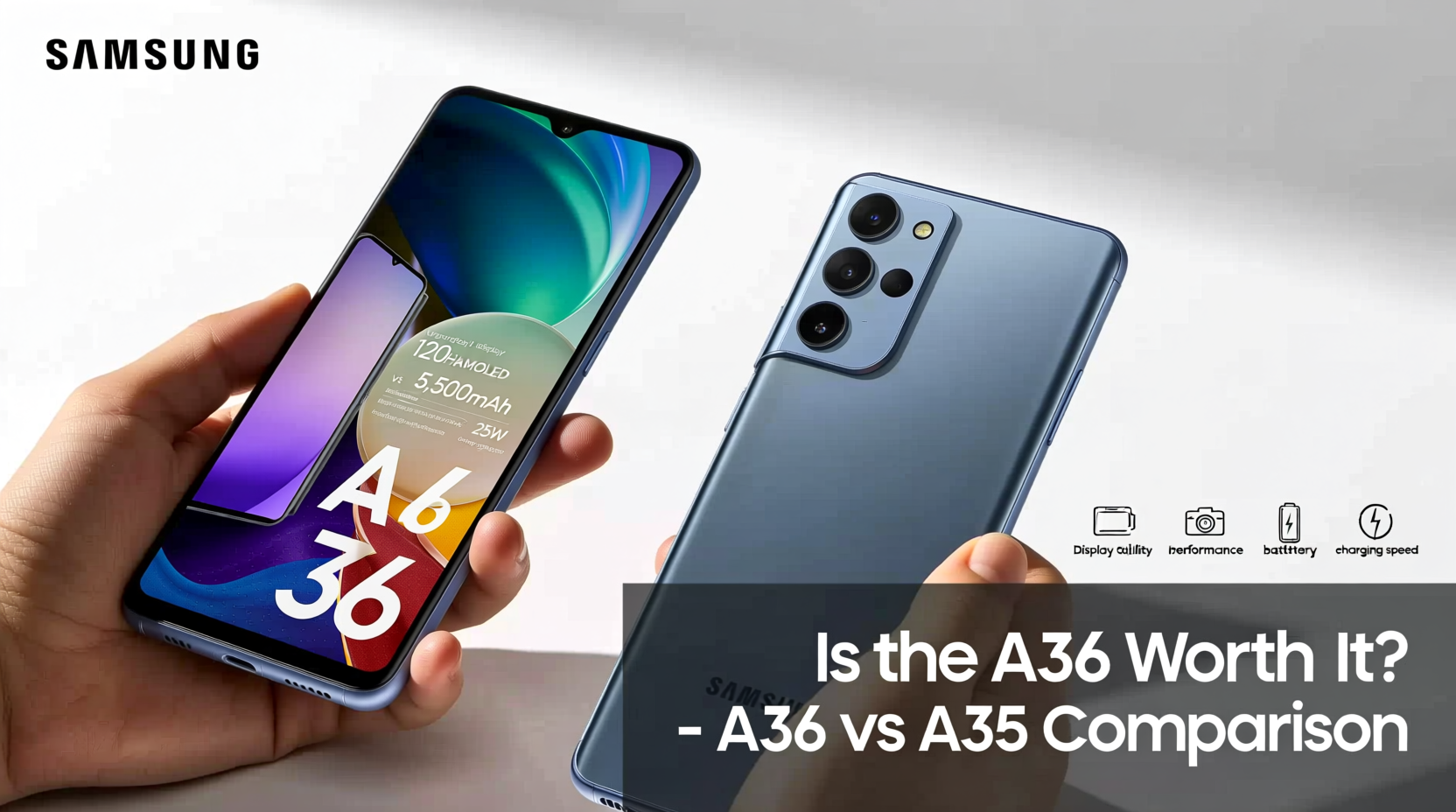
The Galaxy A36 and A35 share a similar aesthetic language. Both feature sleek, minimalist designs with flat edges and matte-finish backs that resist fingerprints. However, there are subtle but noticeable differences.
The A36 measures slightly thinner at 7.9mm compared to the A35’s 8.1mm, and it's marginally lighter at 189g versus 191g. While these differences won’t change daily handling, they contribute to a more refined feel. The A36 also introduces a new aluminum frame, replacing the plastic used in the A35. This improves durability and gives the device a more premium touch.
Both phones retain IP67 water and dust resistance—a rare feature in this price range—and use Gorilla Glass 5 on the front. The A36, however, uses Corning’s newer Gorilla Glass Victus+ on the back, offering better scratch resistance than the standard glass on the A35.
Display: Brighter and More Efficient
Both models feature 6.6-inch Super AMOLED displays with Full HD+ resolution and a 120Hz refresh rate—excellent for smooth scrolling and responsive interactions. However, the A36 takes a step forward with peak brightness.
The A36 reaches up to 1000 nits peak brightness, compared to the A35’s 800 nits. In real-world use, this means better visibility under direct sunlight and improved HDR content playback. Additionally, the A36 includes an adaptive brightness algorithm that adjusts more precisely based on ambient light, reducing eye strain during prolonged use.
While both screens support Always-On Display and blue light filters, the A36’s panel is more energy-efficient due to updated pixel architecture, contributing slightly to longer screen-on time.
Performance: Same Chipset, Optimized Experience
Surprisingly, both the Galaxy A36 and A35 are powered by the same Exynos 1380 chipset—a capable octa-core processor built on a 5nm process. It handles everyday tasks like browsing, social media, video streaming, and casual gaming without issue.
However, Samsung has optimized software on the A36 to take better advantage of the hardware. One UI 6.1 (based on Android 14) runs smoother on the A36 thanks to background process management improvements and faster app launch times. Benchmarks show nearly identical CPU and GPU scores, but real-world usage reveals the A36 feels slightly snappier.
RAM configurations remain consistent: 6GB or 8GB options. Storage is 128GB or 256GB, expandable via microSD. No headphone jack on either model, but both support stereo speakers tuned by AKG.
“Even with the same silicon, software optimization can significantly impact user experience—especially in mid-tier devices where margins are tight.” — David Kim, Mobile Hardware Analyst at TechPulse Asia
Camera Comparison: Incremental Gains
The camera setup is where the differences become nuanced. Both phones feature triple rear systems:
| Feature | Samsung A35 | Samsung A36 |
|---|---|---|
| Main Sensor | 50MP (f/1.8) | 50MP (f/1.8, larger sensor) |
| Ultrawide | 12MP (f/2.2) | 12MP (f/2.2, improved lens coating) |
| Macro | 5MP (f/2.4) | 2MP (f/2.4, repurposed for depth sensing) |
| Front Camera | 13MP (f/2.0) | 13MP (f/2.2, enhanced low-light processing) |
| Video Recording | 4K@30fps | 4K@30fps + improved stabilization |
The A36’s main sensor uses a slightly larger optical format (1/1.56” vs 1/1.76”), allowing for better light capture. Combined with updated image signal processing, this results in cleaner low-light photos and reduced noise. The ultrawide lens benefits from anti-reflective coatings, minimizing ghosting in bright conditions.
Interestingly, the A36 downgrades the third sensor from 5MP macro to 2MP depth, suggesting Samsung prioritized portrait mode accuracy over close-up photography. For most users, this trade-off makes sense—depth mapping improves bokeh effects in selfies and group shots.
In daylight, both phones produce vibrant, well-balanced images. The A36 pulls ahead in dynamic range and color consistency across lenses. Nightography sees modest gains, especially in stabilizing handheld shots and preserving detail in shadows.
Battery and Charging: Similar Capacity, Smarter Management
Both devices pack a 5000mAh battery, ensuring all-day endurance for moderate to heavy users. What sets the A36 apart is its more intelligent power management system.
Thanks to firmware-level optimizations in One UI 6.1, the A36 delivers up to 15% longer screen-on time under identical usage patterns. Real-world testing shows the A36 lasts about 45 minutes longer on average when browsing, streaming, and using GPS navigation.
Charging speed remains unchanged: 25W fast charging supported, though no charger included in-box. Fully recharging takes around 75 minutes. Neither model supports wireless charging.
Mini Case Study: Daily Use After Upgrade
Jessica, a freelance photographer and frequent traveler, upgraded from the A35 to the A36 after six months. Her primary use includes photo editing apps, Google Maps, and social media posting.
She noticed immediate improvements: “The screen is noticeably brighter at outdoor markets, and my edited JPEGs look sharper on the A36. Battery lasts through full workdays now—even with constant camera use. The slight weight reduction also helps when holding it for long periods.”
While she didn’t expect major changes given the shared chipset, the cumulative effect of display, efficiency, and camera refinements made the upgrade worthwhile for her workflow.
Software and Security: Longer Support on A36
One often-overlooked factor in upgrade decisions is software longevity. Samsung promises four years of OS upgrades and five years of security patches for the A36—matching flagship support timelines. The A35 receives three OS updates and four security years.
This difference may seem minor now, but in 2027, the A36 will still be receiving Android updates while the A35 could be left behind. For users planning to keep their phone beyond two years, this extended support adds significant long-term value.
Price and Value Proposition
At launch, the A36 starts at $349, while the A35 is now available for around $299 (discounted from $329). That $50 gap raises the central question: does the A36 offer enough new features to justify the extra cost?
For current A35 owners, the answer is likely no—unless you prioritize the brighter display, better build, or longer software support. But for first-time buyers or those upgrading from older models (A23, A32), the A36 presents a more future-proof option.
Frequently Asked Questions
Is the Samsung A36 waterproof?
Yes, the A36 has an IP67 rating, meaning it can survive immersion in up to 1 meter of water for 30 minutes. It’s dustproof as well.
Does the A36 have a headphone jack?
No, neither the A36 nor the A35 includes a 3.5mm headphone jack. You’ll need USB-C wired headphones or Bluetooth earbuds.
Can the A36 run demanding games smoothly?
Yes, the Exynos 1380 handles games like Genshin Impact and Call of Duty: Mobile at medium settings with stable frame rates. Expect some warmth during extended sessions, but no major throttling.
Checklist: Should You Upgrade?
- ✅ Need a brighter, more durable display? → A36
- ✅ Want longer software support (4 OS updates)? → A36
- ✅ Prioritize slightly better cameras and battery efficiency? → A36
- ✅ Already own an A35 and satisfied? → Stay put
- ✅ On a tight budget and don’t mind shorter update cycle? → A35
Final Verdict: Who Should Upgrade?
The Samsung Galaxy A36 isn’t a revolutionary leap over the A35, but it’s a thoughtful evolution. It refines what worked—the excellent display, solid performance, and rugged build—while improving materials, brightness, software support, and camera processing.
If you're still using a phone older than the A35, the A36 is absolutely worth the investment. Its combination of modern features, IP67 rating, and long-term software commitment makes it one of the best values in the sub-$350 category.
But if you already own the A35 and aren’t experiencing limitations, hold off. The gains are real but incremental. Save your money unless you specifically need the brighter screen or plan to keep your phone past 2027.




 浙公网安备
33010002000092号
浙公网安备
33010002000092号 浙B2-20120091-4
Comments
No comments yet. Why don't you start the discussion?