
When shopping for an affordable Samsung smartphone, two models often come up in conversation: the Galaxy A40 and the Galaxy A20e. Both sit comfortably under $200, making them appealing to budget-conscious buyers. But with a noticeable price gap—typically around $50 to $70—the question arises: does the A40 offer enough improvements to justify its higher cost? To answer this, we need to go beyond specs and look at real-world usability, longevity, and overall user experience.
Design and Build Quality
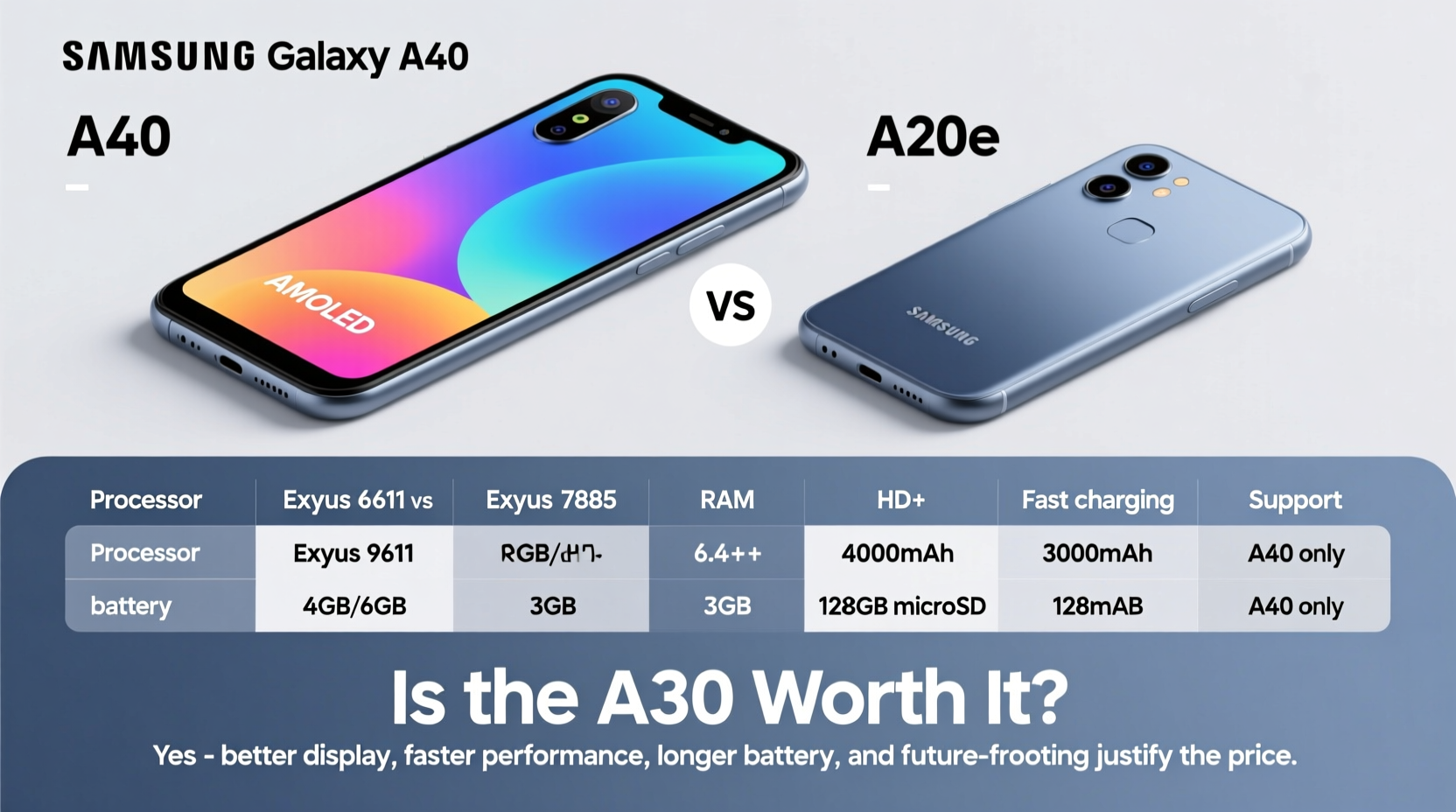
The first impression matters. The Galaxy A40 features a sleek, modern design with a 6.0-inch Super AMOLED display and slim bezels. It uses a glass-like plastic back that gives it a premium feel despite being made of polycarbonate. Its taller 19.5:9 aspect ratio makes it easier to handle with one hand, even with the larger screen.
In contrast, the A20e sticks to a more compact 5.8-inch PLS LCD panel and a squarer, boxier design. While smaller size can be a plus for some, the display feels outdated next to the A40’s AMOLED panel. The A20e also uses a glossy plastic body that attracts fingerprints and feels less refined.
Display Comparison: AMOLED vs LCD
This is where the A40 pulls ahead decisively. Its 6.0-inch Full HD+ (2340 x 1080) Super AMOLED display delivers vibrant colors, excellent contrast, and true blacks. Text appears sharp, videos are immersive, and outdoor visibility is strong thanks to higher peak brightness.
The A20e’s 5.8-inch HD+ (1480 x 720) PLS LCD screen, while functional, lacks the depth and richness of AMOLED. Colors appear washed out, viewing angles are narrower, and black levels are grayish due to backlight bleed. For users who consume media or spend long hours reading, this difference becomes apparent quickly.
“AMOLED isn’t just about looks—it reduces eye strain and improves readability in low light.” — Dr. Lena Park, Display Ergonomics Researcher
Performance and Everyday Use
Under the hood, the differences become starker. The A40 runs on the Exynos 7904, an octa-core processor paired with 4GB of RAM and 64GB of storage. This combination handles multitasking smoothly, supports app switching without lag, and manages social media, streaming, and casual gaming with ease.
The A20e, meanwhile, uses the older Exynos 7884B with only 2GB or 3GB of RAM depending on region, and 32GB of storage. With just 2GB RAM in many markets, the device struggles with background apps. Notifications delay, apps reload frequently, and basic tasks like switching between WhatsApp and Chrome can trigger hiccups.
Real-world usage shows the A40 lasts longer before showing signs of slowdown. Software updates, especially from Android 9 to 10 and later security patches, were delivered faster and more consistently to the A40, indicating better long-term support.
Key Performance Differences
| Feature | Samsung A40 | Samsung A20e |
|---|---|---|
| Processor | Exynos 7904 | Exynos 7884B |
| RAM | 4GB | 2GB / 3GB |
| Storage | 64GB (expandable) | 32GB (expandable) |
| OS Launch Version | Android 9 (Pie) | Android 8.1 (Oreo) |
| Benchmark Score (Antutu ~avg) | 105,000 | 78,000 |
Battery Life and Charging
The A20e packs a 3000mAh battery, which is modest by today’s standards. In practice, moderate users get through a full day, but heavy users—those streaming music, using GPS, or checking social media constantly—often need a midday charge.
The A40 steps up with a 3100mAh battery. While only slightly larger, it benefits from a more efficient AMOLED display that consumes less power when showing dark content. Combined with software optimizations, this results in slightly better endurance—often stretching into a second day under light use.
However, both devices lack fast charging. They support only 15W charging, but the included charger is usually 10W, meaning a full recharge takes nearly two hours. Neither has wireless charging or reverse charging features.
Camera Capabilities
The A40 comes with a dual-camera setup: 16MP main sensor + 5MP ultra-wide. The addition of an ultra-wide lens allows for creative framing—great for landscapes, group shots, or tight indoor spaces. Image processing is more refined, with better dynamic range and color accuracy in daylight.
The A20e has a single 8MP rear camera. While adequate for well-lit conditions, it lacks detail and struggles significantly in low light. There's no depth sensor or secondary lens, so portrait mode relies entirely on software simulation, often resulting in jagged edges and inaccurate blur.
For selfies, the A40’s 25MP front camera captures sharper details and handles backlighting better. The A20e’s 8MP front shooter produces softer images and tends to oversharpen facial features.
Mini Case Study: Maria’s Experience
Maria, a college student in Lisbon, bought the A20e in 2019 for its compact size and lower price. After six months, she noticed constant app crashes, slow camera response, and frustration with the dim screen during online classes. When her phone failed to receive Android 10, she upgraded to an A40 secondhand. “It felt like going from dial-up to broadband,” she said. “Everything loads faster, the screen doesn’t hurt my eyes, and I finally took photos I’m proud to post.” Her experience highlights how hardware limitations can degrade daily satisfaction—even if initial cost savings seem attractive.
Software Support and Longevity
One overlooked factor is software lifespan. Samsung promised two years of major OS updates for the A series starting in 2019. The A40 received Android 10 and 11, along with regular security patches until late 2021. The A20e, however, was stuck on Android 9 in many regions and stopped receiving updates earlier.
This means the A40 remained compatible with newer versions of popular apps longer. Banking apps, messaging platforms, and productivity tools increasingly require updated APIs, leaving older devices behind. For users planning to keep their phone for two or more years, this extended support adds tangible value.
Checklist: Is the A40 Worth It for You?
- ✅ Do you watch videos or read on your phone regularly? → A40’s AMOLED wins.
- ✅ Will you keep the phone for 18+ months? → A40 offers better update support.
- ✅ Do you take photos often? → A40’s dual camera provides more flexibility.
- ✅ Is smooth multitasking important? → A40’s 4GB RAM prevents lag.
- ✅ Are you sensitive to screen quality? → AMOLED reduces eye fatigue.
Frequently Asked Questions
Can the A20e handle modern apps in 2024?
Only lightly. Many newer apps run slowly or may not install due to OS and RAM limitations. Google has phased out support for older Android versions in key services like Gmail and YouTube, making the A20e increasingly obsolete.
Is the price difference still relevant today?
On the used or refurbished market, the gap has narrowed. The A40 now sells for only $20–$30 more than the A20e, making its superior specs an even better deal.
Does the A40 have a headphone jack?
Yes, both phones include a 3.5mm headphone jack and support USB-C audio adapters.
Final Verdict: Is the A40 Worth the Extra Money?
Yes—the Galaxy A40 is absolutely worth the additional investment over the A20e. The advantages aren't minor upgrades; they're fundamental improvements in display technology, performance headroom, camera versatility, and long-term usability. That extra $50 at launch translated into a device that stayed functional, enjoyable, and supported for years longer.
The A20e works as a basic communication tool, but the A40 functions as a capable daily driver. It balances screen size, battery life, and performance in a way that feels modern even years after release. For anyone who uses their phone for more than calls and texts—especially students, commuters, or social media users—the A40 delivers noticeably better value.
In budget tech, small differences compound over time. A slightly faster processor, an extra 2GB of RAM, or a superior screen don’t just improve specs—they reduce friction in everyday use. That’s why the A40 isn’t just “better”—it’s more sustainable, satisfying, and ultimately smarter spending.




 浙公网安备
33010002000092号
浙公网安备
33010002000092号 浙B2-20120091-4
Comments
No comments yet. Why don't you start the discussion?