
When Samsung released the Galaxy A50s just months after the A50, many consumers were left wondering: is this more than just a minor refresh? At first glance, both phones share nearly identical designs, software, and core features. But subtle differences in hardware—especially the camera and processor—raise important questions about value. For users deciding between these two mid-range models, understanding what actually changed (and what didn’t) is key to making a smart purchase.
The A50 was already a solid performer in its class, offering a vibrant AMOLED display, a capable triple rear camera setup, and long battery life. The A50s, introduced later with minimal fanfare, promised slight upgrades but carried a slightly higher price tag. So, does that extra cost translate into meaningful improvements? Or is it simply a marketing move to keep the product line fresh?
Design and Build: Almost Identical Twins
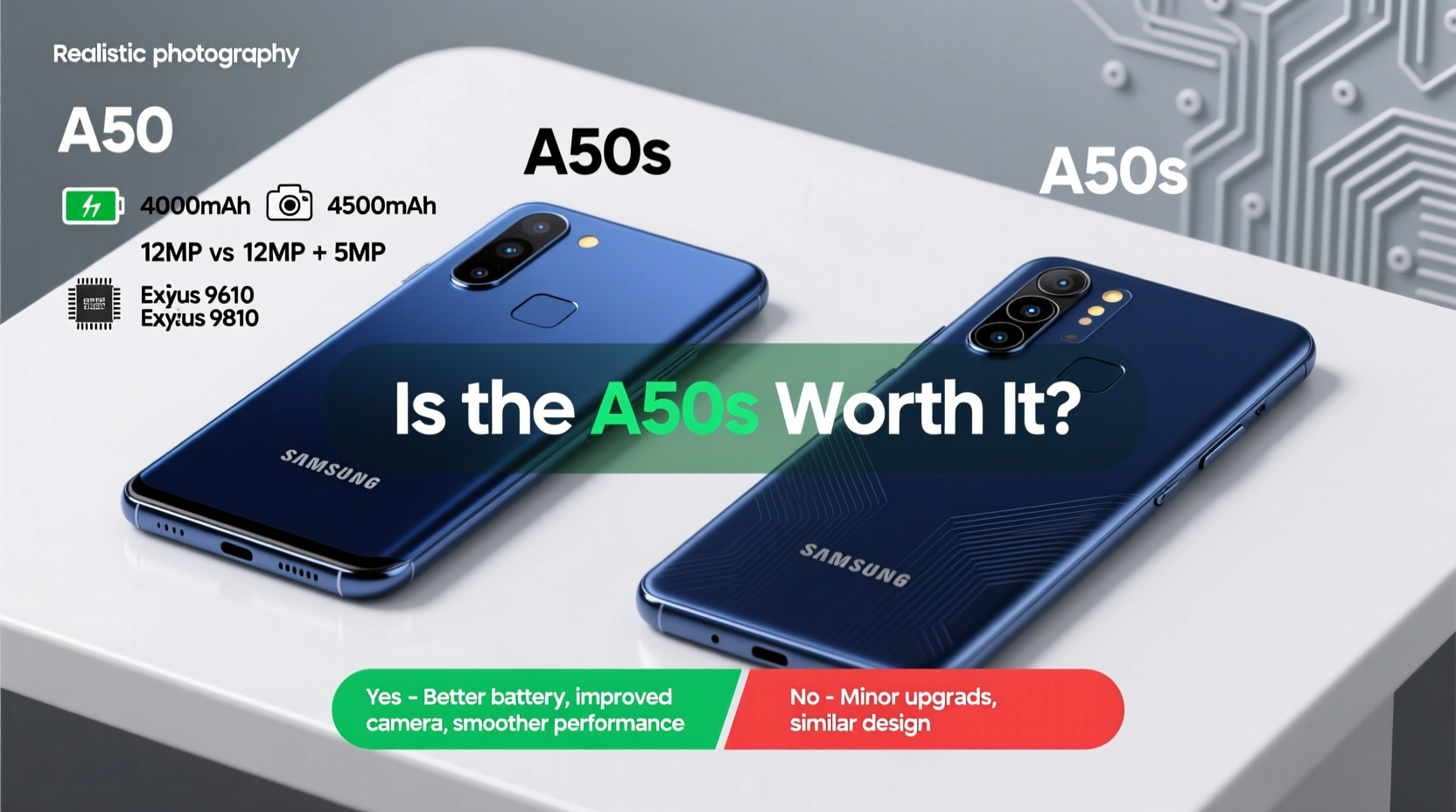
From the outside, distinguishing the A50 from the A50s is nearly impossible. Both devices feature a 6.4-inch Super AMOLED Infinity-U display with a resolution of 1080 x 2340 pixels, delivering crisp visuals and deep blacks. The front glass is protected by Corning Gorilla Glass 3, and the overall build quality feels sturdy for their price range.
The most noticeable difference lies in the back panel. The A50s introduces a new gradient finish with a diamond-like texture that reflects light differently, giving it a slightly more premium appearance. However, this is purely aesthetic—there are no changes in dimensions, weight, or materials. Both phones retain the same plastic body and fingerprint sensor placement under the display.
Performance Comparison: A Closer Look at Hardware
Under the hood, the most significant change comes down to the chipset. The original A50 uses Samsung’s Exynos 9610 processor, an octa-core chip built on a 10nm process. It’s paired with either 4GB or 6GB of RAM and performs well for everyday tasks like browsing, social media, and video streaming.
The A50s, meanwhile, steps up to the Exynos 9611—a modest improvement with similar architecture but slightly better GPU performance and enhanced AI capabilities. While benchmarks show only a 5–10% increase in CPU speed, the real benefit appears in sustained performance during gaming or multitasking.
In real-world usage, neither phone struggles with basic functions, but the A50s handles app switching and heavy games like *PUBG Mobile* or *Call of Duty: Mobile* with marginally smoother frame rates. That said, the difference isn’t dramatic enough to call it a generational leap.
Battery Life: No Change, But Still Strong
Both models pack a 4,000mAh battery and support 15W fast charging via USB-C. There’s no wireless charging or reverse charging here, which is typical for this segment. In daily use, both phones easily last a full day with moderate to heavy usage, including YouTube, messaging, and navigation.
Because the processors are so similar in efficiency and the displays are identical, battery endurance remains virtually unchanged. Users shouldn’t expect longer life from the A50s despite the newer chip—any gains are offset by increased background processing from updated firmware and camera enhancements.
Camera Showdown: Where the A50s Shines
This is where the A50s pulls ahead. While both phones feature triple rear cameras, the configuration differs meaningfully:
| Feature | Samsung A50 | Samsung A50s |
|---|---|---|
| Main Sensor | 25MP (f/1.7) | 48MP (f/2.0) |
| Ultra-Wide | 8MP (f/2.2) | 8MP (f/2.2) |
| Depth Sensor | 5MP (f/2.2) | 5MP (f/2.2) |
| Front Camera | 25MP (f/2.0) | 32MP (f/2.0) |
| AI Features | Limited Scene Optimizer | Enhanced AI Detection (19+ modes) |
The jump from 25MP to 48MP on the main sensor allows the A50s to capture more detail, especially in daylight. While pixel-binning technology combines four pixels into one for better low-light results, the output still shows improved dynamic range and color accuracy compared to the A50.
The front-facing camera also gets a boost—from 25MP to 32MP—making selfies sharper and better suited for digital zooming or cropping. Combined with upgraded AI scene recognition that now detects food, pets, and landscapes more reliably, the A50s offers a noticeably better photography experience.
“Even small sensor upgrades can make a big difference in consumer satisfaction when it comes to smartphone cameras.” — Dr. Lena Park, Mobile Imaging Analyst at TechInsight Group
Software and User Experience
Both phones launched with Android 9 Pie and Samsung’s One UI, and they continue to receive updates through Android 11 and security patches. Over-the-air updates have been consistent, though not the fastest in the industry. As of 2024, neither model receives major OS upgrades, but monthly security patches may still roll out intermittently.
One UI remains intuitive and user-friendly, with dark mode, customizable icons, and excellent gesture navigation. The in-display fingerprint sensor works reasonably well, though it can be slow in cold environments or when fingers are slightly damp.
No software exclusives were added to the A50s—it runs the same interface as the A50. Any perceived UX improvements come from faster app launches due to the slightly better processor, not from system-level changes.
Mini Case Study: Real-World Upgrade Decision
Consider Maria, a college student who bought the A50 at launch in early 2019. By late 2019, she noticed her phone struggling with Instagram filters and slow photo processing. When she saw the A50s advertised with a “better camera,” she considered upgrading.
After testing both devices side-by-side at a retail store, she found that the A50s took visibly clearer photos in dim lighting and booted apps about half a second faster. However, since her current phone still worked fine and she wasn’t a frequent photographer, she decided against spending extra money. Instead, she optimized her A50 with a factory reset and lighter launcher app, extending its usability for another year.
Maria’s story highlights a common dilemma: incremental upgrades often offer marginal benefits that may not justify the cost unless specific needs—like photography—are prioritized.
Checklist: Should You Upgrade?
- ✅ Are you replacing a significantly older phone (pre-2018)? → A50s is a strong choice.
- ✅ Do you take a lot of photos, especially in low light? → A50s offers tangible camera benefits.
- ✅ Is budget tight and the A50 available at a steep discount? → Stick with A50; savings outweigh minor gains.
- ✅ Do you plan to keep your phone for 3+ years? → Neither model will receive future Android versions, so consider newer alternatives.
- ✅ Are you sensitive to phone aesthetics? → A50s has a more modern back design.
Frequently Asked Questions
Is the Samsung A50s waterproof?
No, neither the A50 nor the A50s has an official IP rating for water or dust resistance. They lack sealed ports and protective coatings, so exposure to moisture should be avoided.
Can the A50s run Fortnite smoothly?
Yes, but not at maximum settings. On medium graphics with 30fps, the A50s handles Fortnite reasonably well thanks to the Exynos 9611. Expect occasional frame drops during intense scenes.
Does the A50s support expandable storage?
Yes, both phones support microSD cards up to 512GB via a dedicated slot, allowing you to expand storage without sacrificing dual SIM functionality.
Final Verdict: Is the S Version Worth It?
The Samsung Galaxy A50s is not a revolutionary upgrade over the A50—it’s an evolutionary one. If you’re choosing between them brand new and price is equal, the A50s wins thanks to its superior camera and slightly better processor. The 48MP main sensor and 32MP selfie cam deliver measurable improvements in image quality, and the updated chipset ensures smoother performance over time.
However, if the A50 is significantly cheaper—say, $50 or more below the A50s—it becomes the smarter buy. For most users, the core experience is identical: same screen, same battery, same software, and same general reliability. The gains in the A50s are real but narrow, appealing mostly to photography enthusiasts or those who want the latest model regardless of cost.
Ultimately, the “S” in A50s stands less for \"super\" and more for \"slightly better.\" It’s worth the upgrade only if you value camera quality above all else and are paying close to the same price.




 浙公网安备
33010002000092号
浙公网安备
33010002000092号 浙B2-20120091-4
Comments
No comments yet. Why don't you start the discussion?