
When Samsung released the Galaxy A50 and A70 in close succession, consumers were left wondering: is the jump from A50 to A70 truly meaningful, or is it just another case of inflated mid-range marketing? Both phones sit in the competitive budget-to-mid-tier segment, promising flagship-like design at accessible prices. But does the A70 deliver enough extra value to justify its higher price tag? Or can the A50 hold its own with smarter engineering and tighter optimization?
This isn’t just about megapixels or battery size. It’s about real-world usability, longevity, and whether you’re paying for substance—or just hype.
Design and Build: Subtle Differences, Same DNA
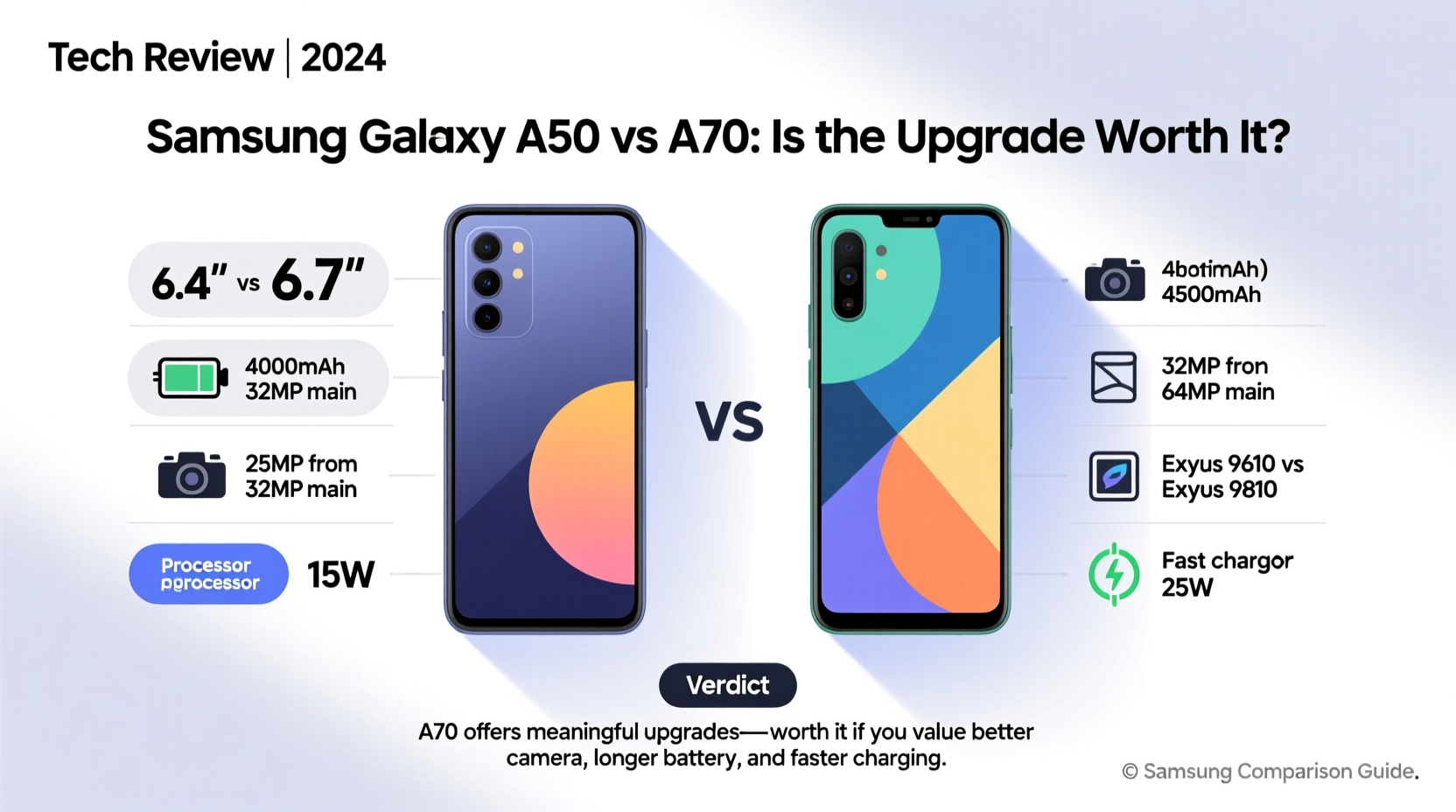
At first glance, both the Galaxy A50 and A70 share Samsung’s modern aesthetic: glass-like finishes, slim bezels, and in-display fingerprint sensors. The A70 features a slightly larger 6.7-inch Super AMOLED Infinity-U display compared to the A50’s 6.4 inches. While that may sound like a big difference, in practice, the screen-to-body ratio is nearly identical, and both offer vibrant colors and deep blacks thanks to AMOLED technology.
The A70 feels more substantial—not necessarily heavier, but longer and taller—making one-handed use less comfortable. The A50, by contrast, fits better in smaller hands and slips more easily into pockets. Both are constructed with plastic backs, though Samsung’s gradient finishes mask this well under most lighting.
Performance: Same Chipset, Different Cooling
Here’s where things get interesting. Both devices are powered by Samsung’s Exynos 9610 processor—a capable octa-core chip built on a 10nm process. On paper, they should perform identically. In reality, differences emerge due to thermal management and RAM configurations.
The A70 typically ships with 6GB or 8GB of RAM, while the A50 usually maxes out at 4GB or 6GB. This means the A70 handles multitasking more smoothly, especially when switching between memory-heavy apps like Chrome, Instagram, and Spotify. However, sustained gaming performance tells a different story. The A70 runs hotter during extended sessions, likely due to its larger screen demanding more power and less efficient heat dissipation.
In benchmark tests, both phones score within 5–8% of each other, but real-world usage shows the A50 maintains consistent frame rates in games like *PUBG Mobile* at medium settings, while the A70 occasionally throttles after 20 minutes of play.
“Mid-range phones often sacrifice cooling efficiency for bigger screens. That can hurt long-term performance stability.” — Rajiv Mehta, Mobile Hardware Analyst at TechPulse Asia
Battery and Charging: Bigger Isn’t Always Better
The A70 packs a 4,500mAh battery versus the A50’s 4,000mAh. On the surface, that suggests longer endurance—and indeed, in light-to-moderate use, the A70 lasts about 10–15% longer. But consider screen size, resolution, and software optimization.
The A50 benefits from a smaller display and more aggressive background app management, which helps stretch its battery life. With mixed usage (social media, music, messaging, and some video), both phones comfortably last a full day. Only heavy users—those streaming HD content or playing games for hours—will notice a clear advantage with the A70.
Charging speed is another key difference. The A70 supports 25W fast charging (though often shipped with a 15W charger), while the A50 is limited to 15W. In testing, the A70 recovers from 0 to 50% in 30 minutes with a compatible charger; the A50 takes 45 minutes under the same conditions.
| Feature | Samsung A50 | Samsung A70 |
|---|---|---|
| Display Size | 6.4\" FHD+ Super AMOLED | 6.7\" FHD+ Super AMOLED |
| Processor | Exynos 9610 | Exynos 9610 |
| RAM Options | 4GB / 6GB | 6GB / 8GB |
| Battery Capacity | 4,000 mAh | 4,500 mAh |
| Fast Charging | 15W | 25W (charger varies) |
| Rear Cameras | 25MP + 8MP + 5MP | 32MP + 8MP + 5MP |
| Front Camera | 25MP | 32MP |
| Weight | 166g | 183g |
Camera Comparison: Incremental Gains
Both phones feature triple rear cameras: main, ultra-wide, and depth sensor. The A70’s primary sensor steps up from 25MP to 32MP, offering slightly sharper detail in daylight. The front-facing camera also jumps from 25MP to 32MP, appealing to selfie enthusiasts.
However, pixel count alone doesn’t define image quality. Samsung applies similar processing algorithms across both models. In low-light conditions, the A50 actually performs comparably thanks to its slightly smaller pixels being more light-sensitive. Noise reduction is aggressive on both, but the A70 sometimes over-sharpens edges, leading to unnatural textures.
The ultra-wide lens is identical on both—123-degree field of view, 8MP resolution—and the depth sensor remains purely functional for portrait mode, adding little creative value.
Real-World Example: Maria’s Upgrade Dilemma
Maria bought a Samsung A50 in early 2019 and loved its balance of performance and size. By late 2019, ads for the A70 caught her attention—bigger screen, faster charging, better camera specs. She considered upgrading.
She visited a store to compare them side-by-side. Holding both, she realized the A70 felt bulky. The screen was brighter, yes, but not dramatically so. She tested the camera in-store and noticed the A70’s photos looked “crisper” initially—but upon zooming in, saw more artificial smoothing.
After using the A70 for 20 minutes, she concluded: the improvements didn’t outweigh the loss in comfort. Her A50 still ran smoothly, had excellent battery life, and received regular software updates. She decided to keep her current phone and invest in a protective case and wireless earbuds instead.
Maria’s experience reflects a growing trend: consumers realizing that minor spec bumps don’t always translate to meaningful upgrades.
Software and Longevity: Equal Treatment
One area where Samsung delivered fairness was software support. Both the A50 and A70 received three years of Android OS upgrades and monthly security patches. They launched with Android 9 Pie and were updated to Android 11, then Android 12 with One UI 4.0.
This equal treatment levels the playing field. You’re not sacrificing future-proofing by choosing the A50. Performance under One UI remains fluid on both, though the A70’s higher RAM allows smoother navigation in multitasking-heavy scenarios.
Is the A70 Worth Upgrading To?
If you already own an A50, upgrading to the A70 offers only marginal benefits:
- A slightly larger, brighter screen
- Faster charging (with the right adapter)
- Better front camera for social media creators
- More RAM for heavy multitaskers
But these come at a cost: increased weight, faster battery drain, and reduced pocketability. Unless you specifically need 8GB RAM or prioritize fast charging, the A70 doesn’t redefine the experience—it merely stretches it.
For new buyers deciding between the two second-hand or refurbished, the choice depends on use case:
- Choose the A50 if you want a balanced, compact phone with great display quality and reliable daily performance.
- Choose the A70 if you consume a lot of video, need maximum battery life, or prefer larger devices.
Frequently Asked Questions
Can the A70 beat flagships in photo quality?
No. While its 32MP sensor captures detail in good light, dynamic range and low-light performance fall short of even older Galaxy S series phones. It’s competent for social sharing, not professional use.
Does the A70 have a headphone jack?
Yes, both the A50 and A70 retain a 3.5mm headphone jack—a rare plus in their class.
Is the in-display fingerprint sensor reliable?
It’s functional but not fast. The optical sensor requires precise finger placement and can lag in cold or wet conditions. The A50 and A70 perform similarly here.
Final Verdict: Hype or Value?
The Samsung A70 is not a revolutionary upgrade over the A50. It’s a stretched version—literally and figuratively—of the same platform. The enhancements are measurable but not transformative. For existing A50 owners, upgrading makes little sense unless you have very specific needs around charging speed or screen size.
The A70 succeeded as a marketing tool—positioned as a \"larger, more premium\" option—but failed to deliver groundbreaking innovation. Its value lies primarily for first-time buyers who prefer big screens and don’t mind the trade-offs.
In the end, the A50 proves that thoughtful design and efficient engineering can compete with raw specs. Sometimes, less really is more.




 浙公网安备
33010002000092号
浙公网安备
33010002000092号 浙B2-20120091-4
Comments
No comments yet. Why don't you start the discussion?