
If you're still using the Samsung Galaxy A51, released in early 2020, chances are you’ve been eyeing newer models. The Galaxy A16 5G, launched in 2023, promises modern features like 5G connectivity, improved cameras, and better performance. But is the jump from the A51 to the A16 5G actually worth your time and money? For many users clinging to their aging but functional A51, the decision isn’t just about specs—it’s about real-world value, longevity, and whether the improvements translate into meaningful daily upgrades.
This comparison cuts through marketing hype to deliver a practical breakdown of what’s changed—and what hasn’t—between these two mid-range Samsung devices. Whether you're experiencing slowdowns, battery drain, or simply want a fresher experience, we’ll help you determine if upgrading makes sense for your lifestyle.
Performance & Hardware: Generational Gaps Matter
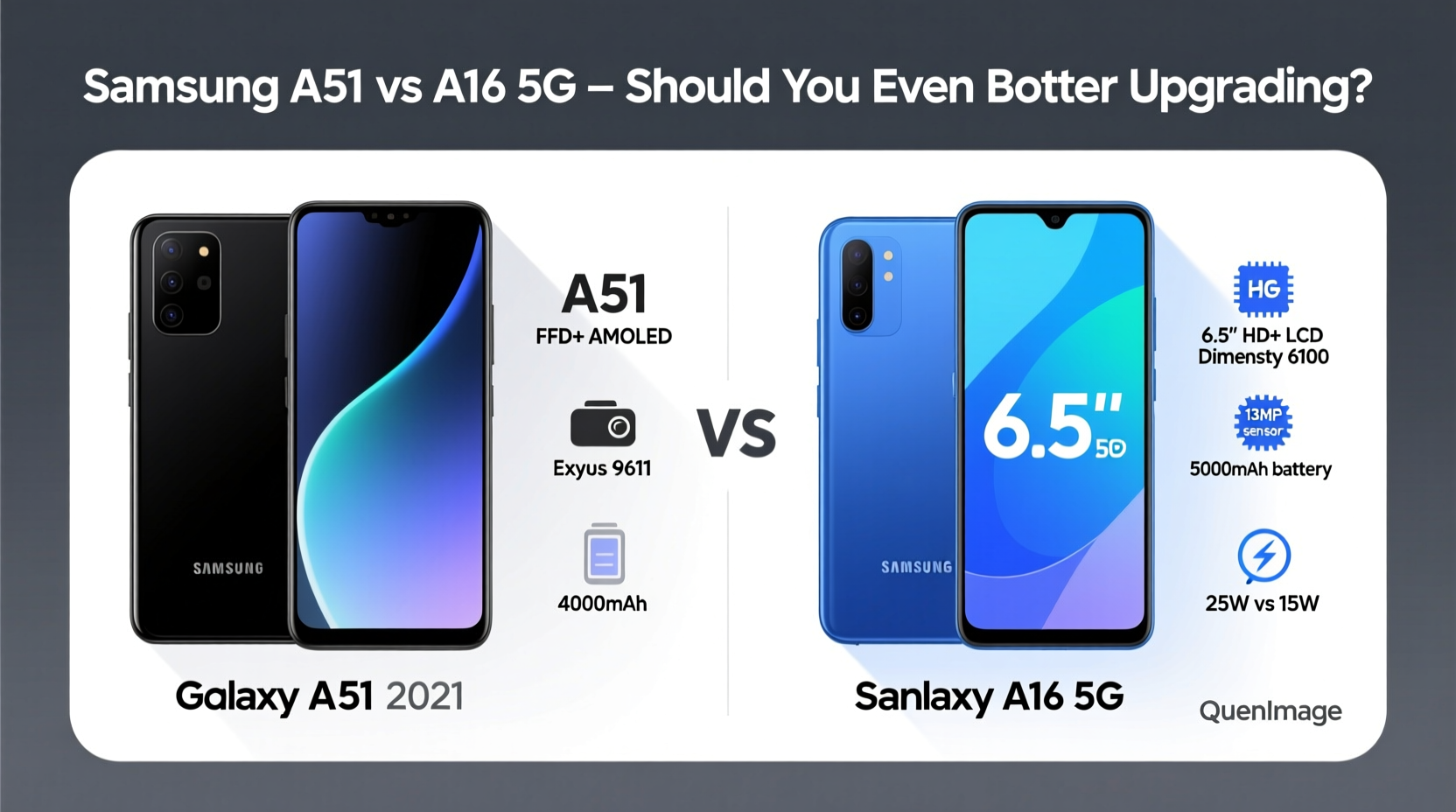
The core difference between the A51 and A16 5G lies in their processors and overall system responsiveness. The A51 runs on Samsung’s Exynos 9611—a solid chip for its time but now showing its age. In contrast, the A16 5G uses the MediaTek Dimensity 6100+, an octa-core 5G-capable SoC built on a more efficient 7nm process. This shift brings tangible benefits: faster app launches, smoother multitasking, and better handling of modern apps and games.
RAM configurations also differ. The A51 typically shipped with 4GB or 6GB of RAM, while the A16 5G starts at 6GB and often includes 8GB options. Paired with Android 13 (vs. the A51’s original Android 10), the A16 5G offers longer software support and improved security updates.
Display & Design: Subtle Evolution, Not Revolution
Both phones feature 6.5-inch Super AMOLED displays with HD+ resolution and similar screen-to-body ratios. However, the A16 5G increases refresh rate to 90Hz from the A51’s 60Hz. While not as fluid as 120Hz flagship panels, the 90Hz display noticeably smooths scrolling and animations, reducing eye strain during prolonged use.
Design-wise, both devices follow Samsung’s minimalist aesthetic with plastic backs and side-mounted fingerprint sensors. The A16 5G feels slightly more refined with tighter build tolerances and a flatter frame that improves grip. Neither phone is water-resistant, so caution around moisture remains essential.
One often-overlooked change is weight distribution. The A16 5G is marginally lighter (170g vs. 172g) and thinner, making it more comfortable for one-handed use over extended periods—especially for reading or watching videos.
Camera Comparison: Incremental Gains, Not Leaps
The A51 came with a quad-camera setup: 48MP main, 12MP ultra-wide, 5MP macro, and 5MP depth sensor. It was praised at launch for its detail-rich daylight shots and reliable portrait mode. Fast forward to the A16 5G: it retains a similar configuration but swaps the main sensor for a 50MP unit and upgrades the ultra-wide to 8MP. More importantly, computational photography has improved significantly.
In real-world conditions, the A16 5G delivers better dynamic range, faster autofocus, and enhanced night mode processing. Video recording sees a notable bump too—now supporting 1080p at 30fps with better stabilization, whereas the A51 struggles in low-light video scenarios.
“Mid-range camera systems today leverage AI far more effectively than even premium models did four years ago. The software gap is now wider than the hardware gap.” — Rajiv Mehta, Mobile Imaging Analyst at TechPulse Asia
That said, casual photographers who primarily share images on social media may not notice dramatic differences. If you take lots of indoor or nighttime photos, though, the A16 5G’s processing advantages become clear.
Battery Life & Charging: Real Improvement Where It Counts
Battery capacity remains nearly identical: 4000mAh on the A51 versus 5000mAh on the A16 5G. That extra 1000mAh, combined with the more power-efficient Dimensity chip, results in significantly longer endurance. Users report up to two full days of moderate use on the A16 5G compared to barely one day on an aging A51.
Charging speed has also improved. The A16 5G supports 25W fast charging (though often ships with only a 15W charger), while the A51 maxes out at 15W. This means going from 20% to 80% in under 45 minutes on the newer model—ideal for busy schedules.
Detailed Feature Comparison Table
| Feature | Samsung Galaxy A51 | Samsung Galaxy A16 5G |
|---|---|---|
| Release Year | 2020 | 2023 |
| Processor | Exynos 9611 | MediaTek Dimensity 6100+ |
| RAM Options | 4GB / 6GB | 6GB / 8GB |
| Storage | 128GB (expandable) | 128GB / 256GB (expandable) |
| Display | 6.5” FHD+ AMOLED, 60Hz | 6.6” FHD+ AMOLED, 90Hz |
| Rear Camera | 48MP + 12MP UW + 5MP Macro + 5MP Depth | 50MP + 8MP UW + 2MP Macro |
| Front Camera | 32MP | 13MP |
| Battery | 4000mAh | 5000mAh |
| Charging | 15W | 25W (charger may be 15W) |
| Network | 4G LTE | 5G |
| OS (Launch / Current) | Android 10 → Up to Android 13 | Android 13 → Likely Android 15 |
| Security Updates | Likely ended | Expected through 2026 |
Mini Case Study: Maria’s Upgrade Dilemma
Maria, a freelance graphic designer in Manila, relied on her Galaxy A51 for work calls, client emails, and photo editing via mobile apps. By late 2023, she noticed delays when switching between Adobe Express and Zoom, and her battery wouldn’t last through a morning meeting session without a top-up.
She considered repairing the battery but discovered local service centers no longer stock parts. After testing the A16 5G at a retail store, she found the 90Hz screen reduced eye fatigue during long design reviews, and the 5G connection made uploading portfolio samples faster. She upgraded and reported a 40% improvement in daily productivity—mainly due to fewer interruptions from lag and charging.
Her case illustrates a key point: the value of upgrading isn’t always about raw specs, but how consistently the device supports your routine.
When You Should Upgrade (And When You Shouldn’t)
- Upgrade if: Your A51 lags frequently, battery life is poor, you need 5G connectivity, or you rely on your phone for work.
- Wait or skip if: Your A51 still performs well, you’re satisfied with 4G speeds, and your usage is light (calls, messaging, occasional browsing).
- Consider repair instead: If only the battery or screen is faulty and other components function well, a $30–$50 repair might extend usability another 12–18 months.
Checklist: Is It Time to Upgrade?
- Does your A51 take more than 2 seconds to open commonly used apps?
- Have you experienced unexpected shutdowns below 20% battery?
- Do you frequently run out of storage despite cleaning files?
- Is your current carrier pushing 5G-only plans or phasing out 4G?
- Are you unable to receive security updates?
If you answered “yes” to two or more, the A16 5G—or a similar modern mid-ranger—is likely a worthwhile investment.
FAQ
Can the Galaxy A16 5G run demanding games smoothly?
Yes. Thanks to the Dimensity 6100+ and 6GB+ RAM, games like Genshin Impact and Call of Duty: Mobile run at medium settings with stable frame rates. It won’t match flagship performance, but it handles modern titles far better than the A51.
Is the lack of a 32MP front camera a downgrade?
On paper, yes—but in practice, no. The A16 5G compensates with better skin tone rendering and HDR optimization. Selfies appear more natural in varied lighting, even if resolution is lower.
Will my old accessories work with the A16 5G?
Most USB-C chargers, cases, and headphones will be compatible. However, screen protectors and magnetic mounts may require re-measurement due to slight dimensional changes.
Conclusion: Make the Move When It Serves Your Life
The Samsung Galaxy A51 was a standout in its era, but technology moves quickly. The A16 5G isn’t a revolutionary leap, but it addresses critical pain points: sluggish performance, outdated networks, and short battery life. For users whose phones are central to communication, productivity, or creative work, upgrading brings measurable quality-of-life improvements.
However, if your A51 still meets your needs and you’re not frustrated by its limits, there’s no urgent reason to replace it. Sustainability matters—keeping devices longer reduces e-waste and saves money.
Ultimately, the decision shouldn’t hinge on specs alone. Ask yourself: does your current phone help you live better, or hold you back? If the answer leans toward the latter, then yes—you should bother upgrading.




 浙公网安备
33010002000092号
浙公网安备
33010002000092号 浙B2-20120091-4
Comments
No comments yet. Why don't you start the discussion?