
Choosing between the Samsung Galaxy A51 and A30 isn’t just about price tags or marketing claims—it’s about real improvements that impact daily use. Both phones emerged during Samsung’s aggressive push into the mid-range market, offering sleek designs and solid features at accessible prices. But if you already own an A30, does moving to the A51 bring meaningful upgrades—or are you simply paying for subtle refinements masked as innovation?
The answer depends on what matters most to you: camera quality, performance longevity, screen experience, or battery life. Let’s break down every key difference with practical insight, so you can decide whether the upgrade delivers value or falls into the trap of incremental tech hype.
Design and Display: Subtle Refinements, Not Revolution
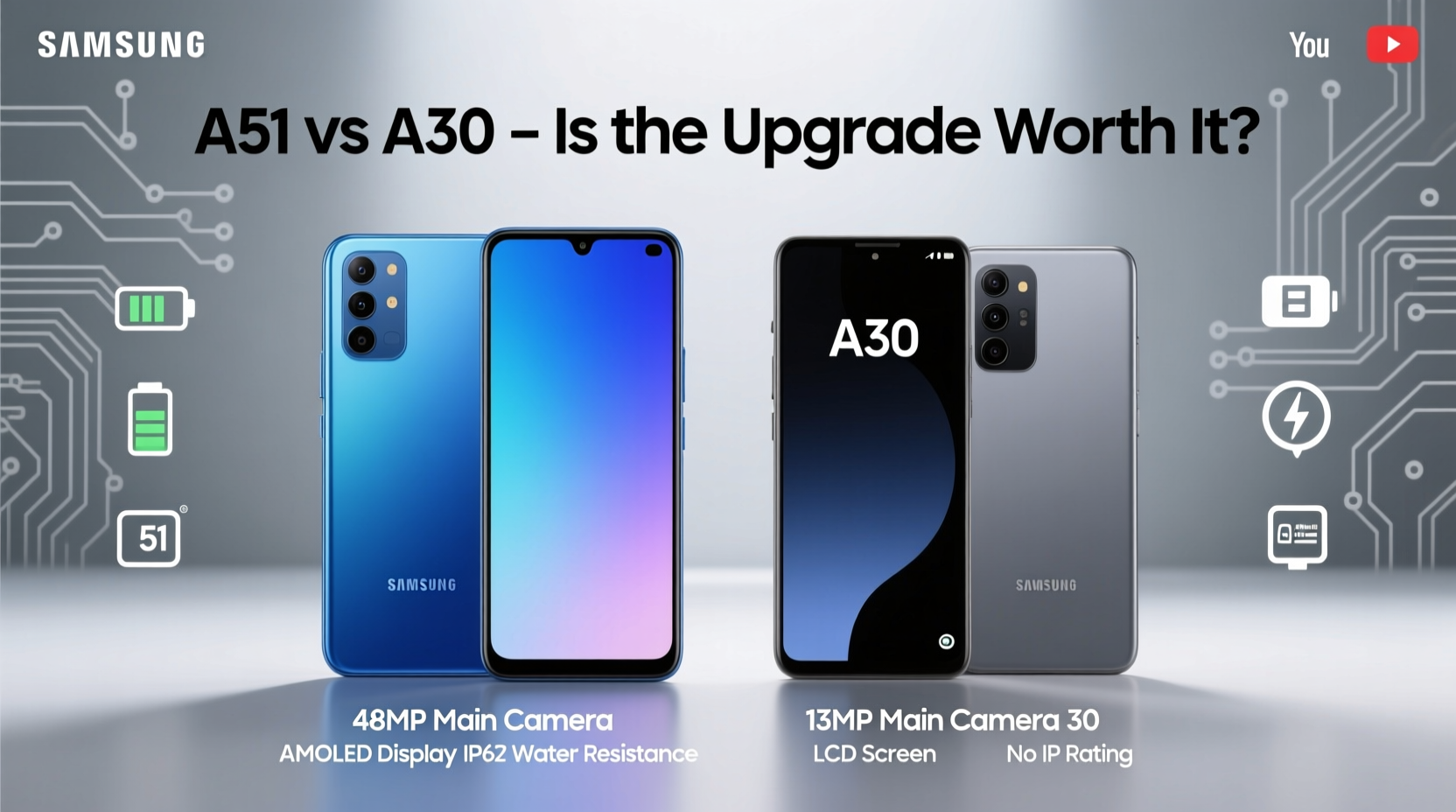
At first glance, both phones share Samsung’s minimalist aesthetic—glass-like backs, slim bezels, and symmetrical silhouettes. The A51 slightly edges ahead with a more refined design. It uses a smoother polycarbonate finish that resists fingerprints better than the A30’s glossy back, which tends to attract smudges quickly.
The display is where the A51 makes a tangible leap. While both feature Super AMOLED panels—a rarity in this segment—the A51 boasts a 6.5-inch FHD+ (1080 x 2400) screen, compared to the A30’s 6.4-inch HD+ (720 x 1560) resolution. That means sharper text, crisper images, and noticeably better video playback.
Additionally, the A51 integrates an in-display fingerprint sensor, replacing the rear-mounted one on the A30. This isn’t just about aesthetics; it streamlines unlocking when holding the phone naturally. However, early users noted slower response times compared to physical sensors—though software updates have improved reliability over time.
Performance and Hardware: More Than Just Specs
Under the hood, the differences become clearer. The A30 runs on Samsung’s older Exynos 9610 processor with 3GB or 4GB RAM, while the A51 steps up to the Exynos 9611 with 4GB or 6GB RAM options. On paper, this seems like a modest bump—but in practice, it translates to smoother multitasking and better app retention.
Real-world usage reveals where the gap widens. The A51 handles background apps more efficiently, reducing reloads when switching between social media, messaging, and browsers. Gamers will also appreciate the improved GPU performance, allowing medium-to-high settings on titles like *PUBG Mobile* or *Call of Duty: Mobile*, whereas the A30 struggles with sustained frame rates.
“Mid-range processors aren’t just about speed—they’re about thermal efficiency and longevity. The Exynos 9611 manages heat better, meaning less throttling over time.” — Rajiv Mehta, Mobile Hardware Analyst
Storage remains expandable via microSD on both models, but the A51 supports UFS 2.1 storage (vs. eMMC 5.1 on the A30), resulting in faster app launches and file transfers. For long-term ownership, this contributes to a fresher-feeling device even after 18 months of use.
Camera Comparison: When More Lenses Actually Matter
This is where the A51 shines—and where the A30 starts to show its age. The A30 features a dual-camera setup: 16MP main + 5MP ultra-wide. In good lighting, photos are acceptable, but low-light shots suffer from noise, poor dynamic range, and inconsistent focus.
The A51 upgrades to a quad-camera array: 48MP main (f/2.0), 12MP ultra-wide (f/2.2), 5MP macro, and 5MP depth sensor. The higher-resolution primary sensor captures significantly more detail, especially when zooming or cropping. Combined with better HDR processing, the A51 produces balanced exposures in challenging light—like backlit portraits or shaded outdoor scenes.
| Feature | Samsung A30 | Samsung A51 |
|---|---|---|
| Main Camera | 16MP (f/1.7) | 48MP (f/2.0) |
| Ultra-Wide | 5MP (f/2.2) | 12MP (f/2.2) |
| Additional Sensors | None | Makro + Depth |
| Front Camera | 16MP (f/2.0) | 32MP (f/2.2) |
| Video Recording | 1080p@30fps | 4K@30fps |
The front cameras tell a similar story. The A51’s 32MP selfie shooter outperforms the A30’s 16MP unit in clarity and skin tone accuracy, particularly in mixed lighting. And unlike the A30, the A51 supports 4K video recording—an increasingly relevant feature for vloggers and social media creators.
Battery and Charging: Longevity Over Speed
Both phones pack large batteries: 4000mAh on the A30 and 4000mAh on the A51. Despite identical capacity, the A51 often lasts longer due to more efficient hardware and software optimization. Users report up to 1.5 extra hours of screen-on time under similar conditions.
Charging speed is identical—15W fast charging supported, though Samsung typically includes only a 10W charger in the box. Neither model offers wireless charging, which isn’t expected at this tier. However, the A51 benefits from slightly smarter power management, delaying battery degradation over extended use.
Mini Case Study: Maria’s Upgrade Decision
Maria has used her Samsung A30 since 2019. By late 2021, she noticed apps loading slower, the camera struggling in evening light, and frequent reboots. She considered buying a flagship but found the A51 on sale for $230—only $80 more than repair costs for her aging A30.
After switching, she immediately valued the brighter screen for reading recipes in her kitchen, the sharper selfies for virtual meetings, and the ability to keep five apps open without reloading. “It felt like I got a new brain for my old habits,” she said. “Not revolutionary, but definitely relieving.”
For Maria, the upgrade wasn’t about chasing trends—it was about restoring confidence in her device’s reliability.
Is the Upgrade Worth It? A Practical Checklist
Before spending money, ask yourself these questions. Check off each that applies:
- ☐ My current A30 feels sluggish when opening apps or switching tasks
- ☐ I take photos regularly and want better low-light results
- ☐ I watch videos or read on my phone and would benefit from a sharper display
- ☐ My battery no longer lasts a full day with moderate use
- ☐ I want a phone that can handle updates and newer apps for another 18–24 months
If three or more apply, the A51 likely offers real value. If not, you may be upgrading for marginal gains that don’t align with your usage.
Frequently Asked Questions
Can the A30 still handle everyday tasks in 2024?
Yes, but with limitations. Basic calling, texting, light browsing, and older apps work fine. However, newer versions of WhatsApp, Instagram, or Google services may run slowly or crash occasionally. Security updates ended in 2022, so using the A30 today carries mild security risks.
Does the A51 support Android 13 or 14?
No. The A51 launched with Android 10 and received updates up to Android 12. It will not receive Android 13 or beyond. However, Android 12 remains functional and secure through 2024 with regular monthly patches.
Is the price difference justified?
At launch, the gap was around $100. Today, both are available secondhand or refurbished. If you can get an A51 within $30–$50 of the A30’s price, it’s absolutely worth the extra cost. Beyond that, consider newer models like the A52 or A53 for better long-term support.
Conclusion: Value Beyond the Hype
Upgrading from the Samsung A30 to the A51 isn’t about succumbing to marketing hype—it’s about reclaiming responsiveness, clarity, and usability that degrade over time. The improvements are measurable: a superior screen, faster processor, better cameras, and more future-proof software support.
But upgrades should serve your needs, not your ego. If your A30 still meets your daily demands, hold on. If you find yourself compensating for its limits—waiting for photos to process, struggling to see the screen, or closing apps repeatedly—the A51 offers tangible relief.




 浙公网安备
33010002000092号
浙公网安备
33010002000092号 浙B2-20120091-4
Comments
No comments yet. Why don't you start the discussion?