
When Samsung released the Galaxy S7 Edge in 2016, it was hailed as a flagship powerhouse with a stunning curved display and top-tier camera. Nearly four years later, the Galaxy A51 arrived as a mid-range contender with modern features like a quad-camera setup and an AMOLED display. On paper, the A51 appears more advanced—but does that mean it's truly better than its older, premium predecessor? Or is it simply newer without being superior?
This comparison isn’t just about specs; it’s about real-world usability, longevity, software support, and value. For users considering upgrading from an S7 Edge or choosing between second-hand models, understanding what \"newer\" really means in smartphone evolution is crucial.
Design and Build Quality: Premium vs Practical
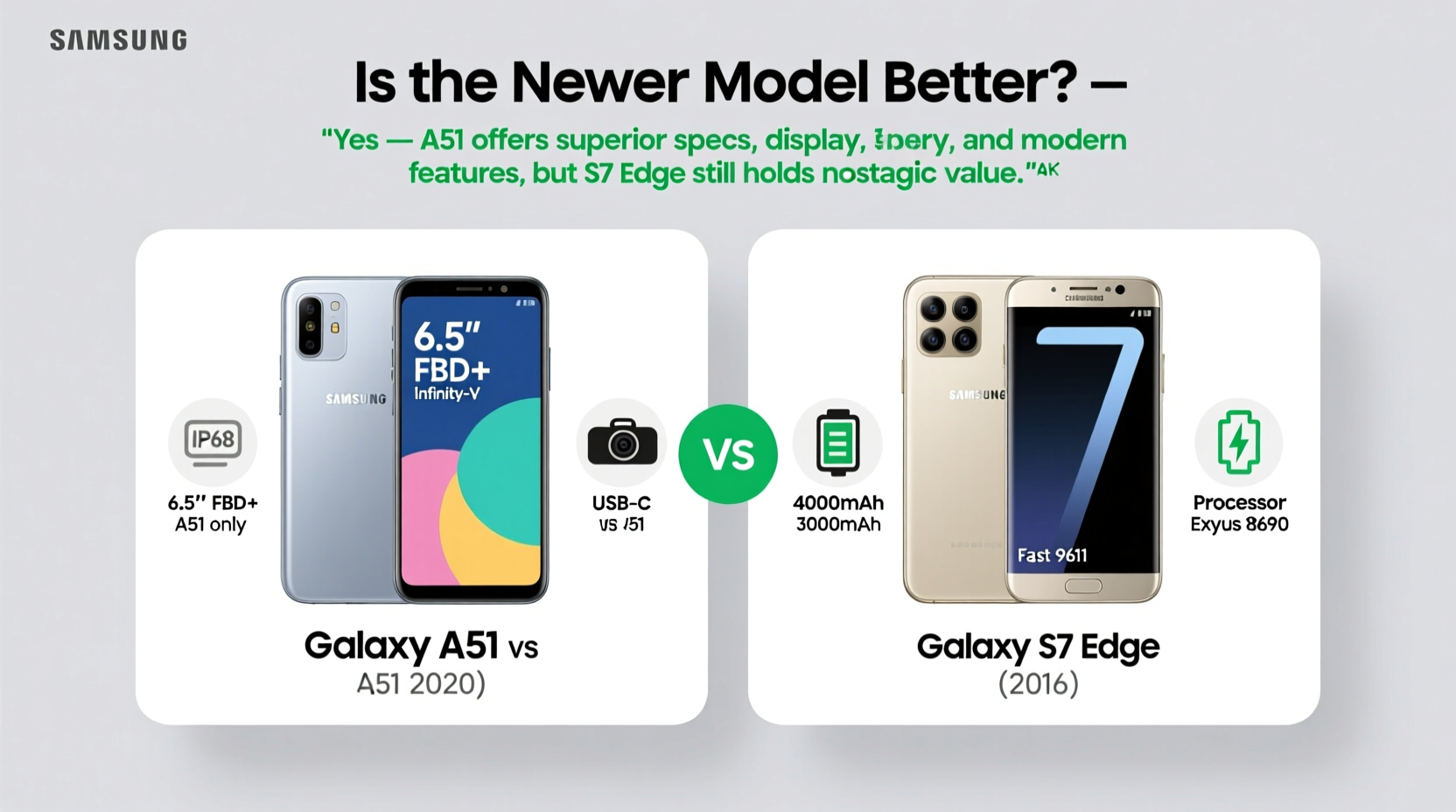
The S7 Edge set a high bar for design in its era. With a glass front and back, metal frame, and IP68 water resistance, it felt luxurious in hand. Its 5.5-inch curved-edge display gave it a futuristic look and improved grip despite the larger screen. At the time, few phones matched its build quality at any price.
In contrast, the A51 uses plastic for both the frame and back. While this makes it lighter and less prone to shattering, it lacks the tactile elegance of the S7 Edge. The A51 compensates with a sleeker modern aesthetic—slimmer bezels, a hole-punch front camera, and a flat 6.5-inch Super AMOLED display. It doesn’t have official IP certification, making it less durable in wet conditions.
Despite being older, the S7 Edge still feels like a premium device. The A51 wins on screen size and contemporary styling but sacrifices material quality for cost efficiency.
Display Comparison: Size vs Curvature
Both phones feature AMOLED technology, known for deep blacks and vibrant colors. However, their implementations differ significantly.
| Feature | Samsung S7 Edge | Samsung A51 |
|---|---|---|
| Screen Size | 5.5 inches | 6.5 inches |
| Resolution | 1440 x 2560 (QHD) | 1080 x 2400 (FHD+) |
| Pixel Density | 534 PPI | 405 PPI |
| Curved Display | Yes | No |
| Refresh Rate | 60Hz | 60Hz |
The S7 Edge’s QHD resolution delivers sharper text and crisper images, even today. The A51’s larger screen is better suited for media consumption and multitasking, but its lower pixel density means fine details aren’t as crisp. Neither phone supports high refresh rates, which has become standard in newer devices.
For many users, the immersive curve of the S7 Edge remains a standout feature—offering quick access to Edge panels and a distinctive look. The A51 plays it safe with a flat, utilitarian screen.
Performance and Software: Raw Power vs Longevity
The S7 Edge launched with either the Exynos 8890 or Snapdragon 820 (depending on region), both of which were flagship-grade chips in 2016. Paired with 4GB of RAM, the device handled multitasking and gaming smoothly—even by 2020 standards. However, Samsung ended major Android updates for the S7 series in 2019, limiting it to Android 8.0 Oreo. Security patches are no longer guaranteed.
The A51, powered by Samsung’s Exynos 9611 (a mid-tier chip) and 4GB or 6GB RAM, runs Android 10 out of the box (upgradable to Android 12). This means better app compatibility, improved background management, and enhanced security. In day-to-day tasks like browsing, messaging, and streaming, the A51 often feels faster due to optimized software—even if its processor isn't as powerful in raw benchmarks.
“Software support matters more than hardware after two years. A newer OS can make a weaker chip feel more responsive.” — David Kim, Mobile Systems Analyst
Benchmarks show the S7 Edge outperforming the A51 in CPU-intensive tasks, but real-world usage favors the A51 thanks to modern UI optimizations and better memory management. Gamers may notice lag in heavy titles like Genshin Impact on the A51, while the S7 Edge struggles with current apps due to outdated drivers.
Camera Showdown: Innovation vs Consistency
The S7 Edge featured a single 12MP rear camera with Dual Pixel autofocus and an f/1.7 aperture—one of the best mobile cameras of its time. Low-light performance was exceptional, and photos retained excellent dynamic range even in challenging lighting.
The A51 boasts a quad-camera array: 48MP main sensor, 12MP ultra-wide, 5MP macro, and 5MP depth. On paper, this sounds superior, but the reality is nuanced. The primary sensor uses pixel binning to produce 12MP images, which improves light capture. However, processing tends to oversharpen and over-saturate, especially in daylight. The ultra-wide lens adds versatility but suffers from distortion at the edges.
In low light, the S7 Edge still holds up remarkably well. Its larger pixels gather more light naturally, resulting in cleaner images without aggressive noise reduction. The A51 applies heavy software enhancement, often blurring fine detail in an attempt to reduce grain.
- The S7 Edge excels in natural-looking photos with accurate color reproduction.
- The A51 offers more shooting options (ultra-wide, macro) but inconsistent results.
- Front cameras favor the A51: 32MP vs 5MP gives much better selfies and video calls.
Mini Case Study: Real-World User Experience
Mark, a long-time S7 Edge user, upgraded to a used A51 in 2021 expecting a noticeable improvement. He found the larger screen great for YouTube and web browsing, and appreciated the extra camera modes. However, he missed the speed and reliability of his old device. “The A51 freezes when switching apps, and night photos look muddy,” he said. After six months, he switched back to a refurbished S7 Edge—finding it more stable for his basic needs.
His experience highlights a key truth: newer doesn’t always mean better for every user. Those who value simplicity and photo quality may prefer the older flagship over the newer mid-ranger.
Battery Life and Charging: Capacity vs Efficiency
The S7 Edge packs a 3,600mAh battery, while the A51 has a slightly larger 4,000mAh unit. Despite the difference, real-world endurance varies based on screen usage and software optimization.
The A51’s larger display and background-heavy One UI consume power quickly. Many users report needing to charge by late afternoon with moderate use. The S7 Edge, though older, benefits from efficient hardware and minimal bloatware in its stock Android 8 setup. It routinely lasts a full day—and sometimes more—with mixed usage.
Neither phone supports fast charging beyond 15W, and wireless charging is exclusive to the S7 Edge. This gives the older device a clear advantage for convenience and flexibility.
Final Verdict: Is Newer Actually Better?
The answer depends on what you value.
If you want modern features like multiple lenses, a large screen, and recent software updates, the A51 is the logical choice. It supports newer apps, has better selfie capabilities, and receives security patches—making it safer for online banking and communication.
But if you prioritize build quality, camera consistency, water resistance, and a smoother overall experience with fewer lags, the S7 Edge remains impressively capable. Its hardware was built to last, and many units still function flawlessly today.
“The S7 Edge was designed to be timeless. The A51 was designed to be affordable.” — Lena Park, Tech Historian
Checklist: Choosing Between S7 Edge and A51
- ✅ Do you need water resistance? → Choose S7 Edge
- ✅ Do you take lots of wide-angle or macro photos? → Choose A51
- ✅ Is software update support important? → Choose A51
- ✅ Do you prefer a compact, premium-feeling phone? → Choose S7 Edge
- ✅ Are you on a tight budget and buying second-hand? → Compare condition and battery health carefully
Frequently Asked Questions
Can the Samsung A51 run modern games smoothly?
The A51 handles casual games like Candy Crush or Among Us without issue. However, graphics-intensive games such as Call of Duty Mobile or Genshin Impact will require lowered settings and may experience frame drops or overheating.
Is the S7 Edge still usable in 2024?
Yes, but with caveats. It works well for calls, texts, web browsing, and light apps. However, lack of security updates and app incompatibility (especially with Google services) make it risky for sensitive tasks like online banking.
Which phone has better resale value?
Neither holds strong resale value now, but the S7 Edge often sells for less due to its age. The A51 retains slightly more value because of its newer software and larger screen appeal.
Conclusion: Make the Choice That Fits Your Life
Technology evolves rapidly, but progress isn’t always linear. The Samsung A51 brings newer features to the table—larger screen, additional cameras, updated OS—but it doesn’t surpass the S7 Edge in every area. Build quality, camera reliability, and water resistance give the older model enduring appeal.
Rather than defaulting to \"newer is better,\" assess what you actually need. Sometimes, yesterday’s flagship outperforms today’s budget option. Evaluate based on your daily habits, not marketing buzzwords.




 浙公网安备
33010002000092号
浙公网安备
33010002000092号 浙B2-20120091-4
Comments
No comments yet. Why don't you start the discussion?