
If you're still using the Samsung Galaxy S10, you're holding onto a phone that was once a flagship powerhouse. Released in 2019, the S10 set benchmarks for display quality, performance, and camera versatility. Fast forward to today, and the Samsung Galaxy A54 represents a new era of mid-range excellence—offering near-flagship features at a fraction of the cost. But does that mean upgrading from the S10 to the A54 makes sense? Or are you simply spending money on a device that doesn’t deliver meaningful improvements? Let’s dissect every critical aspect to determine whether this upgrade is justified or just another unnecessary expense.
Performance: From Flagship Power to Modern Efficiency
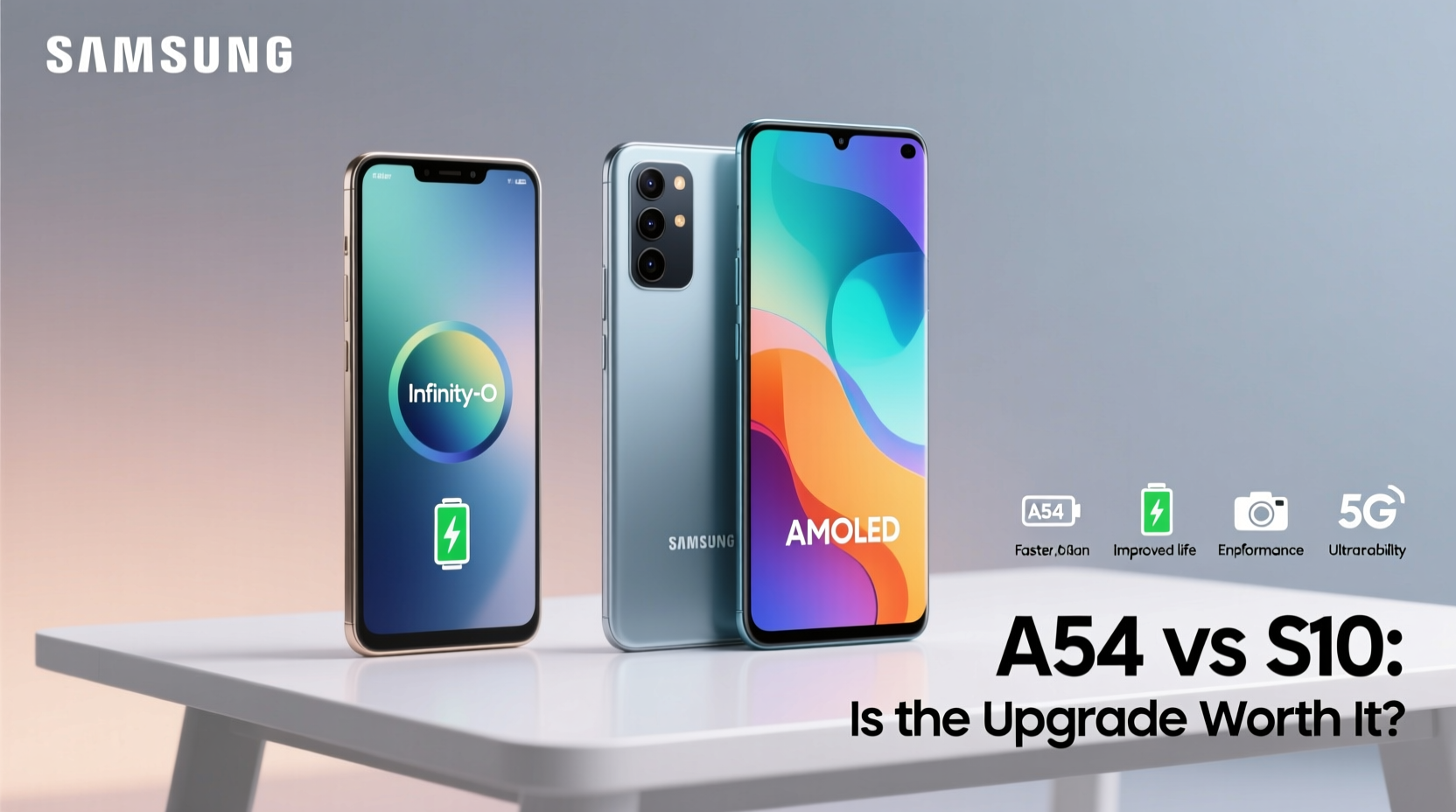
The S10 ran on Qualcomm’s Snapdragon 855 (or Exynos 9820 in some regions), which was top-tier in 2019. It handled multitasking, gaming, and app launches with ease. However, technology has evolved. The A54 uses Samsung’s Exynos 1380 chipset—a mid-range processor built on a more efficient 5nm process. While not as raw-powerful as the 855, the Exynos 1380 benefits from modern architecture, better thermal management, and longer software support.
Real-world usage tells a different story than benchmark scores. The S10 may still feel responsive for basic tasks, but newer apps and Android updates have slowed it down over time. The A54 ships with Android 13 and promises four major OS upgrades and five years of security patches—something the S10 no longer receives.
Display and Design: Evolution in Build and Brightness
The S10 featured a stunning 6.1-inch Dynamic AMOLED display with HDR10+ support and a high 3080x1440 resolution. At the time, it was among the best screens available. The A54 steps down slightly with a 6.4-inch FHD+ (2340x1080) Super AMOLED display—but compensates with a 120Hz refresh rate, which the S10 lacks.
A higher refresh rate makes scrolling, animations, and general navigation feel smoother. In daily use, this can be more noticeable than pixel density. The A54 also improves durability with Gorilla Glass 5 on front and back, while the S10 only had Gorilla Glass 5 on the front and a glossy glass back prone to fingerprints and smudges.
Design-wise, both phones share a similar aesthetic language, but the A54 feels more contemporary with flatter edges and a more modular camera layout. It’s slightly heavier and larger, but the trade-off is a bigger battery and improved ergonomics for one-handed use.
Battery Life and Charging: A Clear Advantage for the A54
This is where the A54 shines. The S10 came with a 3,400mAh battery—respectable in 2019, but modest by today’s standards. After years of charging cycles, even if well-maintained, its capacity has likely degraded significantly. In contrast, the A54 packs a 5,000mAh battery, offering up to two days of moderate use.
Charging speeds are another key difference. The S10 supports 15W fast charging and wireless charging, which the A54 omits entirely. However, the A54 includes 25W fast charging (charger sold separately), meaning you can go from 0% to 50% in about 30 minutes—something the S10 can’t match.
“Battery degradation is often the silent killer of older smartphones. Even if the phone works, poor battery life undermines usability.” — David Kim, Mobile Hardware Analyst
Camera Comparison: Generational Leap in Consistency
The S10 had a triple rear setup: 12MP main, 12MP telephoto, and 16MP ultra-wide. It took excellent photos in daylight and introduced features like Live Focus. But low-light performance and video stabilization have aged poorly.
The A54 drops the telephoto lens but upgrades to a 50MP main sensor with OIS (Optical Image Stabilization)—a first in the A-series. This means sharper photos in motion and better detail in varied lighting. The 12MP ultra-wide and 5MP macro lenses are functional, though not class-leading. The front camera is also upgraded to 13MP with improved skin tone rendering and night mode support.
In practical terms, the A54 delivers more consistent results across conditions. Its AI processing enhances dynamic range and color accuracy, especially in challenging lighting. While the S10 might still take great photos in ideal situations, the A54 performs reliably day-to-day without requiring manual tweaking.
Detailed Feature Comparison
| Feature | Samsung Galaxy S10 | Samsung Galaxy A54 |
|---|---|---|
| Release Year | 2019 | 2023 |
| Processor | Snapdragon 855 / Exynos 9820 | Exynos 1380 |
| RAM Options | 8GB | 6GB / 8GB |
| Storage | 128GB (expandable) | 128GB / 256GB (expandable) |
| Battery Capacity | 3,400mAh | 5,000mAh |
| Charging | 15W wired, Wireless, Reverse wireless | 25W wired, No wireless charging |
| Display | 6.1” QHD+ AMOLED, 60Hz | 6.4” FHD+ AMOLED, 120Hz |
| Rear Cameras | 12MP (main) + 12MP (tele) + 16MP (ultra-wide) | 50MP (main, OIS) + 12MP (ultra-wide) + 5MP (macro) |
| Software Support | No further OS updates | 4 OS upgrades, 5 years security |
| Water Resistance | IP68 | IP67 |
Real-World Upgrade Scenario: Meet James
James has been using his S10 since launch. He loves how compact it feels and still thinks the screen looks great. But over the past year, he’s noticed apps taking longer to open, social media feeds stuttering, and his battery dying by early afternoon. He considered buying a used flagship but found the A54 on sale for $350.
After switching, James immediately noticed the smoother 120Hz display and how much longer the battery lasted—even with GPS navigation and streaming. He didn’t miss the telephoto lens much because he rarely used it, but appreciated the sharper night shots from the OIS-enabled main camera. Most importantly, his phone now receives regular updates, giving him confidence it’ll remain secure and functional for years.
For James, the upgrade wasn’t about chasing specs—it was about regaining reliability and peace of mind.
When Upgrading Makes Sense: A Practical Checklist
Ask yourself these questions before making the leap:
- Does your S10 struggle with everyday tasks like messaging, browsing, or camera use?
- Is the battery life below 50% of its original capacity?
- Have you stopped receiving Android version updates?
- Do you want better photo quality in low light or more consistent video recording?
- Are you paying for cloud storage due to limited local space?
If you answered “yes” to two or more, the A54 offers tangible improvements that enhance daily usability—not just novelty.
Frequently Asked Questions
Can the A54 replace a flagship experience?
For most users, yes. While it lacks premium materials and the fastest chip, the A54 delivers smooth performance, great display, solid cameras, and long-term software support—hallmarks of a modern smartphone experience without the $1,000 price tag.
Am I losing anything important by upgrading to the A54?
You lose wireless charging, a telephoto lens, and QHD+ resolution. However, the gains—120Hz display, OIS, larger battery, and future-proof software—typically outweigh these losses for average users.
Should I wait for the A55 instead?
The A55 may offer minor improvements, but the A54 already covers core needs effectively. Unless you need the latest Bluetooth version or marginal performance gains, the A54 remains a smart buy in 2024.
Final Verdict: Is the Upgrade Worth It?
Upgrading from the S10 to the A54 isn’t about chasing the latest trend—it’s about reclaiming functionality. The S10 was a pioneer in its time, but after five years, its hardware and software limitations hinder daily use. The A54 addresses those pain points directly: longer battery life, smoother interface, better cameras, and guaranteed updates.
You’re not wasting money if your current phone is slowing you down. You’re investing in a device that will work reliably for the next three to four years. And in a world where smartphones are essential tools for communication, productivity, and creativity, that’s a worthwhile upgrade.




 浙公网安备
33010002000092号
浙公网安备
33010002000092号 浙B2-20120091-4
Comments
No comments yet. Why don't you start the discussion?