
Choosing between the Samsung Galaxy A71 5G and the Galaxy S21 isn’t just about price—it’s about understanding how much real-world benefit you gain from upgrading. The A71 5G launched as a mid-range contender with solid specs and broad appeal, while the S21 arrived as a flagship with premium ambitions. But years later, with both devices widely available at discounted prices, the decision becomes more nuanced. For users clinging to their A71 5G, the question remains: does the S21 deliver enough meaningful improvements to justify the cost?
This comparison dives deep into hardware, software longevity, camera capabilities, and daily usability to give you a clear picture of where each phone stands today—and whether stepping up to the S21 truly makes sense.
Performance and Hardware: A Clear Generational Leap
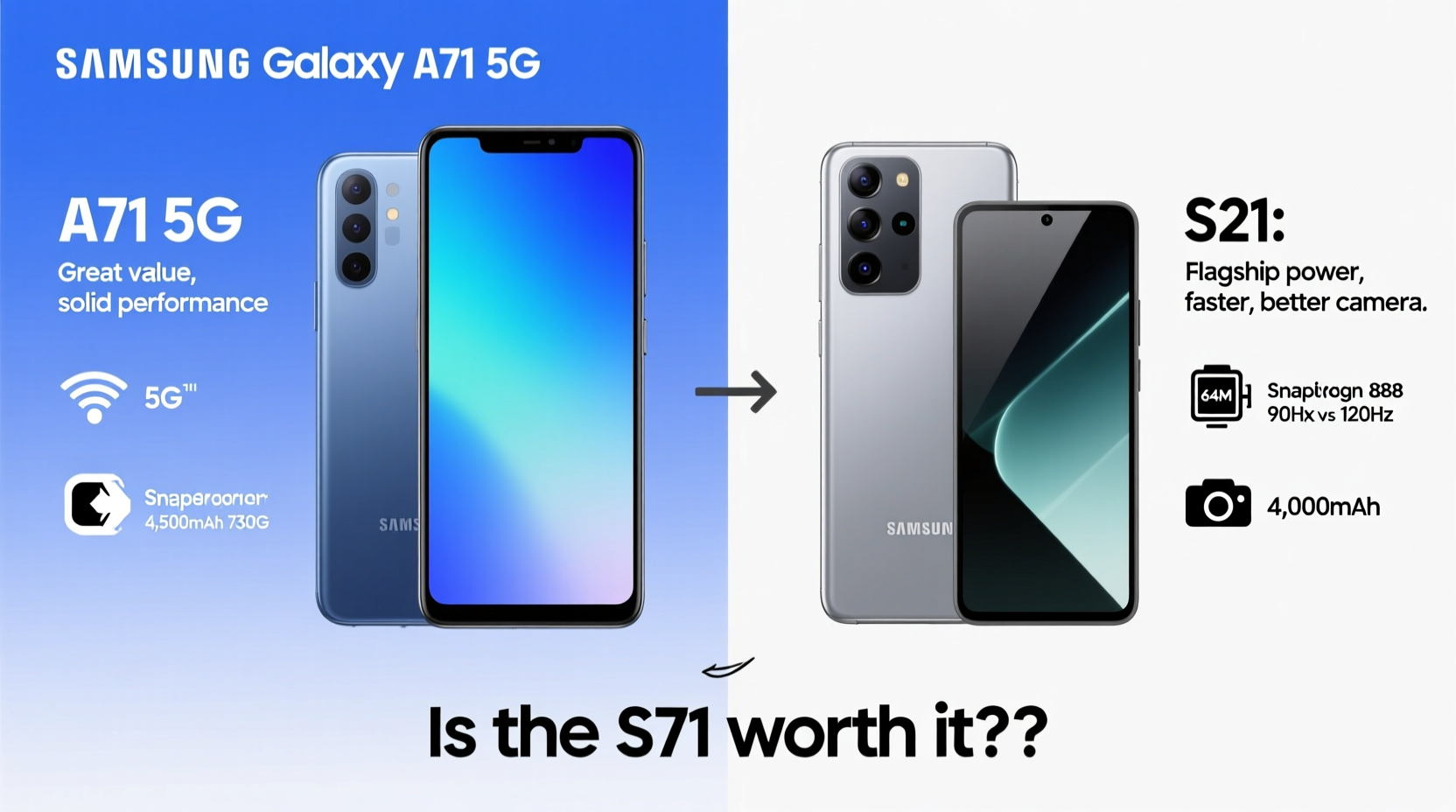
The most immediate difference between the two phones lies in their processing power. The Galaxy A71 5G runs on Qualcomm’s Snapdragon 765G, a capable chipset for everyday tasks like browsing, messaging, and streaming. It handles light gaming and multitasking well but begins to show strain under heavier loads or prolonged use.
In contrast, the Galaxy S21 is powered by the Exynos 2100 (or Snapdragon 888 in select regions), a full-fledged flagship processor from 2021. This chip delivers significantly faster CPU and GPU performance, making app launches snappier, multitasking smoother, and gaming far more responsive—even with high-end titles like Genshin Impact or Call of Duty Mobile at max settings.
RAM also plays a role. The A71 5G comes with 6GB or 8GB of RAM, while the S21 offers 8GB across all variants. More importantly, the S21’s memory management is optimized for higher workloads, reducing background app reloads and improving overall fluidity.
Display and Build Quality: Premium Meets Practical
Both phones feature 6.7-inch AMOLED displays, delivering vibrant colors and deep blacks. However, the differences become apparent upon closer inspection.
The A71 5G has a flat Full HD+ (1080 x 2400) screen with a 60Hz refresh rate. It looks sharp and performs well for media consumption, but scrolling feels less smooth compared to modern standards. The build uses plastic for the back panel and frame, contributing to its lightweight feel but lacking the premium touch.
The S21 ups the ante with a Dynamic AMOLED 2X display, also Full HD+, but with an adaptive 120Hz refresh rate. This means smoother animations, quicker touch response, and better efficiency—especially when navigating through dense UIs or playing fast-paced games. The aluminum frame and matte plastic back (designed to resist fingerprints) give it a sleek, modern look that belies its modest material choice.
“Adaptive refresh rates aren’t just a gimmick—they reduce eye strain and improve interaction precision, especially during long usage sessions.” — David Kim, Mobile UX Analyst
Camera Comparison: From Good to Competitive Flagship
The camera systems reflect their respective price brackets. The A71 5G features a quad-camera setup: 64MP main, 12MP ultra-wide, 5MP macro, and 5MP depth sensor. In daylight, it captures decent detail and color accuracy, though dynamic range can be limited. Low-light performance is average, often producing grainy images with poor shadow detail.
The S21 steps up with a triple rear system: 12MP wide, 12MP ultra-wide, and 64MP telephoto with 3x hybrid zoom. While megapixel count drops on the main sensor, pixel binning and improved optics yield sharper, more balanced photos. Night mode is noticeably better, and video recording supports 8K at 24fps—something the A71 5G doesn’t offer at all.
Front cameras are comparable (32MP on A71 5G vs 10MP on S21), but the S21 processes selfies with better skin tone rendering and HDR handling.
| Feature | Samsung A71 5G | Samsung S21 |
|---|---|---|
| Main Camera | 64MP f/1.8 | 12MP f/1.8 (Dual Pixel AF) |
| Ultra-Wide | 12MP f/2.2 | 12MP f/2.2 |
| Telephoto | None | 64MP f/2.0 (3x hybrid zoom) |
| Video Recording | 4K @ 30fps | 8K @ 24fps, 4K @ 60fps |
| Front Camera | 32MP f/2.2 | 10MP f/2.2 (Dual Pixel) |
Battery Life and Charging: Efficiency Over Raw Capacity
The A71 5G packs a 4500mAh battery, slightly larger than the S21’s 4000mAh unit. On paper, this suggests longer endurance—but real-world usage tells a different story.
Thanks to its more efficient display (adaptive brightness and variable refresh rate) and newer processor architecture, the S21 often matches or exceeds the A71 5G in battery life despite the smaller capacity. Under mixed use—social media, calls, messaging, and moderate video playback—both phones last a full day, but the S21 manages power more intelligently during standby and background operations.
Charging speed favors the A71 5G slightly, supporting 25W fast charging versus the S21’s 25W peak (though Samsung ships no charger in the box). Neither supports wireless charging, which may disappoint some users expecting flagship perks.
Software Support and Longevity: Where the S21 Pulls Ahead
One of the most compelling reasons to upgrade is software longevity. Samsung promises four major Android OS updates and five years of security patches for the Galaxy S21—a commitment not extended to the A71 5G.
The A71 5G received Android 11 out of the box and was upgraded to Android 12 and 13, with security updates tapering off by 2024. In contrast, the S21 launched with Android 11 but is eligible for updates up to Android 15 and security coverage through 2026.
This means the S21 will continue receiving performance optimizations, new features, and critical security fixes longer—making it a safer, more future-proof investment, especially if you plan to keep your phone beyond two years.
Real-World Example: Maria’s Upgrade Decision
Maria has used her A71 5G since 2021. She loves its size and battery life but noticed slowdowns in 2023—apps take longer to open, camera focus lags, and multitasking between Instagram, WhatsApp, and Google Maps became frustrating. After researching, she considered the S21.
She tested one in-store and immediately felt the difference: the screen scrolled effortlessly, the camera focused instantly, and switching between apps was seamless. Though the battery is smaller, she found it lasted just as long due to better optimization. Six months after upgrading, she reports fewer crashes, faster photo processing, and confidence that her phone will stay secure and updated through 2025.
For Maria, the upgrade wasn’t about chasing specs—it was about regaining reliability and responsiveness in her daily routine.
Frequently Asked Questions
Is the Galaxy S21 still worth buying in 2024?
Yes, especially if purchased at a discounted price. Its performance, display, and software support remain competitive for most users, even against newer mid-range phones.
Can the A71 5G still handle everyday tasks?
Absolutely. For calls, messaging, social media, and light streaming, the A71 5G holds up well. However, heavy multitasking or modern gaming may expose its limitations.
Does the S21 have better signal reception?
Generally, yes. The S21 includes more advanced 5G bands and modem technology, leading to stronger connectivity in weak-signal areas compared to the A71 5G.
Upgrade Checklist: Are You Ready for the S21?
- ✅ Currently using A71 5G or similar mid-range device
- ✅ Notice lag in app launches or camera response
- ✅ Want longer software support (4 OS updates)
- ✅ Value smooth scrolling and responsive touch input
- ✅ Use your phone for photography or video recording
- ✅ Plan to keep your phone for 2+ years
Final Verdict: Is the S21 Worth It?
The Galaxy A71 5G remains a competent device for basic smartphone needs. If you’re satisfied with its performance and don’t mind occasional sluggishness, there’s no urgent need to replace it. However, the Galaxy S21 represents a tangible leap forward—not just in raw power, but in long-term usability, display quality, and software support.
If you can find the S21 at a reasonable price—particularly refurbished or second-hand—the upgrade is absolutely justified. You’re not just getting a faster phone; you’re investing in three more years of reliable updates, better camera experiences, and a smoother overall interface.
For those who rely on their phone for work, content creation, or staying connected without compromise, the S21 isn’t just worth it—it’s the smarter long-term choice.




 浙公网安备
33010002000092号
浙公网安备
33010002000092号 浙B2-20120091-4
Comments
No comments yet. Why don't you start the discussion?