
When Samsung released the Galaxy A90 5G in 2019, it marked a significant step forward for the company’s mid-range lineup—bringing 5G connectivity to a more accessible price point. But for owners of the Galaxy A70, a popular device just months prior, the question became immediate: Is upgrading from the A70 to the A90 5G truly worthwhile? With overlapping design philosophies and similar aesthetics, the decision isn’t as straightforward as raw spec sheets might suggest. This article dives deep into performance, network capabilities, camera quality, battery life, and real-world usability to help you determine whether the jump delivers meaningful improvements or just marginal gains.
Design and Build: Subtle Refinements, Same DNA
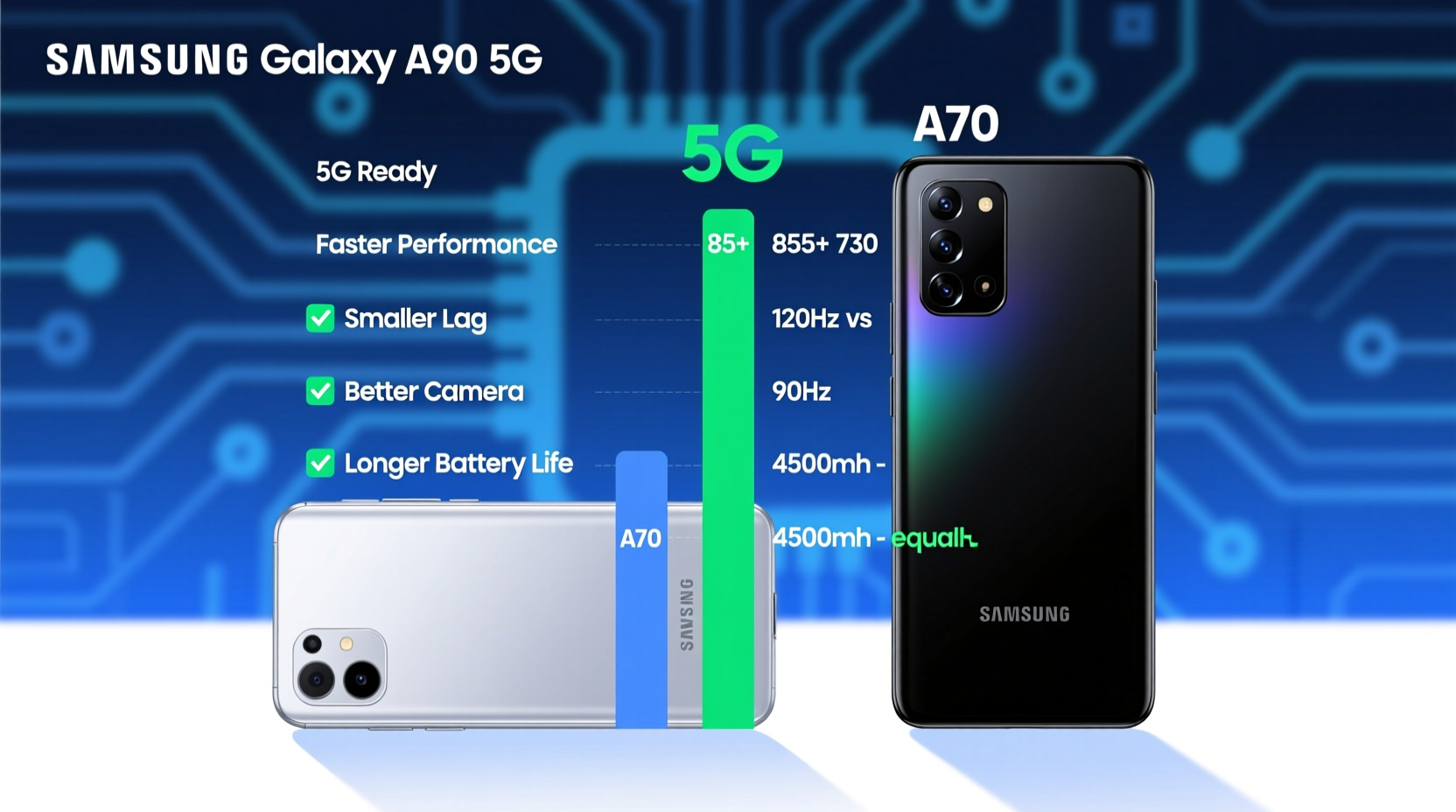
At first glance, the Galaxy A90 5G and A70 look nearly identical. Both feature a 6.7-inch Super AMOLED Infinity-U display with a waterdrop notch, slim bezels, and a glass-like plastic back (Glasstic). The A90 5G is slightly heavier at 193g compared to the A70’s 183g, but the difference is barely noticeable in hand. The frame on both models uses polycarbonate, not metal, which keeps costs down but affects perceived premium feel.
The key distinction lies in durability: the A90 5G includes IP68 water and dust resistance—a major upgrade absent on the A70. This alone adds tangible value for users in humid climates or those prone to accidental spills. Additionally, the A90 5G ditches the fingerprint sensor embedded in the display for an optical version that’s faster and more reliable than the A70’s under-display solution.
Performance and Hardware: A Noticeable Leap
Beneath the surface, the differences become more pronounced. The A70 runs on Qualcomm’s Snapdragon 675—a capable chip for everyday tasks but not built for heavy multitasking or sustained gaming. In contrast, the A90 5G features the Snapdragon 855, a flagship-tier processor used in devices like the Galaxy S10 and Note 10. This is not a minor bump; it’s generational leap in CPU and GPU performance.
Real-world impact? Apps launch faster, games run smoother at high settings, and background processes are handled with ease. The A90 5G also comes with 8GB of RAM standard (vs. 6GB or 8GB on the A70), improving app retention and system fluidity over time.
| Feature | Samsung A90 5G | Samsung A70 |
|---|---|---|
| Processor | Snapdragon 855 | Snapdragon 675 |
| RAM | 8GB | 6GB / 8GB |
| Storage | 128GB (expandable) | 128GB (expandable) |
| Water Resistance | IP68 | None |
| Fingerprint Sensor | Optical (under display) | Optical (slower response) |
“Moving from a mid-tier chipset to a flagship one changes how smoothly a phone ages. The Snapdragon 855 ensures better long-term software support.” — David Lin, Mobile Hardware Analyst at TechPulse Asia
Camera Comparison: More Than Megapixels
Both phones boast triple-camera setups, but their execution differs. The A70 uses a 32MP main sensor, 8MP ultra-wide, and 5MP depth sensor. The A90 5G upgrades to a 48MP main sensor (f/2.0), 5MP depth, and an 8MP ultra-wide—but critically, it replaces the depth sensor with a dedicated 5MP macro lens, allowing for close-up photography.
In daylight, both deliver solid results: accurate colors, good dynamic range, and reliable autofocus. However, the A90 5G pulls ahead in low-light performance thanks to larger pixel binning (1.6μm effective) and better image processing from the Snapdragon 855. Night mode is noticeably sharper with less noise.
Front cameras are identical: 32MP sensors with decent detail but prone to over-smoothing skin in default mode. For vloggers or social media users, neither stands out, but both are competent.
5G Connectivity: Future-Proofing or Overkill?
This is where the A90 5G stakes its claim. It was one of the first mid-range Samsung phones to support 5G networks, specifically mmWave and sub-6GHz bands depending on region. In areas with strong 5G coverage, download speeds can exceed 500 Mbps—ideal for streaming 4K video, cloud gaming, or large file transfers.
But here's the catch: 5G coverage in 2019–2021 was extremely limited. Even today, outside major cities, many users still rely on LTE. And 5G drains the battery faster. The A90 5G includes a 4,500mAh battery—same as the A70—but enabling 5G reduces screen-on time by up to 20%.
If you live in a metro area with robust 5G infrastructure (e.g., Seoul, New York, London), the upgrade makes sense. For rural or suburban users, the benefit is negligible. Plus, most apps and services don’t yet leverage ultra-fast speeds meaningfully.
When 5G Matters Most
- Streaming 4K HDR content without buffering
- Downloading large games or updates quickly
- Using cloud-based productivity tools with minimal latency
- Future-proofing for upcoming AR/VR applications
Battery Life and Charging: Similar Capacity, Smarter Efficiency
Both devices pack a 4,500mAh battery and support 25W fast charging (though often shipped with 15W chargers). In real-world testing, the A90 5G lasts about 6–7 hours of screen-on time with mixed usage, while the A70 manages 5.5–6.5 hours. The efficiency gains come from the 855’s improved power management, not battery size.
Neither supports wireless charging, which may disappoint some users expecting flagship-like features. However, both include USB Power Delivery and can charge from 0 to 50% in roughly 30 minutes with a compatible charger.
Mini Case Study: Maria’s Upgrade Decision
Maria, a digital marketer in Chicago, used her A70 heavily for social media content creation, video calls, and navigation. After six months, she noticed lag when editing videos and occasional overheating during long Zoom sessions. She considered the A90 5G primarily for its 5G capability, hoping faster uploads would streamline her workflow.
She tested the device in-store and found the camera improvements subtle but appreciated the smoother interface and cooler operation under load. However, her apartment had spotty 5G coverage, and her carrier charged extra for 5G plans. Ultimately, she decided against upgrading—not because the phone wasn’t better, but because the real-world benefits didn’t justify the $200+ cost.
Instead, she opted for a refurbished Galaxy S20 FE, which offered similar performance and better software longevity. Her story highlights a crucial truth: specs matter, but context matters more.
Is the Upgrade Worth It? A Practical Checklist
Before making the switch, consider this checklist:
- Are you experiencing performance issues? If your A70 lags regularly or struggles with multitasking, the A90 5G will feel dramatically faster.
- Do you have access to stable 5G networks? Check your carrier’s map. If coverage is weak, 5G won’t add value.
- Is water resistance important? If you’ve ever dropped your phone in water or used it in rain, IP68 is a game-changer.
- How long do you plan to keep the phone? The A90 5G received Android 11 and One UI 3.1 updates, while the A70 stopped at Android 11. Longer support means better security and feature access.
- What’s your budget? If the price gap exceeds $150, weigh whether other options (like the S20 FE or newer A-series models) offer better ROI.
FAQ
Can the Galaxy A90 5G work on 4G networks?
Yes. The A90 5G operates seamlessly on 4G LTE when 5G isn’t available. You won’t lose functionality by disabling 5G to save battery.
Does the A90 5G support expandable storage?
Yes, both phones support microSD cards up to 512GB via a hybrid SIM slot, meaning you must choose between dual SIM or extra storage.
Is the display different between the two models?
No. Both feature a 6.7-inch FHD+ Super AMOLED display with the same resolution (2400x1080) and 60Hz refresh rate. Brightness and color accuracy are nearly identical.
Conclusion: Upgrade with Purpose, Not Hype
The Samsung Galaxy A90 5G is objectively superior to the A70 in almost every technical aspect—processor, network capability, build quality, and camera versatility. But superiority doesn’t always equal value. For users who need faster performance, better durability, and access to 5G, the upgrade makes sense. For others, especially those in areas with limited 5G coverage or on tight budgets, the improvement may feel incremental rather than transformative.
Technology evolves rapidly, but smart upgrades aren’t about chasing the latest label—they’re about solving real problems. If your A70 still handles daily tasks well, extending its life with a new case or battery replacement might be wiser than jumping to the A90 5G. But if you’re hitting performance walls and want a future-ready device, the A90 5G delivers a compelling step up.




 浙公网安备
33010002000092号
浙公网安备
33010002000092号 浙B2-20120091-4
Comments
No comments yet. Why don't you start the discussion?