
When Samsung released the Galaxy S7 in 2016, it set a new benchmark for Android flagships—excellent camera, sleek design, and solid performance. Fast forward to 2020, the Galaxy A51 arrived as a mid-range contender with modern features like a quad-camera setup and an edge-to-edge display. But if you're still using an S7, is upgrading to the A51 actually worthwhile? Despite being newer, does the A51 truly outperform its older flagship predecessor? This deep dive compares both devices across key categories to help you decide whether the upgrade makes sense.
Design and Build: Evolution of Form
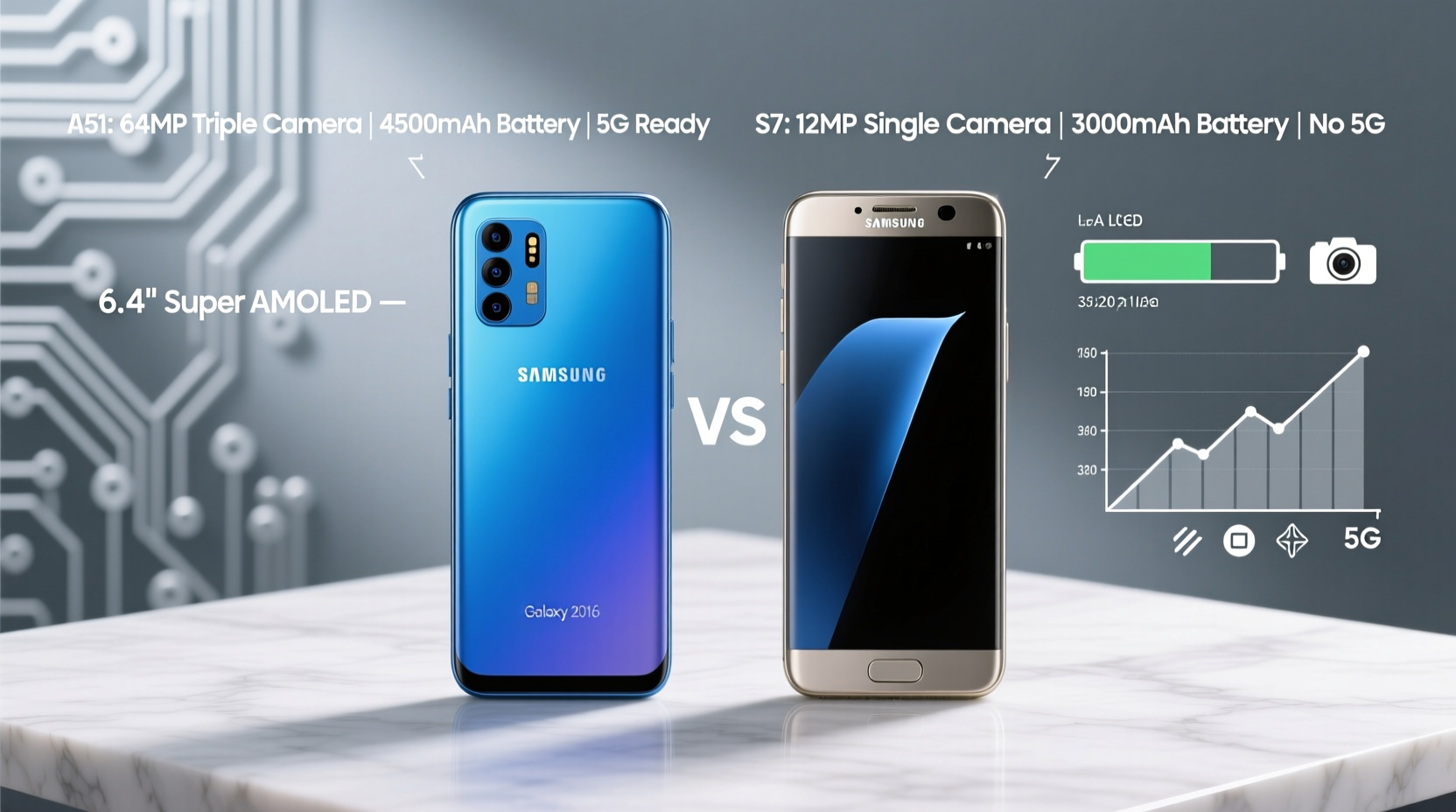
The Galaxy S7 featured a premium glass-and-metal build with a curved AMOLED display and IP68 water resistance. At the time, it was among the most refined smartphones available. The A51, while plastic-backed, adopts a more contemporary design language with slimmer bezels, a punch-hole front camera, and a flat 6.5-inch Super AMOLED display. It lacks water resistance but offers a larger screen in a slightly bulkier frame.
From a usability standpoint, the A51’s taller 20:9 aspect ratio fits better in one hand and improves media consumption. However, the S7 still feels more compact and luxurious due to its materials. If you value durability and elegance over screen size, the older S7 holds up surprisingly well.
Display Quality: Bigger Isn’t Always Better
The S7 sports a 5.1-inch Quad HD (1440 x 2560) Super AMOLED display with exceptional pixel density and color accuracy. Even today, it delivers vibrant visuals and deep blacks. The A51 steps up in screen size with a 6.5-inch Full HD+ (1080 x 2400) panel, offering more real estate for videos and multitasking. However, it doesn’t match the S7’s pixel sharpness or brightness levels.
In direct sunlight, the S7 often performs better due to superior outdoor visibility calibration. That said, the A51 supports modern features like always-on display and smoother scrolling thanks to optimized software rendering. For users prioritizing screen size and modern UI interactions, the A51 wins. But purists who care about display fidelity may prefer the S7’s crisper output.
Performance and Software: Generational Shifts
This is where the gap becomes complex. The Galaxy S7 launched with either the Snapdragon 820 or Exynos 8890—flagship chips at the time—paired with 4GB of RAM. In contrast, the A51 uses the mid-tier Exynos 9611 processor and comes with 4GB or 6GB of RAM. On paper, the S7 had a stronger foundation.
However, real-world performance tells a different story. Over years of use, the S7 has slowed down significantly. It no longer receives official OS updates beyond Android 8.0, lacks app optimization for modern software, and struggles with multitasking and heavy apps like Chrome or Instagram. The A51, running Android 10 (upgradable to 11), handles current apps smoothly, boots faster, and manages background processes more efficiently thanks to newer architecture and software tuning.
“Even powerful older phones lose relevance not because they’re slow, but because the ecosystem moves on.” — David Kim, Mobile Systems Analyst
Real-World Example: Daily Use After Five Years
Consider Sarah, a long-time S7 user who held onto her phone for reliability. By 2021, she noticed delays opening messages, frequent app crashes, and GPS lag in navigation apps. She upgraded to the A51 expecting disappointment due to its \"mid-range\" label. Instead, she found web browsing snappier, social media apps loaded faster, and video calls were stable—thanks to updated drivers and better memory management. Her experience reflects a broader trend: sustained software support matters more than raw hardware specs over time.
Camera Comparison: More Lenses, Better Results?
The S7 introduced one of the best mobile cameras of its era—a 12MP Dual Pixel sensor with f/1.7 aperture, capable of excellent low-light shots and fast autofocus. Its image processing remains impressive even by today’s standards.
The A51 counters with a quad-camera array: 48MP main, 12MP ultra-wide, 5MP macro, and 5MP depth sensor. While the higher megapixel count sounds impressive, the smaller pixel size (0.8µm vs 1.4µm on the S7) means poorer light capture. In daylight, the A51 produces vivid, detailed photos with good dynamic range. But in dim conditions, noise creeps in, and detail drops sharply compared to the S7.
That said, the A51 brings practical advantages: ultra-wide shots for landscapes, dedicated macro mode, and AI scene optimization. These features expand creative options, especially for casual photographers. Video recording is also capped at 30fps on both, but the A51 includes basic stabilization improvements.
| Feature | Galaxy S7 | Galaxy A51 |
|---|---|---|
| Main Camera | 12MP f/1.7 | 48MP f/2.0 |
| Low-Light Performance | Excellent | Fair to Good |
| Ultra-Wide Lens | No | Yes (12MP) |
| Macro Support | No | Yes |
| Front Camera | 5MP f/1.7 | 32MP f/2.2 |
Battery Life and Charging: Endurance Meets Modern Needs
The S7 packs a 3000mAh battery—modest by today’s standards. With moderate use, it lasted a full day in 2016, but aging batteries reduce that now. The A51 houses a much larger 4000mAh cell, which easily lasts 1.5 days under average usage. This alone can be a compelling reason to upgrade.
Charging is another point of divergence. The S7 supported fast charging (Adaptive Fast Charging), reaching 50% in about 30 minutes. The A51 supports 15W fast charging, but many units ship with only a 10W charger. Neither supports wireless charging, but third-party accessories work with the S7 due to its glass back.
- S7: 3000mAh, aging capacity, fast charging capable
- A51: 4000mAh, consistent daily life, slower default charging
Should You Upgrade? A Practical Checklist
If you're deciding between holding onto your S7 or moving to the A51, ask yourself the following:
- Is your S7 slowing down? Frequent freezes, delayed responses, or app crashes signal diminishing performance.
- Do you need longer battery life? If you charge multiple times a day, the A51’s 4000mAh battery will be a noticeable improvement.
- Do you take wide-angle or close-up photos? The A51’s additional lenses offer versatility the S7 lacks.
- Are you stuck on an old Android version? No security patches since 2019 make the S7 vulnerable to threats.
- Do you value premium materials? If build quality is non-negotiable, consider a used S20 or refurbished flagship instead.
Frequently Asked Questions
Can the Galaxy A51 run modern games smoothly?
Yes, the Exynos 9611 handles most games at medium settings. Titles like Genshin Impact may require lowered graphics, but PUBG Mobile and Call of Duty Mobile run adequately without major stuttering.
Does the S7 still receive software updates?
No. Samsung ended major OS updates in 2018 and security patches in 2019. Using the S7 today poses potential security risks when accessing sensitive accounts.
Is the A51 waterproof?
No, the A51 lacks an official IP rating. It has no water or dust resistance, so extra caution is needed around liquids—unlike the S7, which was fully sealed.
Final Verdict: Yes, But With Caveats
The Galaxy A51 isn’t objectively “better” than the S7 in every way. It sacrifices build quality, display sharpness, and low-light camera prowess. Yet, for most users still clinging to a five-year-old flagship, the upgrade brings tangible benefits: longer battery, modern software support, improved multitasking, and expanded photography features.
The real value lies in longevity. The A51 received three years of security updates (until 2023) and two OS upgrades, meaning it stays functional and secure far longer than the outdated S7. Unless you’re deeply attached to the S7’s compact design and camera excellence, stepping up to the A51—or a similar modern mid-ranger—makes practical sense.




 浙公网安备
33010002000092号
浙公网安备
33010002000092号 浙B2-20120091-4
Comments
No comments yet. Why don't you start the discussion?