
When Samsung released the Galaxy S9 in 2018, it set a high bar for flagship Android phones with its sleek design, powerful internals, and advanced camera system. Fast forward to 2020, the Galaxy A51 arrived as a mid-range contender promising modern features at a fraction of the cost. But is the A51 truly an upgrade over the older S9? On paper, newer often means better—but real-world performance, user experience, and long-term value tell a more nuanced story.
This comparison dives deep into both devices, evaluating hardware, software, camera capabilities, and overall usability to determine whether the Galaxy A51 justifies replacing a still-competent flagship like the S9.
Design and Build Quality
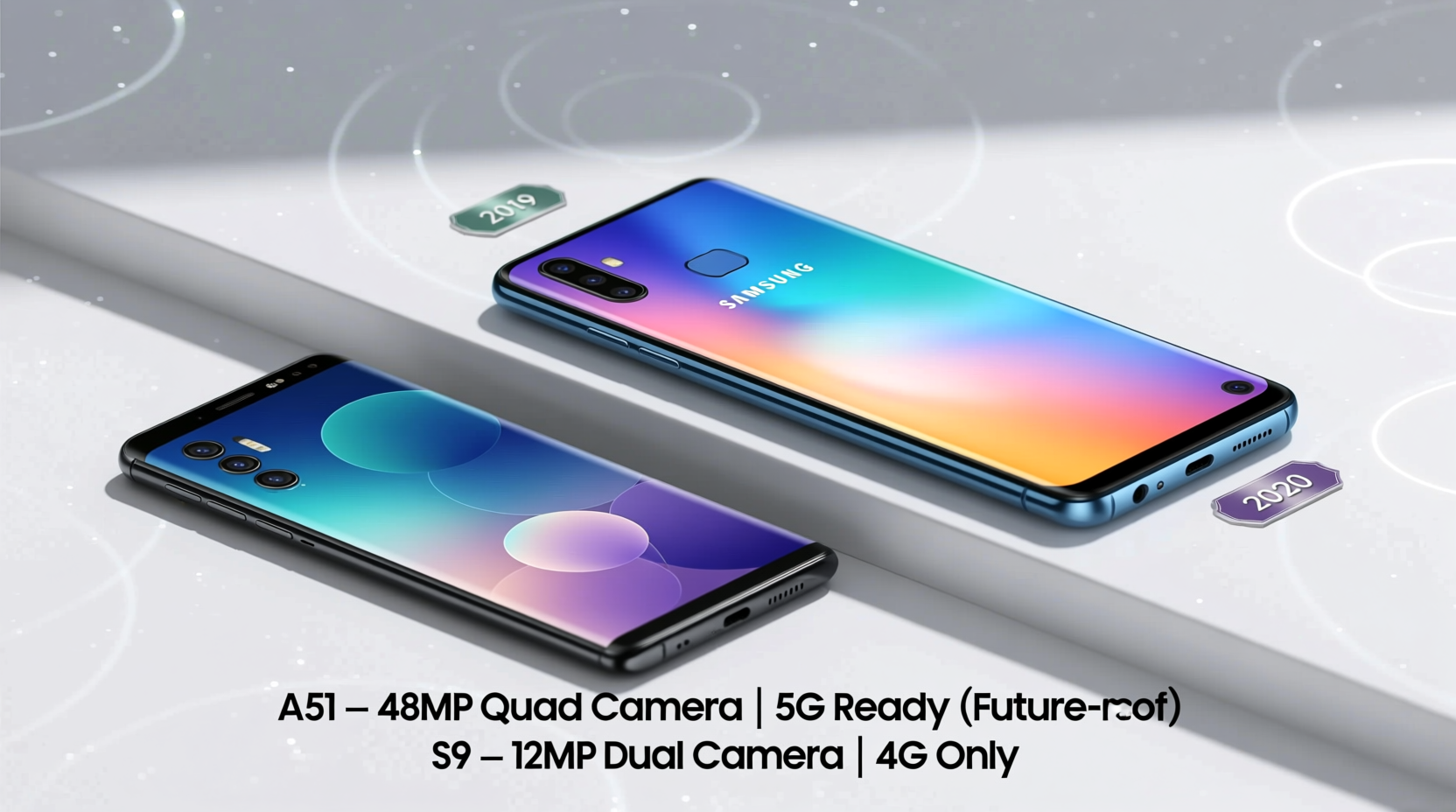
The Galaxy S9 was crafted with premium materials—glass back, aluminum frame, and IP68 water and dust resistance. It felt solid, compact, and luxurious in hand. Measuring 147.7 x 68.7 x 8.5 mm and weighing 163g, it offered excellent ergonomics for one-handed use.
In contrast, the Galaxy A51 uses plastic for both the frame and back panel. While this makes it lighter at 172g, it lacks the refined feel of the S9. The A51 is also larger (158.5 x 73.6 x 7.9 mm), which improves screen real estate but reduces pocketability. It does not have any official IP rating, making it less resilient against spills or rain.
Despite being newer, the A51 sacrifices build quality for cost efficiency. For users who value durability and tactile satisfaction, the S9 remains the superior choice in design.
Display and Screen Experience
The S9 features a 5.8-inch Quad HD+ Super AMOLED display with a resolution of 2960 x 1440 pixels. At 570 PPI, it delivers sharp text, vibrant colors, and deep blacks. Its smaller size made it ideal for media consumption without straining thumbs during navigation.
The A51 steps up with a larger 6.5-inch Full HD+ Super AMOLED display (2400 x 1080). While the pixel density drops to 405 PPI, the screen remains crisp and bright. The taller 20:9 aspect ratio is better suited for modern video formats and multitasking. Additionally, the A51 includes an in-display fingerprint sensor—a feature absent in the S9, which uses a rear-mounted one.
Winner here depends on preference. The S9 wins on pixel density and compactness; the A51 wins on screen size, modern design integration, and convenience of under-display biometrics.
Performance and Software Longevity
Under the hood, the Galaxy S9 runs on the Qualcomm Snapdragon 845 (or Exynos 9810, depending on region)—a true flagship chipset from 2018. Paired with 4GB of RAM, it handled multitasking, gaming, and UI animations smoothly even years after release.
The A51 uses the Exynos 9611, a mid-tier processor with 4GB or 6GB RAM options. While adequate for daily tasks like browsing, messaging, and streaming, it struggles with heavier apps and sustained gaming. Benchmark scores show the S9’s chip outperforming the A51’s by nearly 40% in CPU-intensive operations.
Software support tells another story. The S9 received three major Android updates (up to Android 10), while the A51 launched with Android 10 and was upgraded to Android 12. Though both are now end-of-life in terms of updates, the A51 benefits from having shipped with newer software and longer security patch cycles typical of Samsung’s A-series post-2019.
“Hardware age doesn’t always correlate with relevance. The S9’s superior chipset gives it staying power that many budget 2020 phones can’t match.” — Rajiv Mehta, Mobile Analyst at TechPulse Asia
Camera Comparison: Still Photos and Video
The S9 has a single 12MP rear camera with Dual Pixel autofocus, variable aperture (f/1.5–f/2.4), and optical image stabilization. Its low-light performance was class-leading in 2018, and HDR processing produced balanced, natural-looking photos.
The A51 counters with a quad-camera array: 48MP main sensor, 12MP ultra-wide, 5MP macro, and 5MP depth. On paper, this looks impressive, but the main sensor uses pixel binning to output 12MP images. In practice, daylight shots are detailed, but dynamic range lags behind the S9. Low-light photography reveals excessive noise and inconsistent processing. The ultra-wide lens adds versatility, but image quality degrades at the edges.
For video, the S9 records 4K at 60fps with excellent stabilization and audio capture. The A51 maxes out at 4K 30fps and lacks advanced stabilization features, resulting in shakier footage.
| Feature | Galaxy S9 | Galaxy A51 |
|---|---|---|
| Main Camera | 12MP, f/1.5-2.4, OIS | 48MP (12MP output), f/2.0 |
| Ultra-Wide Lens | No | 12MP, f/2.2 |
| Video Recording | 4K @ 60fps | 4K @ 30fps |
| Low-Light Performance | Excellent | Fair, noisy |
| Front Camera | 8MP, f/1.7 | 32MP, f/2.2 |
The front camera favors the A51—its 32MP selfie shooter captures more detail, though skin tones can appear oversharpened. The S9’s 8MP sensor produces more natural portraits with better tone reproduction.
Battery Life and Charging
The Galaxy S9 packs a 3000mAh battery, which was modest even in 2018. With heavy use, it often required charging by late afternoon. It supports fast charging (15W) and wireless charging, but lacks reverse wireless charging.
The A51 comes with a significantly larger 4000mAh battery. Real-world testing shows it easily lasts a full day, even with screen-on times exceeding six hours. However, it only supports 15W fast charging and does not offer wireless charging—an omission considering the S9 had it five years prior.
If battery endurance is your priority, the A51 clearly wins. But the S9’s ability to charge wirelessly adds convenience, especially in environments where Qi pads are common.
Real-World Example: Daily Use After Two Years
Consider Maria, a freelance writer who owned a Galaxy S9 from 2018 to 2021. By 2020, she noticed slower app launches and occasional stutters when switching between writing apps and research browsers. She upgraded to the A51 expecting smoother performance due to its newer branding.
Instead, she found that while the larger screen improved document readability, the A51 froze occasionally when using split-screen mode. The lack of wireless charging was a downgrade, and she missed the S9’s compact form. However, she appreciated the longer battery life and enjoyed taking wide-angle shots of her travel destinations—something the S9 couldn’t do.
Maria’s experience reflects a common theme: upgrading to a newer model doesn’t guarantee a better experience if core needs like responsiveness, build quality, and ecosystem compatibility aren’t met.
Checklist: Should You Switch from S9 to A51?
- ✅ Need longer battery life? → A51 wins
- ✅ Want ultra-wide photos? → A51 offers it
- ❌ Prioritize smooth performance and future-proofing? → S9 still holds up better
- ❌ Value premium build and water resistance? → Stick with S9
- ✅ Prefer in-display fingerprint sensor? → A51 has it
- ❌ Use wireless charging regularly? → A51 lacks this feature
Frequently Asked Questions
Can the Galaxy A51 run modern apps smoothly in 2024?
Yes, for basic tasks like social media, email, and video streaming. However, demanding apps like photo editors, AR tools, or high-end games may lag or overheat the device.
Is the Galaxy S9 still worth using today?
Absolutely. Despite its age, the S9’s hardware remains competent for everyday use. With lightweight launchers and minimal background apps, it can deliver a snappy experience. Just be mindful of outdated software and security risks.
Does the A51's higher megapixel count mean better photos?
Not necessarily. Megapixels don’t equal quality. The S9’s larger pixels and advanced processing produce better dynamic range and low-light results, proving that sensor quality and software tuning matter more than number alone.
Final Verdict: Is the A51 Really an Upgrade?
The answer isn't straightforward. The Galaxy A51 brings modern conveniences—larger battery, bigger screen, in-display fingerprint, and additional cameras—that appeal to budget-conscious users. But it compromises on materials, processing power, video capabilities, and premium features like wireless charging and IP68 rating.
The Galaxy S9, despite being five years older, still outperforms the A51 in key areas: build quality, display sharpness, camera consistency, and raw performance. For someone already owning an S9 in good condition, switching to the A51 feels more like a lateral move—or even a step down in certain aspects—rather than a clear upgrade.
If you're coming from a much older phone or entering the Samsung ecosystem for the first time, the A51 offers great value. But if you're an S9 owner wondering whether to upgrade, ask yourself: Are you trading refinement for novelty?




 浙公网安备
33010002000092号
浙公网安备
33010002000092号 浙B2-20120091-4
Comments
No comments yet. Why don't you start the discussion?