
If you're still holding onto your Samsung Galaxy S8, you're not alone. Many users have found the device surprisingly durable and reliable — even years after its 2017 release. But technology has evolved dramatically since then. The Samsung Galaxy A54 5G, released in 2023, represents a new generation of mid-range smartphones that offer flagship-like features at accessible prices. So, is it finally time to let go of your trusty S8? Let’s compare these two devices across key areas to help you make an informed decision.
Performance: From Snapdragon 835 to Exynos 1380
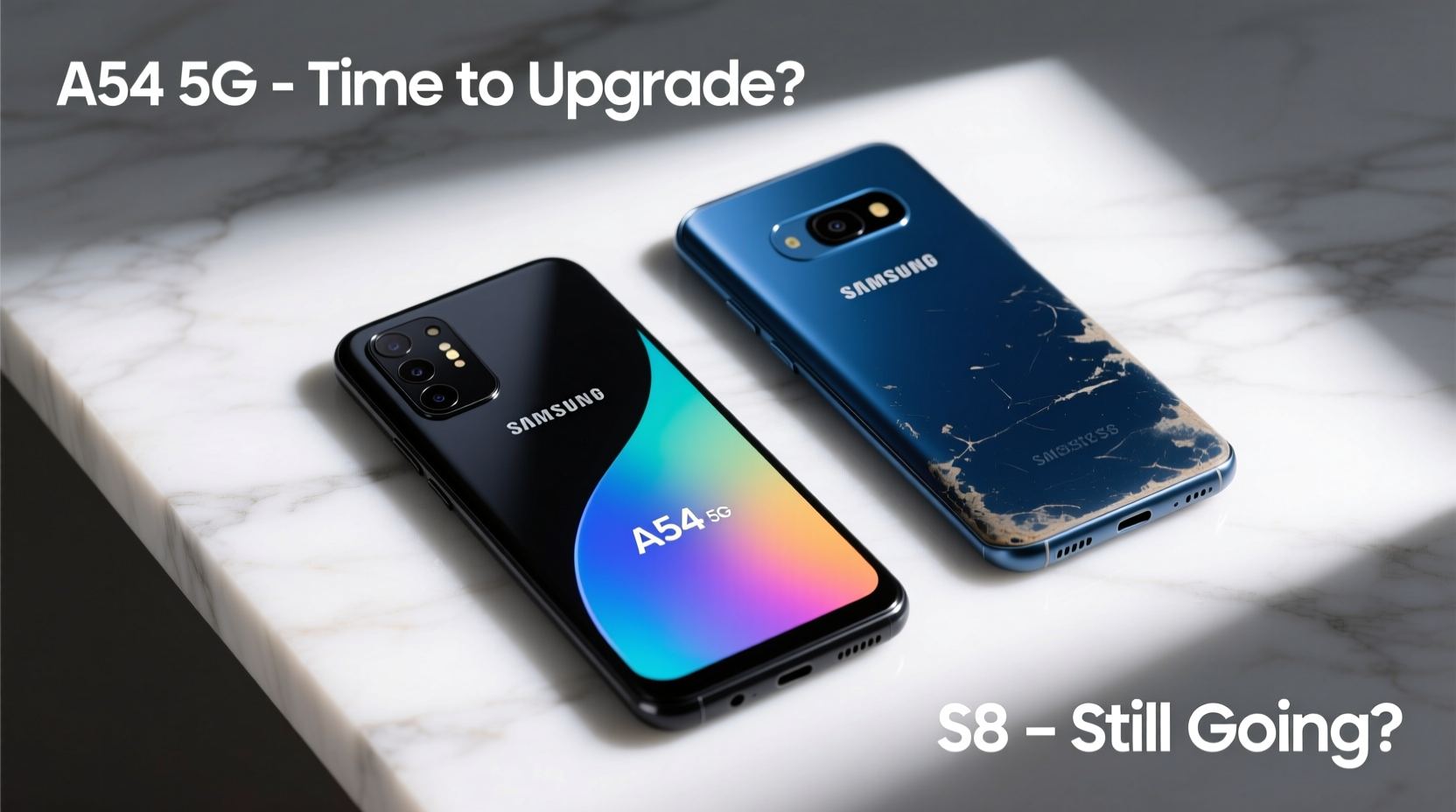
The Galaxy S8 was powered by the Qualcomm Snapdragon 835 (or Exynos 9810 in some regions), which was top-tier in 2017. At the time, it handled multitasking, gaming, and everyday apps with ease. However, modern apps and operating systems demand far more processing power than what the S8 can deliver today.
In contrast, the Galaxy A54 5G runs on Samsung’s Exynos 1380 chipset, built on a 5nm process. This brings significant improvements in CPU and GPU performance, better energy efficiency, and support for newer technologies like Wi-Fi 6 and Bluetooth 5.3. Real-world usage shows the A54 handling multiple apps, high-resolution video streaming, and even demanding games like Genshin Impact without noticeable lag.
While the S8 may still open basic apps, background processes and system updates slow it down considerably. The A54 offers smoother animations, faster app launches, and consistent responsiveness — something that enhances daily usability more than specs alone suggest.
Display and Design: Glass Evolution
The Galaxy S8 was groundbreaking for its time, introducing the “Infinity Display” — a nearly bezel-less 5.8-inch Quad HD+ Super AMOLED screen with an 18.5:9 aspect ratio. It felt futuristic and set the design language for future Samsung flagships.
The Galaxy A54 5G steps into a different era. It features a larger 6.4-inch FHD+ Super AMOLED display with a 120Hz refresh rate. While the resolution is slightly lower than the S8’s Quad HD panel, the higher refresh rate makes scrolling, swiping, and gaming feel significantly smoother. Motion clarity and touch response are objectively better.
Design-wise, the S8 remains elegant with its glass-and-metal build and curved edges. However, the A54 improves durability with Gorilla Glass 5 on front and back, IP67 water and dust resistance, and a more practical flat display that’s less prone to accidental touches and easier to protect with standard cases.
“Upgrading from a 60Hz to a 120Hz screen is one of the most immediately noticeable improvements in user experience.” — David Kim, Mobile UX Analyst at TechPulse Insights
Battery Life and Charging: From One Day to Two
The Galaxy S8 came with a 3000mAh battery — adequate in 2017 but underpowered by today’s standards. With moderate use, it typically lasted about a day, and heavy users often needed a midday charge. Fast charging was supported, but only up to 15W, and wireless charging was limited to older standards.
The Galaxy A54 5G packs a 5000mAh battery, nearly 70% larger. This translates to consistent 1.5 to 2 days of battery life under mixed usage — web browsing, social media, video streaming, and messaging. Even with the brighter screen and 5G connectivity, the A54 manages power efficiently thanks to its modern chipset and software optimizations.
Charging has also improved. The A54 supports 25W fast charging (charger sold separately), cutting charge time nearly in half compared to the S8. While neither phone supports ultra-fast 45W charging, the A54’s combination of larger battery and faster charging makes it far more convenient for daily use.
Camera Comparison: Night Mode, AI, and Real-World Results
The Galaxy S8 featured a solid 12MP rear camera with Dual Pixel autofocus and f/1.7 aperture — excellent for its time. It produced vibrant, natural-looking photos in daylight and respectable low-light shots. However, it lacks modern computational photography features like Night Mode, HDR+, or AI scene optimization.
The Galaxy A54 5G comes with a triple-camera setup: 50MP main sensor (f/1.8), 12MP ultrawide (f/2.2), and 5MP macro (f/2.4). The main sensor uses pixel binning (combining four pixels into one) to produce sharp, detailed 12.5MP images even in low light. With Night Mode, the A54 captures dramatically better photos after dark — brighter subjects, reduced noise, and more accurate colors.
Video recording has also evolved. The S8 maxes out at 4K@30fps, while the A54 adds stabilization enhancements and records 4K video with improved dynamic range. Front-facing cameras are night and day: the S8’s 8MP shooter is functional but grainy in dim light; the A54’s 32MP front camera delivers crisp selfies and smooth video calls.
| Feature | Galaxy S8 | Galaxy A54 5G |
|---|---|---|
| Release Year | 2017 | 2023 |
| Processor | Snapdragon 835 / Exynos 9810 | Exynos 1380 |
| RAM | 4GB | 6GB / 8GB |
| Storage | 64GB (expandable) | 128GB / 256GB (expandable) |
| Battery | 3000mAh | 5000mAh |
| Charging | 15W Fast, Wireless | 25W Fast, Wireless |
| Display | 5.8\" QHD+ AMOLED, 60Hz | 6.4\" FHD+ AMOLED, 120Hz |
| Rear Camera | 12MP (f/1.7) | 50MP + 12MP + 5MP |
| Front Camera | 8MP (f/1.7) | 32MP (f/2.2) |
| OS at Launch | Android 7.0 | Android 13 |
| Current OS Support | No updates since 2020 | Android 14, up to Android 17 |
| Water Resistance | IP68 | IP67 |
| 5G Support | No | Yes |
Software and Security: The Hidden Upgrade
Perhaps the most critical reason to upgrade isn’t visible — it’s software. The Galaxy S8 originally launched with Android 7.0 Nougat and received updates up to Android 9 Pie. Security patches stopped entirely in 2020. That means your device hasn’t had any official protection against emerging threats for over four years.
In contrast, the Galaxy A54 5G ships with Android 13 and Samsung’s One UI 5.1, with a promise of **four major OS upgrades and five years of security patches** — meaning it will be supported through at least 2028. This ensures access to new features, better app compatibility, and, most importantly, ongoing protection against malware and vulnerabilities.
Modern apps are increasingly optimized for newer Android versions. Banking apps, streaming services, and productivity tools may soon stop supporting Android 9 or earlier. Upgrading now avoids being locked out of essential services later.
Real-Life Example: Maria’s Upgrade Journey
Maria had been using her Galaxy S8 since 2017. She loved the compact size and familiar interface. But by 2023, she noticed constant slowdowns, failed app updates, and her banking app began crashing regularly. After switching to the A54, she was surprised by how much smoother everything felt — especially video calls with her grandchildren and taking photos during family events. “I didn’t realize how much I was missing until I upgraded,” she said. “The battery lasts all day, and I don’t have to close apps every few minutes.”
Upgrade Checklist: Are You Ready?
Before making the switch, ask yourself the following:
- ✅ Does your phone struggle to run basic apps or frequently freeze?
- ✅ Have you stopped receiving software or security updates?
- ✅ Is the battery life no longer lasting a full day?
- ✅ Do you want to use 5G networks or newer camera features?
- ✅ Are important apps becoming incompatible?
- ✅ Do you value long-term support and future-proofing?
If you answered yes to three or more, it’s likely time to move on.
Frequently Asked Questions
Can the Galaxy S8 still be used safely in 2024?
Possibly, but not recommended for sensitive tasks like online banking or shopping. Without security updates, it’s vulnerable to exploits. Using it as a secondary device or offline tool is safer.
Is the Galaxy A54 5G worth the price?
Absolutely. Priced in the $400–$450 range, it offers exceptional value with 5G, a 120Hz display, strong battery life, and long-term software support — features that were once exclusive to premium models.
Will my accessories work with the new phone?
Most wired headphones and chargers will work, but the A54 uses a USB-C port (same as S8), so existing cables are compatible. Cases and screen protectors will not fit due to different dimensions and flat vs. curved screens.
Conclusion: Time to Move Forward
The Galaxy S8 was a landmark device — sleek, innovative, and ahead of its time. But six years in smartphone years is a lifetime. Holding onto outdated hardware limits your ability to stay connected, secure, and productive.
The Galaxy A54 5G isn’t just an incremental upgrade; it’s a leap into modern mobile computing. Faster performance, superior battery life, advanced cameras, and guaranteed software support make it a compelling replacement. If you’ve been hesitating, know this: upgrading isn’t admitting defeat — it’s embracing progress.




 浙公网安备
33010002000092号
浙公网安备
33010002000092号 浙B2-20120091-4
Comments
No comments yet. Why don't you start the discussion?