
When it comes to premium smartphones that blend innovation with lifestyle appeal, the Samsung Galaxy Z Flip 5 and the iPhone 15 Plus represent two very different philosophies. One embraces the future of form factors with a foldable hinge and compact footprint. The other doubles down on screen real estate, battery life, and seamless integration within Apple’s ecosystem. Choosing between them isn’t just about specs—it’s about how you use your phone, what kind of experiences matter most, and whether you value novelty or consistency.
The Galaxy Z Flip 5 stands as one of the most refined clamshell foldables on the market, offering portability, fashion-forward aesthetics, and cutting-edge engineering. Meanwhile, the iPhone 15 Plus delivers flagship-level performance in a familiar slab design, with superior longevity, camera quality, and iOS reliability. But which device truly offers the better \"foldable experience\"? Let’s break it down across key categories to help you decide where your investment makes the most sense.
Design and Portability: Form Meets Function
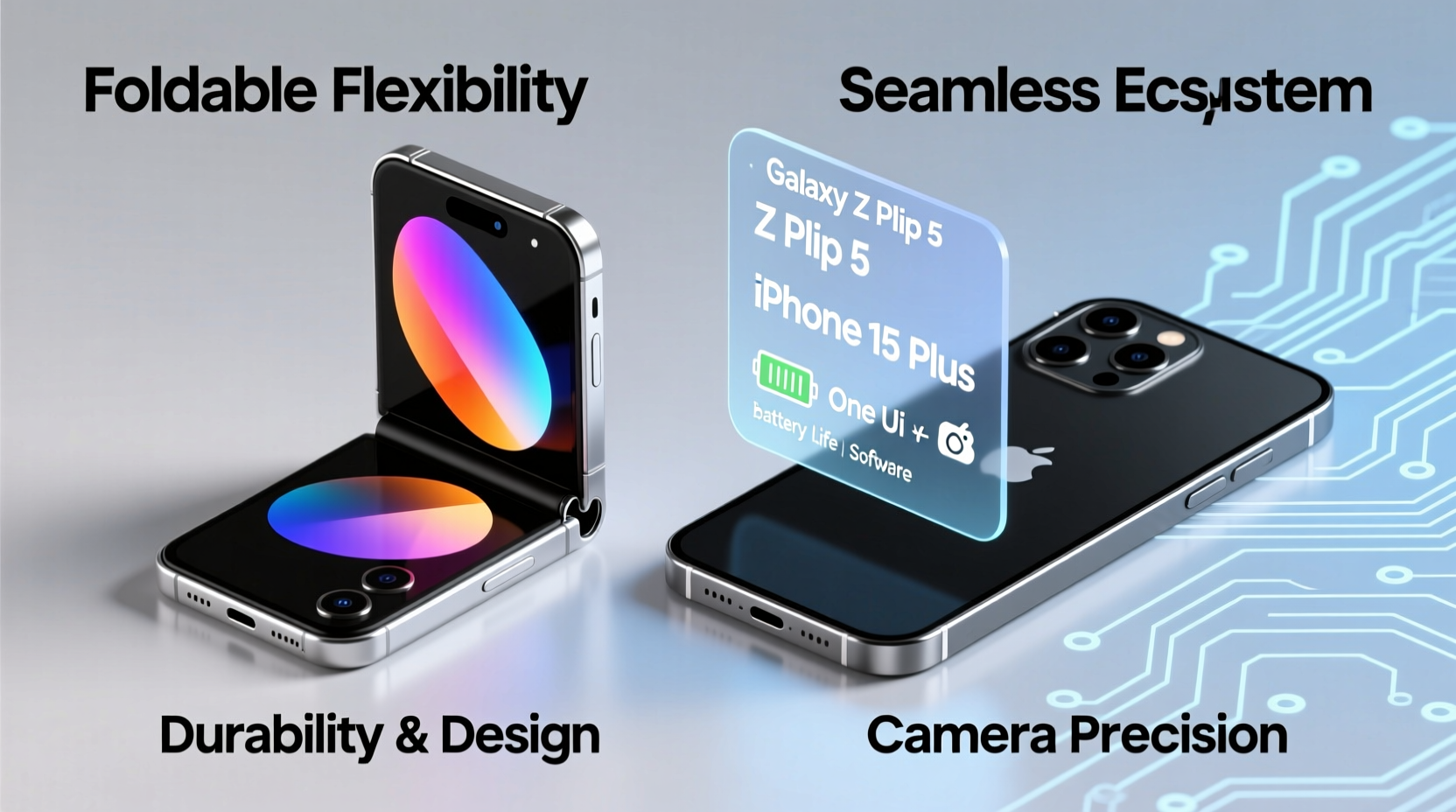
The most immediate difference between these devices lies in their physical design. The Galaxy Z Flip 5 folds vertically like a compact mirror or makeup case, shrinking to half its size when closed. This makes it significantly easier to slip into small pockets, clutches, or bags—ideal for users who prioritize minimalism or dislike bulky phones.
In contrast, the iPhone 15 Plus maintains Apple’s traditional rectangular shape with a 6.7-inch display. While this provides more screen space upfront, it also means the phone is longer and heavier (199g) than the folded Flip 5 (183g). When open, the Flip 5 measures 6.7 inches tall—nearly identical to the iPhone—but its width is only 74mm compared to the iPhone’s 78.5mm. That slight difference can affect single-handed grip, especially for users with smaller hands.
One standout feature of the Flip 5 is its **Flex Mode**. Thanks to the hinge mechanism, the phone can stay propped open at various angles, enabling hands-free video calls, cooking tutorials, or selfies without needing a stand. The iPhone 15 Plus lacks any such functionality unless paired with an external accessory.
However, durability remains a concern. Despite improvements in Samsung’s Ultra Thin Glass and Armor Aluminum frame, foldables inherently carry more mechanical risk than solid-body phones. The iPhone 15 Plus, built with Ceramic Shield glass and aerospace-grade aluminum, feels more rugged out of the box—even if it doesn’t offer transformative versatility.
Display Technology and Usability
Both devices deliver excellent displays, but they serve entirely different purposes.
The Galaxy Z Flip 5 features a 6.7-inch Dynamic AMOLED 2X main screen with a 120Hz adaptive refresh rate, ensuring smooth scrolling and vibrant colors. Its inner display folds seamlessly, though a faint crease remains visible under certain lighting conditions—a trade-off accepted across the foldable industry. What sets the Flip 5 apart is its **Cover Screen**, now expanded to 3.4 inches with full app support. You can reply to messages, check notifications, control music, or even view Instagram stories without opening the phone.
On the other hand, the iPhone 15 Plus uses a 6.7-inch Super Retina XDR OLED display with a fixed 60Hz refresh rate. While color accuracy and brightness are superb (up to 1000 nits), the lack of high refresh rate becomes noticeable after using the Flip 5’s buttery 120Hz panel. However, iOS animations are so well-optimized that the lower refresh rate rarely feels sluggish in daily use.
“Foldables aren’t just about bigger screens—they’re about smarter interactions.” — Dr. Lena Park, Human-Computer Interaction Researcher at MIT Media Lab
For multitasking, the Flip 5 supports split-screen apps, drag-and-drop functionality, and floating windows—features absent from iOS. The iPhone relies on Slide Over and Picture in Picture, which are functional but limited. If you frequently juggle tasks (e.g., watching a tutorial while taking notes), the Flip 5 has a clear edge.
Performance and Software Experience
Under the hood, both phones are powered by top-tier chipsets: the Galaxy Z Flip 5 runs on Qualcomm’s Snapdragon 8 Gen 2 (for Galaxy), while the iPhone 15 Plus uses Apple’s A16 Bionic chip. On paper, the A16 leads in single-core performance and efficiency, giving iOS an advantage in long-term responsiveness and app optimization.
But raw speed isn’t everything. The Flip 5 benefits from Android 13 (upgradable to Android 14) with Samsung’s One UI 5.1.1, tailored for foldables. Features like **App Continuity**—where an app transitions smoothly from cover screen to main display—are unique to Samsung’s ecosystem. Additionally, Samsung promises four generations of OS updates and five years of security patches, narrowing the historical software lifespan gap with Apple.
iOS, meanwhile, continues to lead in ecosystem cohesion. If you own an iPad, Mac, or Apple Watch, the iPhone 15 Plus integrates effortlessly via AirDrop, Handoff, Universal Clipboard, and iCloud syncing. Notifications appear across devices, FaceTime links work universally, and iMessage remains a gold standard for cross-platform messaging (despite SMS limitations).
Foldable-specific software maturity is still evolving. Some third-party apps don’t fully optimize for the Flip 5’s aspect ratio or dual-screen capabilities. Apple’s App Store, by contrast, ensures near-universal compatibility and consistent UI behavior.
Camera Comparison: Real-World Photography Needs
Photography preferences often sway purchasing decisions. Here, the iPhone 15 Plus holds a measurable advantage in consistency and dynamic range.
It features a dual-camera system: a 48MP main sensor (with pixel binning for sharper 12MP shots) and a 12MP ultrawide lens. The main sensor captures exceptional detail, handles low light gracefully, and benefits from Photonic Engine processing for natural HDR results. Portrait mode now works at any focal length, and Smart HDR 5 adapts intelligently to faces and scenes.
The Galaxy Z Flip 5 uses a 50MP main camera and a 10MP front-facing selfie cam (when open), plus a 12MP ultrawide on the back. Image quality is strong during daylight, with accurate skin tones and good autofocus. However, in low-light scenarios, noise reduction tends to oversoften details, and night mode processing lags slightly behind Apple’s computational photography.
| Feature | Samsung Galaxy Z Flip 5 | iPhone 15 Plus |
|---|---|---|
| Main Camera | 50MP, f/1.8 | 48MP, f/1.6 (sensor-shift OIS) |
| Ultrawide | 12MP, f/2.2 | 12MP, f/2.4 |
| Front Camera | 10MP (internal), 4MP (cover) | 12MP TrueDepth (Dynamic Island) |
| Video Recording | 4K @ 60fps, Auto Framing | 4K @ 60fps, Cinematic Mode, Action Mode |
| Low-Light Performance | Good, minor blur in motion | Excellent, advanced stabilization |
Where the Flip 5 shines is in creative flexibility. With Flex Mode, you can set it on a table and record hands-free videos. The cover screen allows quick selfies without unlocking the phone—perfect for spontaneous moments. The iPhone requires opening the camera app first, making it slightly slower for impromptu shots.
Battery Life and Charging: Endurance vs Efficiency
The iPhone 15 Plus boasts one of the longest battery lives among smartphones, routinely lasting 1.5 to 2 days with moderate use. Its 4,323mAh battery powers through streaming, navigation, and social media with ease. It supports 20W wired fast charging (30% in 30 minutes), 15W MagSafe wireless, and reverse charging for AirPods.
The Galaxy Z Flip 5 packs a smaller 4,400mAh dual-cell battery, constrained by its slim profile. In practice, it lasts about a full day with mixed usage—less if you're frequently unfolding the screen or using GPS. It charges faster via USB-C (25W supported, though no charger included), reaching 50% in around 30 minutes.
While neither phone offers replaceable batteries, the iPhone’s longer lifespan and energy-efficient A16 mean slower degradation over time. Foldables, due to dual displays and hinges, inherently consume more power per inch of screen real estate.
Real-World Use Case: Who Benefits Most?
Consider Sarah, a 29-year-old marketing consultant who travels weekly for client meetings. She values discretion, quick access to messages, and professional appearance. During flights, she uses her Galaxy Z Flip 5 in Flex Mode to watch presentations hands-free. At networking events, she keeps it folded in her blazer pocket—something she couldn’t do with her old iPhone 14 Pro Max.
She occasionally misses the iPhone’s superior portrait mode for LinkedIn headshots, but loves being able to glance at calendar alerts on the cover screen without “pulling out her phone” in meetings. For her, the Flip 5 isn’t just a gadget—it’s a tool that aligns with her mobile, image-conscious lifestyle.
Compare that to James, a freelance photographer who shoots on his phone and edits in Lightroom. He chose the iPhone 15 Plus for its reliable color grading, extended battery for shoots, and seamless transfer to his MacBook. He finds foldables gimmicky and worries about screen damage on location. For him, consistency trumps innovation.
Checklist: Which Phone Is Right for You?
- Choose the Galaxy Z Flip 5 if:
- You want a compact, stylish phone that fits in small spaces
- You value hands-free Flex Mode for videos or calls
- You enjoy interacting with the cover screen without opening the device
- You multitask across apps and appreciate Android customization
- Choose the iPhone 15 Plus if:
- You prioritize camera quality and video stabilization
- You already use other Apple devices and want seamless integration
- You prefer proven durability and longer software support (up to 6–7 years)
- You need all-day-plus battery life with minimal charging anxiety
Frequently Asked Questions
Can the Galaxy Z Flip 5 really last as long as an iPhone?
Samsung rates the Flip 5’s hinge for 200,000 folds—equivalent to about 5 years of average use. With proper care, it can last that long. However, drop resistance and water protection (IPX8 only) are weaker than the iPhone 15 Plus’s IP68 rating. Longevity depends heavily on handling.
Is the iPhone 15 Plus considered a foldable?
No. The iPhone 15 Plus is not a foldable device. Apple has not released any foldable phones as of 2024. The term “foldable experience” in this context refers to comparing the utility and innovation of current alternatives.
Does the cover screen on the Flip 5 drain the battery quickly?
Not significantly. Samsung optimized the outer display with low-power widgets and ambient display modes. With typical usage (checking time, notifications), it adds minimal strain—usually less than 5% daily drain.
Final Verdict: Innovation or Reliability?
The Samsung Galaxy Z Flip 5 and iPhone 15 Plus cater to fundamentally different priorities. The Flip 5 is a statement piece—an evolution of mobile design that reimagines how we interact with our devices. It rewards early adopters, fashion-conscious users, and those who appreciate novel functionality like Flex Mode and cover screen interactivity.
The iPhone 15 Plus, by contrast, is a masterclass in refinement. It doesn’t surprise, but it consistently delivers. Its camera, battery life, ecosystem integration, and long-term software support make it one of the most dependable flagship phones available.
If you’re asking which foldable experience is worth it, the answer hinges on your definition of “worth.” Is it measured in convenience, personal expression, and forward-thinking design? Then the Galaxy Z Flip 5 earns its place. Or is it defined by reliability, longevity, and photographic excellence? Then the iPhone 15 Plus remains unmatched—even without folding.




 浙公网安备
33010002000092号
浙公网安备
33010002000092号 浙B2-20120091-4
Comments
No comments yet. Why don't you start the discussion?