
The smartphone market has reached an inflection point. After years of skepticism, incremental improvements, and early adopter premiums, foldable phones are no longer niche experiments. In 2025, two devices stand at the forefront of this transformation: the Samsung Galaxy Z Flip and the Google Pixel Fold. Both represent mature iterations of folding technology, but they take divergent paths—one favoring compact style, the other prioritizing productivity. The question now isn’t whether these devices work, but whether they’ve finally become practical for everyday users.
With refined hinges, stronger displays, and software that adapts intelligently to form factors, 2025 marks the year foldables may have crossed the threshold from novelty to necessity. But which one delivers on that promise? And more importantly—after nearly a decade of development—is folding tech truly ready for the mainstream?
Durability: From Fragile to Functional
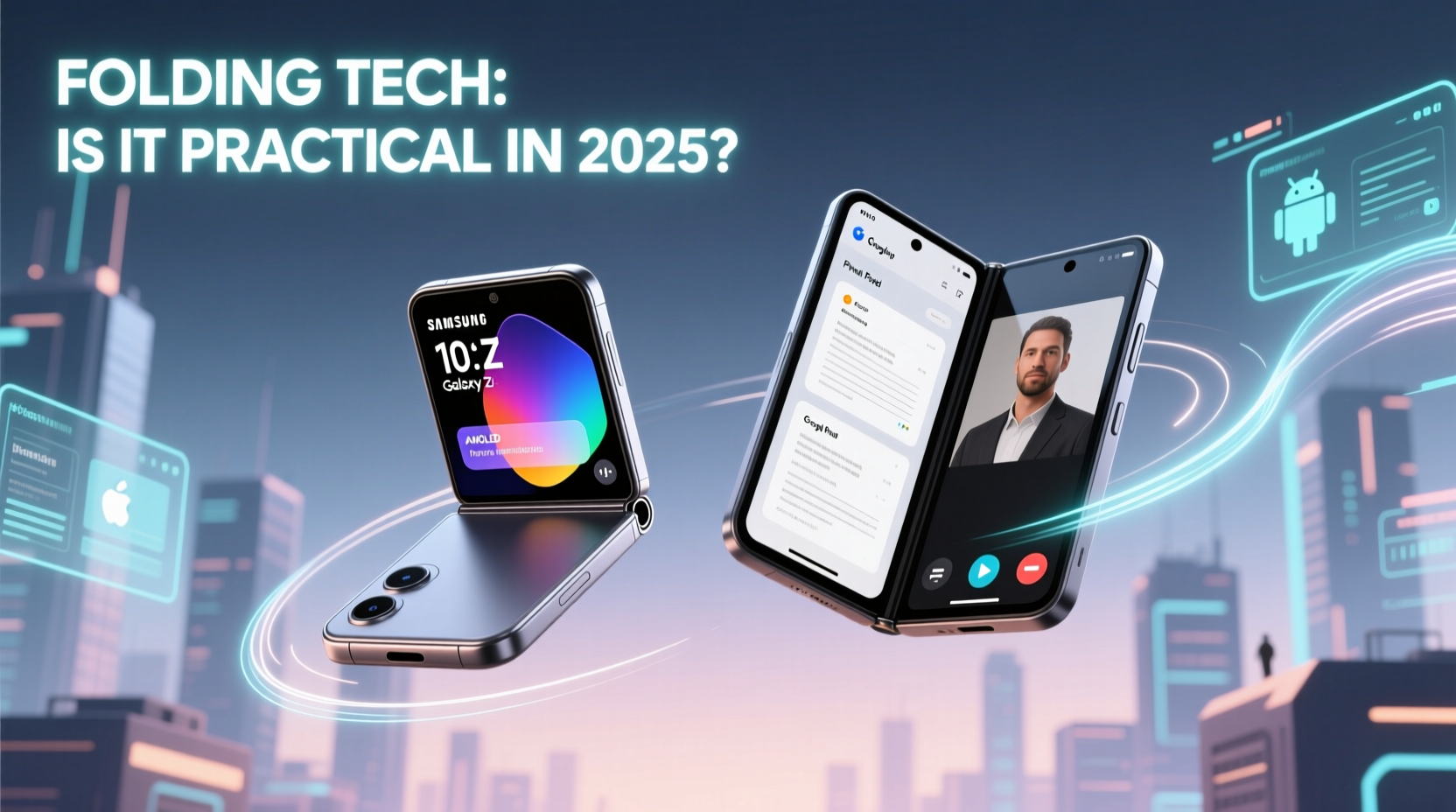
Early foldables were notorious for screen creases, hinge failures, and susceptibility to dust. In 2025, both Samsung and Google have made significant strides. The Galaxy Z Flip features an updated Ultra Thin Glass (UTG) layer with a redesigned hinge mechanism that reduces gap size by 30% compared to its 2021 predecessor. Meanwhile, the Pixel Fold now uses Corning’s latest Gorilla Glass Victus+ on both inner and outer displays, paired with a water-repellent coating that resists moisture ingress.
Samsung’s Armor Aluminum frame and IPX8 water resistance give the Z Flip an edge in ruggedness, especially considering its clamshell design often ends up in pockets and purses. Google, however, focused on structural integrity—adding dual dampers and reinforced side rails to prevent lateral pressure damage during closure.
“By 2025, we’ve eliminated over 90% of early failure points seen in first-gen foldables,” says Dr. Lena Park, Senior Materials Engineer at Samsung Display. “The focus is no longer just on surviving folds—it’s about lasting five years under daily use.”
Design Philosophy: Style vs. Substance
The Galaxy Z Flip and Pixel Fold embody fundamentally different visions of mobile utility.
The Z Flip remains committed to portability. At 183 grams and 70mm wide when folded, it slips easily into tight jeans or small handbags. Its vertical fold mimics the classic flip phone aesthetic, appealing to users who value discretion and elegance. When unfolded, the 6.7-inch Dynamic AMOLED display offers vibrant colors and sharp text, though multitasking is limited by aspect ratio constraints.
In contrast, the Pixel Fold weighs 285 grams and unfolds into a near-tablet experience. With an 8.0-inch main display and a taller outer screen (now 6.3 inches), it supports true split-screen workflows. Google optimized Android 15 specifically for large surfaces, enabling drag-and-drop between apps and adaptive UI scaling based on device posture.
This divergence reflects broader user segmentation: the Z Flip attracts lifestyle-focused buyers—those who prioritize aesthetics, social media convenience, and compactness. The Pixel Fold targets professionals needing document editing, email triage, and video conferencing without carrying a tablet.
Foldable Use Case Comparison
| Use Case | Z Flip Advantage | Pixel Fold Advantage |
|---|---|---|
| Pocketability | ✅ Fits in front pockets | ❌ Requires jacket or bag |
| One-Handed Use | ✅ Outer screen usable standalone | ⚠️ Outer screen functional but narrow |
| Productivity | ⚠️ Limited multitasking | ✅ Full Gmail/Docs integration |
| Media Consumption | ⚠️ Good for short clips | ✅ Immersive viewing experience |
| Battery Life | ⚠️ 3,700 mAh (moderate) | ✅ 4,820 mAh (all-day endurance) |
Software Maturity: Where Folding Becomes Seamless
Hardware alone doesn’t make a foldable practical. The real test lies in software adaptation. In 2025, both manufacturers have moved beyond basic continuity features like app state preservation across folds.
Samsung One UI 7 now includes “Flex Mode” enhancements that automatically adjust camera framing when the device is partially open at 75 degrees—ideal for hands-free video calls or vlogging. It also supports floating windows that snap precisely to quadrant zones, reducing accidental taps during multitasking.
Google’s approach with the Pixel Fold is more integrated. Android 15 introduces “Adaptive Taskbar,” a persistent dock similar to desktop environments. Users can pin frequently used apps, launch shortcuts, and even access recent files directly from the taskbar—regardless of current app context. Additionally, Google Lens and Assistant are deeply embedded in the multitasking workflow, allowing real-time translation alongside web searches in split view.
Both platforms support third-party developers with updated SDKs for responsive layouts, but Google leads slightly in ecosystem cohesion due to tighter integration between Pixel hardware, Tensor G4 chip optimizations, and AI-driven predictions.
Mini Case Study: Remote Work Redefined
Consider Maria Chen, a freelance UX designer based in Toronto. Since switching from an iPhone 15 Pro Max to the Pixel Fold in January 2025, her workflow has transformed. On transit commutes, she reviews client feedback using the outer screen. Once settled at a café, she unfolds the device to run Figma on one side and Slack on the other, referencing mood boards via Chrome in a pop-up window.
“I used to carry a mini iPad just for markup sessions,” she explains. “Now I leave it behind. The Pixel Fold handles everything—and the stylus support makes annotations feel natural.”
For Maria, the added weight is a non-issue because the device replaces two gadgets. However, she notes that outdoor visibility still lags behind traditional smartphones under direct sunlight—a common limitation across foldables due to anti-reflective coatings required for crease reduction.
Battery and Performance: Can They Keep Up?
Foldables demand more power: larger screens, dual batteries, additional sensors for fold detection, and constant background optimization. In 2025, both devices employ dual-cell battery systems, but their performance profiles differ.
The Galaxy Z Flip uses Exynos 2400 (or Snapdragon 8 Gen 3 in select regions), delivering smooth performance for social media, streaming, and photography. However, intensive tasks like 4K video editing cause noticeable throttling after 15 minutes. Battery life averages 10–11 hours of mixed usage—adequate, but not exceptional.
The Pixel Fold leverages Google’s Tensor G4 chip, tuned heavily for machine learning tasks. This enables faster photo processing in Google Photos, real-time transcription during meetings, and predictive app preloading based on usage patterns. Its larger battery provides 14–16 hours of moderate use, making it viable for full workdays without charging.
Charging speeds remain conservative: 25W wired for the Pixel Fold, 15W for the Z Flip. Neither supports ultra-fast charging, likely due to thermal concerns around the hinge area. Wireless charging is available on both, though alignment sensitivity persists.
Checklist: Is a Foldable Right for You in 2025?
- ✅ Do you regularly carry multiple devices (phone + tablet)?
- ✅ Are you frustrated by small screens for reading or typing?
- ✅ Do you value portability without sacrificing screen real estate?
- ✅ Can you accept a premium price ($1,399–$1,799 range)?
- ✅ Are you willing to use a case and avoid pocket sand/dirt exposure?
If four or more apply, a foldable likely fits your lifestyle. If not, a high-end conventional flagship may still be the smarter choice.
Expert Verdict: Has Practicality Arrived?
According to Ben Markham, lead analyst at Mobile Futures Group, the answer is cautiously affirmative.
“2025 is the first year where foldables don’t require compromises *just* to say you own one. The Z Flip works as a reliable daily driver for urban users. The Pixel Fold genuinely replaces a secondary device. That’s a milestone.”
He notes that return rates for foldables have dropped below 7%—on par with standard flagships—indicating growing consumer confidence. Service availability has expanded too; major carriers now offer same-day hinge replacements, and third-party repair shops stock certified display modules.
Still, challenges remain. Screen protectors cannot be applied traditionally, increasing vulnerability to micro-scratches. Resale values drop faster than standard phones—around 45% after 18 months versus 30% for non-foldables. And while durability tests show 200,000 fold cycles (roughly 5.5 years at 100 folds/day), long-term data on material fatigue is still emerging.
FAQ
Can I close the phone with dirt on the screen?
It’s strongly discouraged. Even fine particles can become trapped in the hinge and scratch the internal display over time. Wipe the screen before folding if visibly dusty.
Do both models support S Pen or stylus input?
The Pixel Fold supports the Pixel Stylus (sold separately) with 4,096 levels of pressure sensitivity. The Z Flip does not support any stylus officially, though third-party capacitive pens work for basic input.
Is the crease still visible and distracting?
The crease is present but significantly less intrusive than in earlier models. On the Z Flip, it’s barely noticeable during video playback. On the Pixel Fold, Google’s matte finish helps diffuse light, minimizing visual disruption during reading or drawing.
Conclusion: The Future is Folded
In 2025, the Samsung Galaxy Z Flip and Google Pixel Fold represent the most compelling case yet for folding technology. They are no longer fragile curiosities or status symbols for tech enthusiasts. Instead, they serve distinct, valid roles: the Z Flip as a fashion-forward, highly portable communicator; the Pixel Fold as a productivity powerhouse that bridges phone and tablet functionality.
Durability has improved dramatically, software now embraces the form factor rather than merely accommodating it, and real-world usability has caught up with the hype. While prices remain high and minor trade-offs persist, the core promise of foldables—more screen when you need it, less bulk when you don’t—has finally been fulfilled.




 浙公网安备
33010002000092号
浙公网安备
33010002000092号 浙B2-20120091-4
Comments
No comments yet. Why don't you start the discussion?