
Two years may not sound like a long time in the smartphone lifecycle, but in the fast-moving world of Android flagship technology, the gap between the Samsung Galaxy Note 20 Ultra (2020) and the Galaxy S23 (2023) represents multiple generational leaps. For users still relying on the Note 20 Ultra, the question isn’t just whether the S23 offers better specs—it’s whether the upgrade delivers tangible improvements in daily use, longevity, and overall value in 2024 and beyond.
This comparison goes beyond raw numbers. It considers real-world usability, software support, ecosystem compatibility, and whether investing in a new device now makes sense when older models are still capable.
Performance and Hardware Evolution
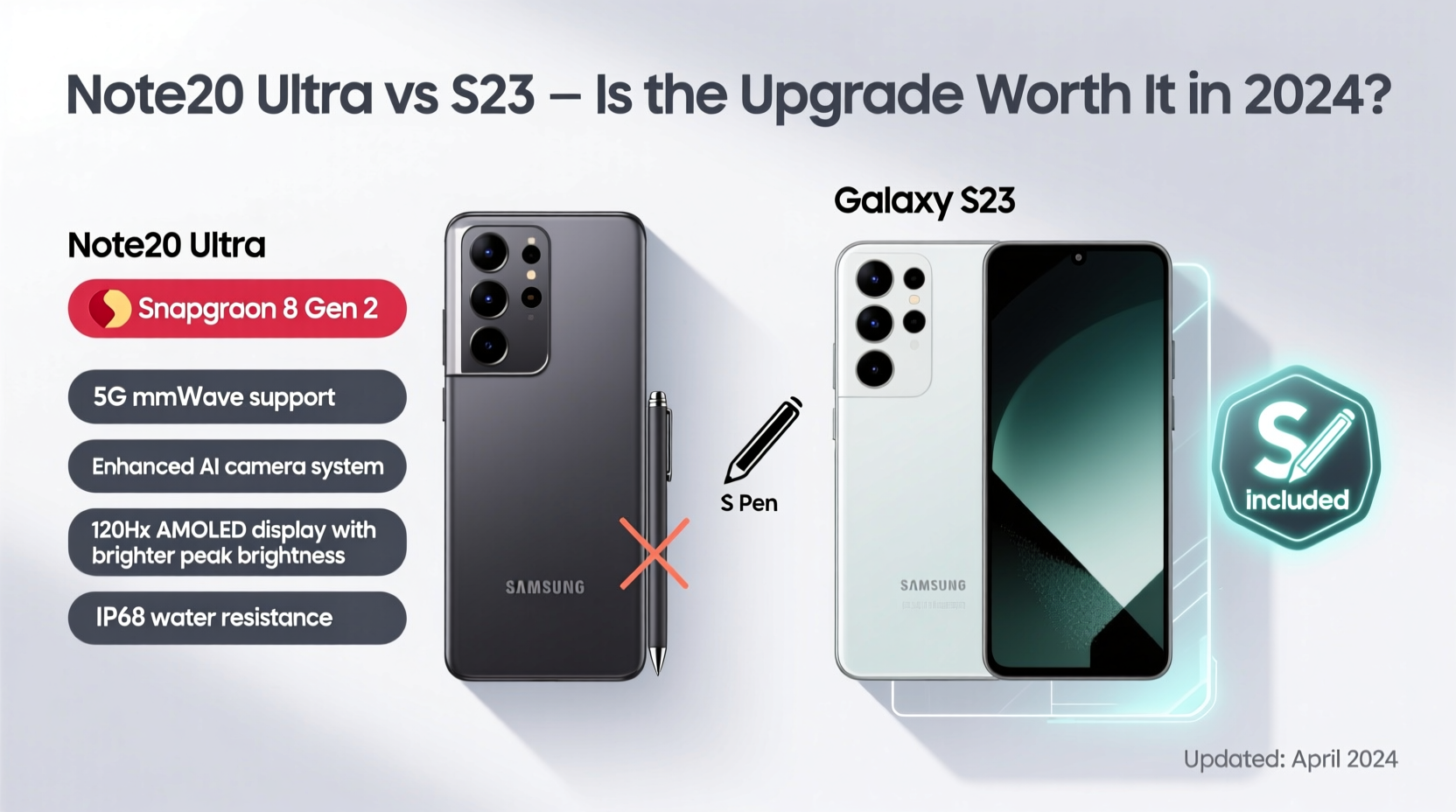
The core of any upgrade decision lies in performance. The Note 20 Ultra launched with the Exynos 990 or Snapdragon 865+ (depending on region), both of which were already showing limitations at launch—particularly in thermal management and GPU efficiency. In contrast, the Galaxy S23 runs on the custom Snapdragon 8 Gen 2 for Galaxy, a chip co-developed by Qualcomm and Samsung that delivers significantly higher CPU and GPU performance while consuming less power.
Benchmarks tell a clear story: the S23 scores around 50% higher in multi-core performance and nearly double in graphics tests. But more importantly, this translates into smoother multitasking, faster app launches, and better sustained performance during gaming or video editing. Users upgrading from the Note 20 Ultra often report that the S23 feels “snappier” even during routine tasks like scrolling through social media or switching between apps.
Memory and Storage Efficiency
Both devices offer 12GB RAM and up to 512GB storage, but the S23 uses faster LPDDR5X RAM and UFS 4.0 storage—making file transfers, app installations, and system operations quicker. While the Note 20 Ultra supported microSD expansion, the S23 does not, so users must choose their storage tier carefully.
Display and Design: Subtle Refinements
The Note 20 Ultra featured a stunning 6.9-inch QHD+ Dynamic AMOLED 2X display with a 120Hz refresh rate, a standard that still holds up well. The S23, however, uses a slightly smaller 6.1-inch FHD+ display with an adaptive 1–120Hz LTPO panel. Despite the lower resolution, the S23’s screen benefits from improved peak brightness (up to 1750 nits vs. 1500 nits), better outdoor visibility, and reduced power consumption thanks to its smaller size and optimized refresh rate scaling.
Design-wise, the S23 is more compact and significantly lighter (168g vs. 208g), making it far more comfortable for one-handed use. The squared-off aluminum frame gives it a modern, premium feel, while the Note 20 Ultra’s curved edges, though elegant, made accidental touches more common.
“Smaller doesn’t always mean lesser. The S23 proves that refining size and ergonomics can enhance usability more than sheer screen real estate.” — David Kim, Mobile UX Analyst at TechInsight Asia
Camera Comparison: Generational Leap
The camera systems reflect the most dramatic improvement. The Note 20 Ultra had a strong triple setup: 108MP main, 12MP ultra-wide, and a 12MP periscope telephoto with 5x optical zoom. The S23 retains a similar configuration but upgrades every sensor and processing pipeline.
- Main Sensor: 50MP with larger pixels (1.8µm), improved low-light performance, and better dynamic range.
- Ultra-Wide: Now 12MP with reduced distortion and better edge clarity.
- Telephoto: Still 10MP with 3x optical zoom—less than the Note’s 5x—but compensated by vastly superior AI-powered zoom and Night Mode enhancements.
In practical terms, the S23 produces more natural color science, faster focusing, and significantly better results beyond 10x digital zoom. Its AI processing reduces noise intelligently and preserves detail in challenging lighting—something the Note 20 Ultra struggled with as its processing aged.
Video Capabilities
The S23 supports 8K recording at 30fps with improved stabilization, while the Note 20 Ultra’s 8K footage suffered from overheating and aggressive cropping. For content creators, this alone could justify an upgrade.
Battery Life and Charging: A Shift in Priorities
The Note 20 Ultra packed a 5000mAh battery, outclassing the S23’s 3900mAh unit on paper. However, real-world usage tells a different story. Thanks to the efficient chipset, optimized software, and smaller display, the S23 often lasts just as long—or longer—on moderate use.
Heavy users who rely on DeX, note-taking, or extended video sessions may find the Note 20 Ultra’s endurance still unmatched. But for average users, the S23 delivers consistent all-day performance with about 6–7 hours of screen-on time.
| Feature | Note 20 Ultra | S23 |
|---|---|---|
| Battery Capacity | 5000 mAh | 3900 mAh |
| Charging Speed | 25W wired, 15W wireless | 25W wired, 15W wireless |
| USB Port | USB-C 3.2 | USB-C 3.2 |
| Estimated Daily Use | 7–9 hrs SOT | 6–7.5 hrs SOT |
Software Support and Longevity
This is where the S23 pulls decisively ahead. Samsung guarantees four major Android OS updates and five years of security patches for the S23 series. As of 2024, the Note 20 Ultra has reached the end of its update cycle—no further Android version upgrades will be released for it.
Running outdated software increases vulnerability to security threats and limits compatibility with newer apps. Google and third-party developers increasingly optimize apps for Android 13 and above, meaning older devices may experience bugs, slower performance, or missing features.
For users concerned about long-term reliability and privacy, the S23 offers peace of mind. It will likely remain supported until 2028, making it a smarter investment for those planning to keep their phone for three years or more.
Mini Case Study: Sarah’s Upgrade Decision
Sarah, a freelance architect, relied on her Note 20 Ultra for sketching, client presentations via DeX, and managing project timelines. By late 2023, she noticed apps taking longer to load, occasional crashes in OneNote, and difficulty exporting high-res renders. After testing the S23, she found that PDF rendering was 40% faster, multitasking between AutoCAD and Zoom was seamless, and her stylus notes synced instantly across devices. Though she missed the larger screen, the performance gains and continued software support made the switch worthwhile.
Is the Upgrade Worth It in 2024?
The answer depends on your usage patterns and expectations:
- If you're experiencing slowdowns, app instability, or security concerns on the Note 20 Ultra, the S23 offers meaningful improvements.
- If you value compact design, superior cameras, and long-term software support, the upgrade is justified.
- If you depend on the S Pen with precise handwriting input and prefer a larger canvas, the Note 20 Ultra may still serve you—though consider the S23 Ultra instead.
However, for casual users whose Note 20 Ultra still performs adequately, the upgrade may not be urgent. The S23 is excellent, but not revolutionary for basic tasks like calling, messaging, or browsing.
Checklist: Should You Upgrade?
- ✅ Is your phone slowing down or crashing frequently?
- ✅ Do you want better photo quality, especially in low light?
- ✅ Are you concerned about future software updates and security?
- ✅ Do you prefer a smaller, more manageable device?
- ✅ Can you benefit from improved video recording and stabilization?
If you answered yes to three or more, the S23 is a worthy successor.
Frequently Asked Questions
Can the S23 replace the S Pen functionality of the Note 20 Ultra?
The S23 does not have built-in S Pen support. While you can pair a Bluetooth-enabled S Pen, there's no silo for storage, and latency is slightly higher. For heavy stylus users, the Galaxy S23 Ultra or refurbished Note models may be better choices.
Is the S23 waterproof like the Note 20 Ultra?
Yes, both phones carry an IP68 rating, meaning they can survive submersion in up to 1.5 meters of water for 30 minutes. No compromise here.
Will my accessories work with the S23?
Most USB-C chargers and wireless chargers are compatible. However, Note 20 Ultra cases won’t fit due to different dimensions and camera layout.
Final Verdict: Future-Proofing Matters
The Galaxy S23 isn't just a faster phone—it's a more sustainable choice in 2024. With longer software support, refined hardware, and superior day-to-day responsiveness, it addresses the growing limitations of the Note 20 Ultra in a post-pandemic mobile landscape where reliability and security matter more than ever.
While the Note 20 Ultra was a powerhouse in its time, technology has moved on. For users seeking a dependable, secure, and future-ready device, the upgrade to the S23 is not only worth it—it’s timely.




 浙公网安备
33010002000092号
浙公网安备
33010002000092号 浙B2-20120091-4
Comments
No comments yet. Why don't you start the discussion?