
In 2015, the smartphone market reached a turning point. Flagships were no longer just about calling and texting—they were productivity tools, media centers, and creative companions. Two devices stood out: the Samsung Galaxy Note 5 and the Apple iPhone 6 Plus. At launch, both were hailed as top-tier choices, but with very different philosophies. The Note 5 embraced customization, power, and the stylus; the iPhone 6 Plus doubled down on ecosystem integration, smooth performance, and minimalist design. Years later, with the benefit of hindsight, it’s worth asking: Was the Note 5 really that much better?
Design and Build: Premium Materials, Different Philosophies
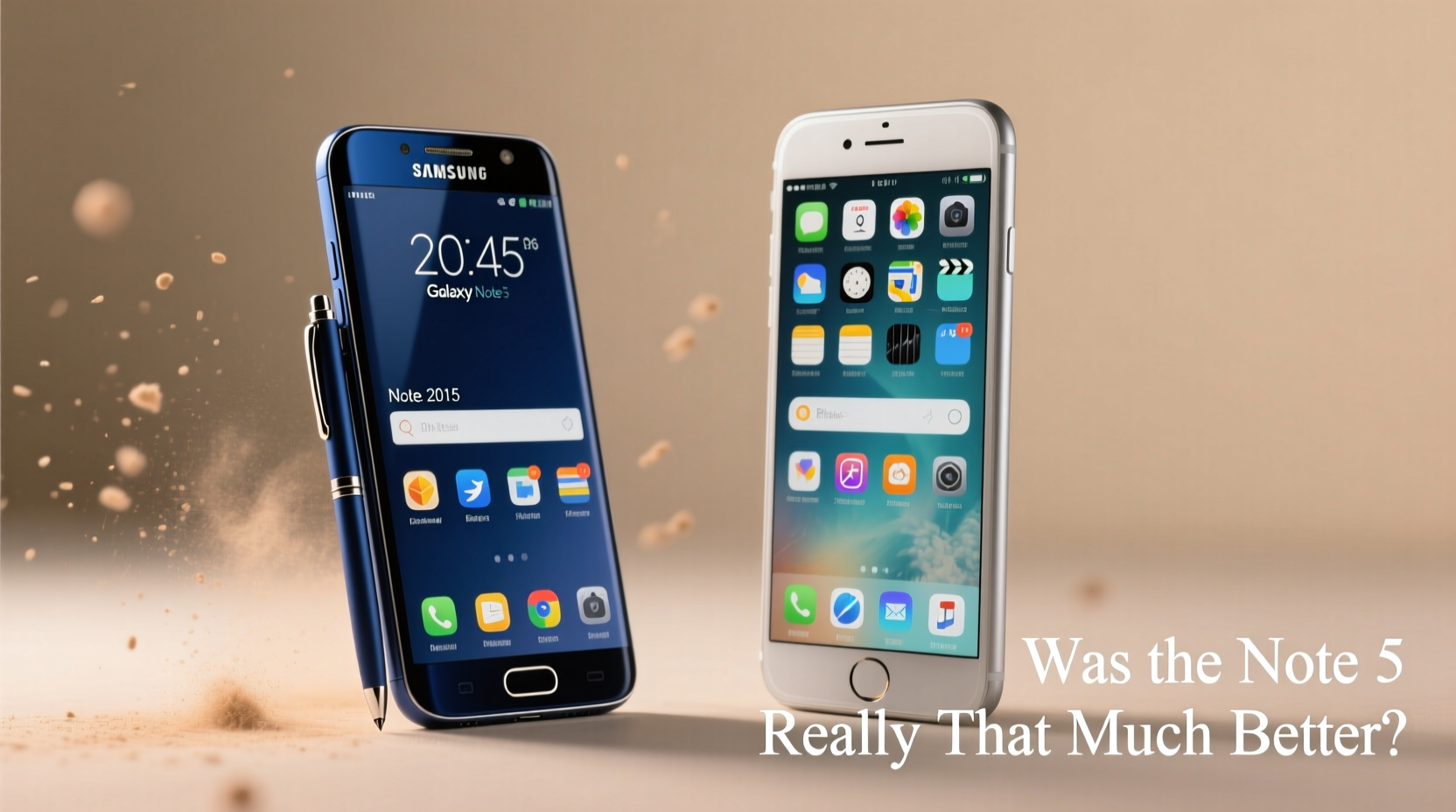
The Note 5 marked a significant shift in Samsung’s design language. It featured a glass-and-metal body—its first flagship with a metal frame and Gorilla Glass on both front and back. This gave it a premium feel that previous plastic-heavy Galaxy devices lacked. However, this elegance came with a trade-off: the once-removable battery was now sealed, a move that frustrated users who valued replaceable power sources.
In contrast, the iPhone 6 Plus used an aluminum unibody design with chamfered edges. While less flashy than the Note 5’s dual-glass look, it offered excellent ergonomics and durability for its time. Apple also introduced a refined camera bump, which became a hallmark of future iPhones.
Both phones felt solid in hand, but their usability diverged. The Note 5 measured 153.2 x 76.1 x 7.6 mm and weighed 171g. The iPhone 6 Plus was slightly larger at 158.1 x 77.8 x 7.1 mm but lighter at 172g. Despite similar dimensions, the Note 5’s squared edges made one-handed use more difficult, while the iPhone’s rounded form factor offered better grip.
Display and Performance: Sharpness vs. Optimization
The Note 5 boasted a 5.7-inch Quad HD (1440 x 2560) Super AMOLED display with a pixel density of 518 PPI. Colors were vibrant, blacks were deep, and outdoor visibility remained strong thanks to AMOLED’s inherent advantages. It was one of the sharpest screens available at the time.
The iPhone 6 Plus, meanwhile, had a 5.5-inch Retina HD display with a resolution of 1080 x 1920 (401 PPI). While technically inferior in resolution and color range, Apple’s display tuning ensured accurate color reproduction and excellent brightness calibration. For many users, especially creatives, the iPhone’s screen was “good enough” and more than sufficient for everyday tasks.
Under the hood, the Note 5 ran on Samsung’s Exynos 7420 or Snapdragon 808 (depending on region), both paired with 4GB of RAM. This allowed for true multitasking, including split-screen apps and background S Pen functions. The iPhone 6 Plus used Apple’s A8 chip with only 1GB of RAM, yet delivered smoother animations and app launches due to iOS optimization.
“Hardware specs don’t always tell the full story. The A8 may have had less RAM, but iOS’s memory management made it feel faster in daily use.” — David Kim, Mobile Systems Analyst
Camera Comparison: Quantity vs. Quality
The Note 5 featured a 16MP rear camera with OIS, f/1.9 aperture, and 4K video recording. Image quality was strong in daylight, though dynamic range and low-light performance lagged behind expectations. The front-facing 5MP shooter included an f/1.9 lens, making selfies brighter than most competitors.
The iPhone 6 Plus had a 8MP rear sensor with improved pixel size (1.5µm) and Focus Pixels for faster autofocus. While lower in megapixels, Apple’s image signal processing produced more natural colors, better exposure, and superior video stabilization. Its iSight camera became a benchmark for consistency, even if it didn’t win spec sheets.
In real-world use, the iPhone often produced more reliable results. The Note 5 gave users more control and higher-resolution output, but required manual tweaking to match the iPhone’s point-and-shoot excellence.
User Experience and Ecosystem
Samsung’s TouchWiz interface on the Note 5 was feature-rich but bloated. It offered Air Command, multi-window mode, and advanced S Pen functionality like Screen Off Memo and translation tools. These features appealed to power users but added complexity for casual ones.
iOS 8 on the iPhone 6 Plus was clean, intuitive, and tightly integrated with iCloud, Messages, and Apple Watch (when paired). Features like Continuity and Handoff enabled seamless transitions between devices—a major advantage for users already in the Apple ecosystem.
The S Pen was the Note 5’s standout feature. Artists, students, and professionals appreciated its precision for note-taking and sketching. However, outside niche use cases, many saw it as underutilized. Meanwhile, the iPhone thrived on simplicity and consistency—no stylus needed.
| Feature | Samsung Note 5 | iPhone 6 Plus |
|---|---|---|
| Display | 5.7\" QHD AMOLED | 5.5\" 1080p LCD |
| Processor | Exynos 7420 / Snapdragon 808 | A8 |
| RAM | 4GB | 1GB |
| Rear Camera | 16MP, f/1.9, 4K video | 8MP, f/2.2, 1080p video |
| Battery | 3000mAh (non-removable) | 2915mAh |
| Charging | Fast charging, Wireless charging | No fast charging, No wireless |
| Stylus | S Pen with advanced features | None |
| Software Updates | 2 major OS updates | 4 major iOS updates |
Long-Term Viability and Legacy
When evaluating which phone was “better,” longevity matters. The iPhone 6 Plus received iOS updates up to iOS 12, giving it over four years of official support. Apps remained compatible well into the late 2010s. In contrast, the Note 5 only got two major Android updates (from 5.1.1 to 7.0 Nougat), limiting its usefulness by 2018.
Battery degradation also played a role. The Note 5’s non-removable 3000mAh cell showed signs of wear quickly, and replacement required professional service. Apple later introduced battery health management, but early adopters of the 6 Plus faced similar issues without easy fixes.
Resale value tells another story. Three years post-launch, used iPhone 6 Plus units retained significantly higher value than Note 5 models, reflecting stronger consumer trust in Apple’s long-term reliability.
Mini Case Study: The Business Professional’s Choice
Consider Mark, a consultant in 2015 who needed a phone for presentations, note-taking, and travel. He chose the Note 5 for its S Pen and split-screen email/calendar view. For two years, it served him well. But by 2017, apps began crashing, and Android updates stopped arriving. His colleague, using an iPhone 6 Plus, still had smooth performance and current iOS features. Mark switched to iPhone the next year, citing reliability over raw specs.
This scenario illustrates a broader trend: high-end Android devices of that era offered more features upfront, but Apple’s ecosystem provided sustained usability.
Frequently Asked Questions
Was the Samsung Note 5 waterproof?
No, the Note 5 did not have an IP rating for water resistance. Unlike later Galaxy models, it lacked any official protection against spills or rain.
Could the iPhone 6 Plus use a stylus effectively?
Not natively. While third-party capacitive styluses worked, they lacked pressure sensitivity and palm rejection. The absence of a built-in stylus limited its appeal to artists and note-takers.
Which phone had better battery life?
Battery life was comparable in mixed use—about 1.5 days with light usage. However, the Note 5 supported fast charging and wireless charging, giving it an edge in convenience.
Conclusion: Reassessing “Better” in Smartphone Evolution
So, was the Samsung Note 5 really that much better than the iPhone 6 Plus? Objectively, yes—in raw specs, screen quality, RAM, and unique features like the S Pen. It was a powerhouse designed for tinkerers and multitaskers. But subjectively, “better” depends on priorities. For users valuing ecosystem cohesion, long-term updates, and consistent performance, the iPhone 6 Plus held its ground remarkably well.
The real lesson lies in understanding that smartphone superiority isn’t just about benchmarks. It’s about sustainability, software support, and alignment with user habits. The Note 5 was ahead of its time in features but hamstrung by Samsung’s update policy and design decisions like the non-replaceable battery. The iPhone 6 Plus, while less ambitious on paper, exemplified Apple’s philosophy: do fewer things, but do them exceptionally well.
Today, both phones are relics, but their legacies shaped modern mobile computing. The Note series pushed innovation in productivity, influencing foldables and stylus integration. The iPhone 6 Plus cemented Apple’s dominance in user retention and ecosystem lock-in. Looking back, neither was definitively “better”—they simply served different visions of what a smartphone could be.




 浙公网安备
33010002000092号
浙公网安备
33010002000092号 浙B2-20120091-4
Comments
No comments yet. Why don't you start the discussion?