
When Samsung launched the NX210 in 2012, it quickly became a favorite among mirrorless camera enthusiasts looking for strong image quality in a compact body. Two years later, the NX300 arrived with notable upgrades—faster autofocus, better resolution, and Wi-Fi/NFC integration. But nearly a decade later, many photographers still own the NX210 and wonder: is upgrading to the NX300 truly worthwhile, or does the older model still hold its ground?
This comparison dives into sensor performance, autofocus, handling, connectivity, and real-world usability to help you make an informed decision—whether you're considering buying used, upgrading your current gear, or simply curious about the evolution of Samsung’s APS-C mirrorless line.
Design and Build: Subtle Refinements
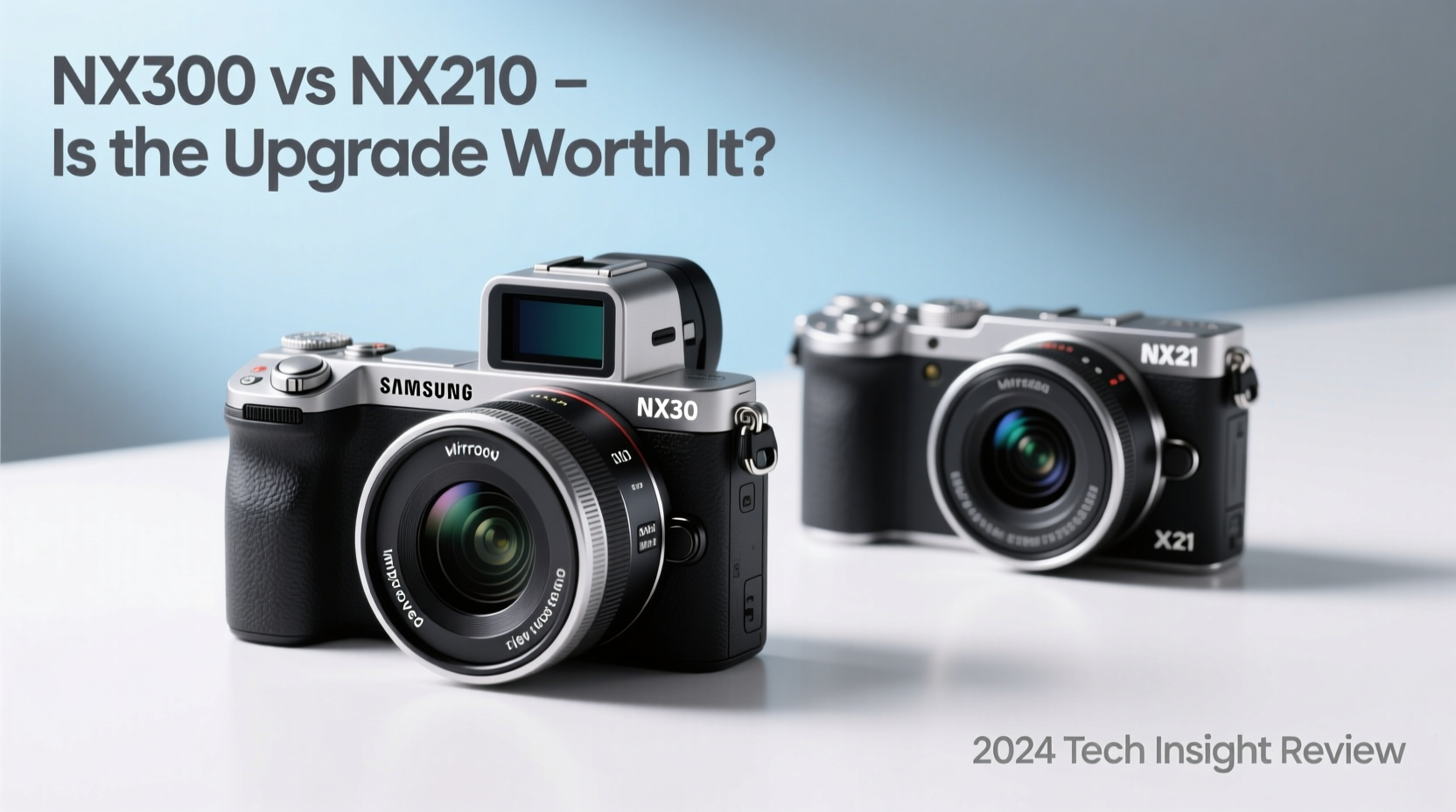
The NX300 maintains the sleek, minimalist design language of the NX210 but introduces several ergonomic improvements. The most noticeable change is the reshaped grip, which provides better stability during handheld shooting. While both cameras are constructed primarily from polycarbonate, the NX300 feels slightly more refined in hand due to textured rubber on the grip and rear thumb rest.
Dimensions between the two models are nearly identical—the NX300 is only 2mm wider and 4mm shorter—but the weight drops slightly from 269g (NX210) to 260g (NX300). This minor reduction doesn’t impact durability but contributes to a more balanced feel when paired with larger lenses.
Sensor and Image Quality: A Modest Step Forward
Both cameras feature APS-C CMOS sensors, but there are key differences. The NX210 uses a 20.3-megapixel sensor without an optical low-pass filter, aiming for sharper images. The NX300 steps up to a 20.3-megapixel backside-illuminated (BSI) CMOS sensor—the first in Samsung’s NX series. BSI technology improves light gathering, especially in low-light conditions.
In practice, the NX300 delivers cleaner high-ISO performance. At ISO 1600 and above, images from the NX210 show more luminance noise and color smearing, while the NX300 maintains better detail retention and dynamic range. Shadow recovery in RAW files is also more forgiving on the newer model.
Color science remains consistent across both models, with Samsung’s signature vibrant rendering. Skin tones can lean slightly warm under artificial lighting, but white balance adjustments in post-processing correct this easily. For JPEG shooters, the “Natural” and “Faithful” picture styles offer the most accurate results.
Autofocus and Performance: Where the NX300 Shines
The biggest leap between these two models lies in autofocus performance. The NX210 relies on contrast-detection AF with 15 points, which, while accurate, can be slow—especially in low light. Hunting is common when using manual focus lenses via adapters.
The NX300 introduces a hybrid autofocus system combining contrast-detection with phase-detection points embedded in the sensor. This results in faster subject acquisition, better tracking, and improved responsiveness when shooting moving subjects. In real-world use, the difference is immediately apparent when photographing children, pets, or street scenes.
Burst shooting also improves: the NX300 can shoot at 8 fps with continuous AF (compared to 5 fps with fixed focus on the NX210). Buffer depth allows up to 15 RAW frames before slowing, making it more suitable for action sequences.
“Hybrid AF was a game-changer for mirrorless systems in the early 2010s. The NX300 showed that Samsung could compete with Fujifilm and Sony in speed and accuracy.” — David Lin, Former Senior Editor, Digital Camera Review
Connectivity and User Experience
One of the NX300’s standout features is built-in Wi-Fi and NFC. These allow seamless transfer of photos to smartphones, remote control via the Samsung Smart Camera app, and direct uploads to social platforms. The NX210 lacks any wireless capability, requiring third-party SD cards like Eye-Fi for similar functionality—an expensive and often unreliable workaround.
The NX300’s touchscreen interface is also significantly improved. It supports pinch-to-zoom in playback, swipe navigation, and touch-to-focus during video recording. While the menu system remains somewhat clunky by modern standards, the added responsiveness makes a difference in daily use.
Video capabilities are comparable: both support 1080p at 30fps with stereo audio input. However, the NX300 adds continuous autofocus during video—a crucial upgrade for vloggers or documentary-style shooting. Manual focus peaking is available on both, but the NX300’s higher-resolution LCD (1,036k dots vs 921k) makes precise focusing easier.
Comparison Table: Key Specifications
| Feature | Samsung NX210 | Samsung NX300 |
|---|---|---|
| Release Year | 2012 | 2013 |
| Sensor | 20.3MP APS-C CMOS | 20.3MP APS-C BSI CMOS |
| Autofocus System | Contrast-detection (15 points) | Hybrid AF (Phase + Contrast) |
| Burst Shooting | 5 fps (up to 8 RAW) | 8 fps (up to 15 RAW) |
| ISO Range | 100–12800 (expandable) | 100–25600 (expandable) |
| Screen Resolution | 921k dots | 1,036k dots |
| Wi-Fi / NFC | No | Yes |
| Video AF Tracking | No | Yes |
| Weight (body only) | 269g | 260g |
| Price (Launch) | $749 (kit) | $799 (kit) |
Is Upgrading Worth It? Real-World Considerations
For existing NX210 owners, the value of upgrading depends heavily on how you use your camera. Casual shooters who primarily take stills in daylight may find the improvements subtle. The core image quality is very similar, and lens compatibility is identical across both models.
However, if you frequently shoot in dim environments, record video, or rely on fast-paced photography, the NX300 offers tangible benefits. The combination of better low-light performance, faster autofocus, and reliable Wi-Fi makes it a more versatile tool. Transferring images wirelessly to your phone for quick editing and sharing eliminates the need for card readers or cables—a small convenience that adds up over time.
Mini Case Study: Travel Photographer’s Dilemma
Mark, a travel blogger based in Barcelona, used his NX210 for three years. He loved its portability and image quality but grew frustrated with slow focusing in crowded markets and museums. After upgrading to a used NX300 for €220, he noticed immediate improvements. “The hybrid AF locks onto faces faster, and I can send photos directly to my phone while walking,” he said. “It saved me hours during trips where I needed to post same-day content.”
For Mark, the upgrade wasn’t about megapixels—it was about workflow efficiency and reliability in unpredictable conditions.
Checklist: Should You Upgrade?
- ✅ Do you shoot in low-light environments regularly?
- ✅ Is fast autofocus critical for your subjects (e.g., kids, animals)?
- ✅ Do you want to transfer photos wirelessly without extra accessories?
- ✅ Are you recording video with continuous autofocus?
- ✅ Can you find the NX300 at a reasonable price (under $300 used)?
If you answered yes to three or more, the NX300 is likely a worthwhile upgrade.
Frequently Asked Questions
Can I use the same lenses on both cameras?
Yes. Both the NX210 and NX300 use the Samsung NX mount. All NX lenses are fully compatible with either body, including power zooms and prime lenses.
Is the NX300 still supported by Samsung?
Samsung discontinued its camera division in 2016, so no official firmware updates or customer support exist. However, the cameras remain functional, and third-party repair services still handle basic servicing.
Are these cameras suitable for beginners today?
As budget-friendly entry points into APS-C photography, both models can still serve beginners well—especially if paired with prime lenses. However, consider limitations like aging software, lack of app support, and limited resale value. Modern alternatives like used Fujifilm X-E3 or Olympus OM-D E-M10 models may offer better long-term usability.
Final Thoughts: Balancing Value and Performance
The Samsung NX300 represents a meaningful, though not revolutionary, improvement over the NX210. If you already own the older model and are satisfied with its performance, upgrading solely for marginal gains may not justify the cost. But for those seeking faster operation, better low-light results, and modern connectivity, the NX300 delivers where it counts.
The NX210 remains a capable camera—its 20MP sensor holds up well, and the lens ecosystem offers sharp, affordable options. Yet, the NX300’s hybrid AF and Wi-Fi integration reflect a shift toward responsive, connected photography that aligns better with current expectations.




 浙公网安备
33010002000092号
浙公网安备
33010002000092号 浙B2-20120091-4
Comments
No comments yet. Why don't you start the discussion?